Memory Admission and Result-Retention Sizing in an RV32IMC FPGA Soft Processor
By Yihang Dai, Shuyu Xu, Yinfeng Zhou, Chenglei Peng
Nanjing University, China
Abstract
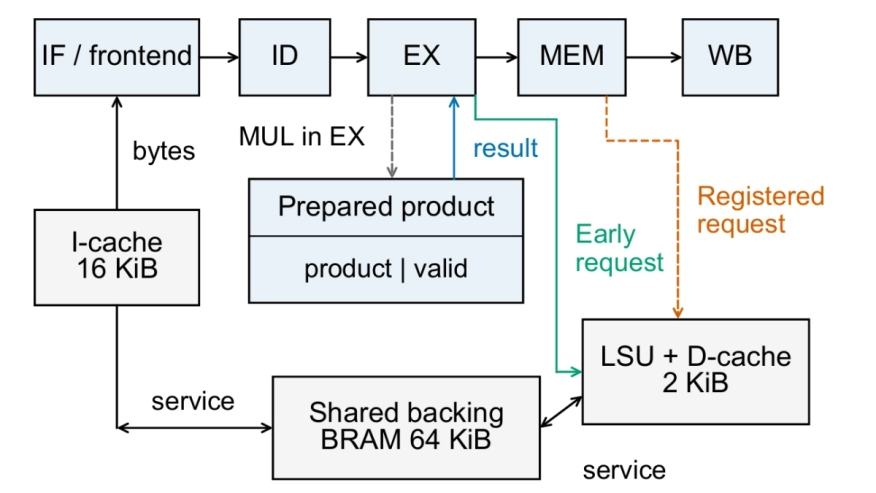
In FPGA soft processors with shared backing block RAM, memory admission can stall a multiplication after its product has been prepared. We study how admission timing changes result retention in PaceRV, our board-tested five-stage RV32IMC core, using fixed binaries and matched dynamic instructions. Offering data requests one edge earlier reduces geometric-mean Embench cycles by 18.2% and retention opportunities from 375,063 to 4,373. Admission and retention cycle gains are conditional and non-additive. Under slower reads, a 99% capture target selects an 18-edge validity window with registered requests and 28 edges with early requests, although no multiplication matched within both measurement intervals waits longer. A predeclared sizing rule predicts opportunity recovery exactly in all finite tests, including kernels excluded from model development. Independent timing analysis closely estimates execution-cycle savings. The results support choosing admission first, then deciding whether to extend validity and sizing it against an explicit capture or missed-opportunity objective.
Index Terms — RISC-V, FPGA soft processor, memory admission, prepared arithmetic, performance prediction, result retention
To read the full article, click here
Related Semiconductor IP
- RISC-V Debug & Trace IP
- RISC-V IOPMP IP
- Gen#2 of 64-bit RISC-V core with out-of-order pipeline based complex
- 64-bit RISC-V core with in-order single issue pipeline. Tiny Linux-capable processor for IoT applications.
- Multi-core capable RISC-V processor with vector extensions
Related Articles
- Efficiency and memory footprint of Xilkernel for the Microblaze soft processor
- FPGA Soft Processor Design Considerations
- Building high-speed FPGA memory interfaces
- Control an FPGA bus without using the processor
Latest Articles
- Memory Admission and Result-Retention Sizing in an RV32IMC FPGA Soft Processor
- A Cross-Domain Matrix Engine for Signal Processing and Deep Neural Net Inference
- LLM Agent-Based Design of RISC-V CPUs with FPGA-in-the-Loop Evaluation
- Automated Multi-Line Bug Repair Using Model Checker Aided LLMs: A Case Study on RISC-V Processors
- Cryogenic Recharacterization of a Commercial 22 nm FD-SOI Foundry Standard-Cell Library