GSPIM: A Temporal-Locality-Aware 4D Gaussian Splatting Accelerator with Polymorphic PIM and Multi-Frame Rendering Dataflow
By Zirui Ma 1, Zhihua Fan 1, Haibin Wu 1, Dongrui Fan 2, Xiaochun Ye 1, and Wenming Li 1
1 Institute of Computing Technology, Chinese Academy of Sciences, Beijing, China
2 University of Chinese Academy of Sciences, Beijing, China
Abstract
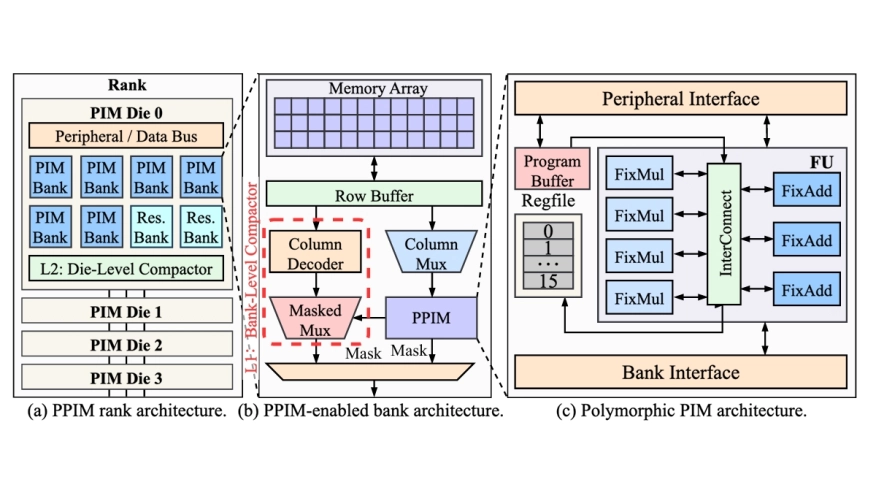
4D Gaussian Splatting (4DGS) enables high-quality real-time novel-view synthesis for dynamic scenes, supporting free-viewpoint video, mobile XR, and autonomous systems at the edge. Methods using explicit 4D distributions, keyframe interpolation, or anchor binding share two GPU data-movement bottlenecks. Temporal filtering follows model record loading, wasting LPDDR5 bandwidth on inactive data. Frame-isolated execution also overlooks highly overlapping active sets and depth relationships across adjacent frames, reloading shared attributes when working sets exceed on-chip cache capacity. To address these bottlenecks, we present GSPIM, a temporal-locality-aware 4DGS accelerator for PIM-enabled edge devices. Polymorphic PIM adapts a shared near-memory datapath to representation-specific field layouts and selection procedures. It filters and compacts valid data into contiguous inputs before the GPU accesses complete attributes, reducing ineffective transfers. Multi-Frame Rendering Dataflow reuses active attributes and stable depth relationships within a temporal window, reducing repeated work across frames. Hybrid Dataflow Scheduling overlaps near-memory data preparation with GPU rendering to reduce waiting. Evaluation combines a GPU-PIM model calibrated to Jetson AGX Orin 64 GB with a 1z DRAM physical implementation of the added circuits. Across three 4DGS methods and six dynamic scenes, GSPIM achieves a 4.15x geometric-mean speedup and a 4.99x geometric-mean energy-efficiency improvement over a fully optimized frame-by-frame GPU baseline. The maximum scene-level PSNR difference is 0.011 dB, and the added physical footprint is 18.7172 square millimeters across 32 LPDDR5 dies.
To read the full article, click here
Related Semiconductor IP
- USB-C Power Delivery IP Core
- Configurable Multi-Channel DMA Controller
- Samsung Foundry 4nm 1V8 GPIO I3C
- Root-of-Trust IP - High-Assurance Security for Advanced and Regulated Applications
- Root-of-Trust IP - Enhanced-Assurance, Configurable Security for Scalable Semiconductor Designs
Related Articles
- A 129FPS Full HD Real-Time Accelerator for 3D Gaussian Splatting
- 3+ ways to design reconfigurable algorithm accelerator in IP block
- RAID6 accelerator in a PowerPC IOP SOC
- Emulator, accelerator, prototype - what’s the difference?
Latest Articles
- GSPIM: A Temporal-Locality-Aware 4D Gaussian Splatting Accelerator with Polymorphic PIM and Multi-Frame Rendering Dataflow
- Memory Admission and Result-Retention Sizing in an RV32IMC FPGA Soft Processor
- A Cross-Domain Matrix Engine for Signal Processing and Deep Neural Net Inference
- LLM Agent-Based Design of RISC-V CPUs with FPGA-in-the-Loop Evaluation
- Automated Multi-Line Bug Repair Using Model Checker Aided LLMs: A Case Study on RISC-V Processors