Configurable Multi-Channel DMA Controller
Scatter-Gather | AMBA 5 AHB | 1 - 126 Channels
Overview
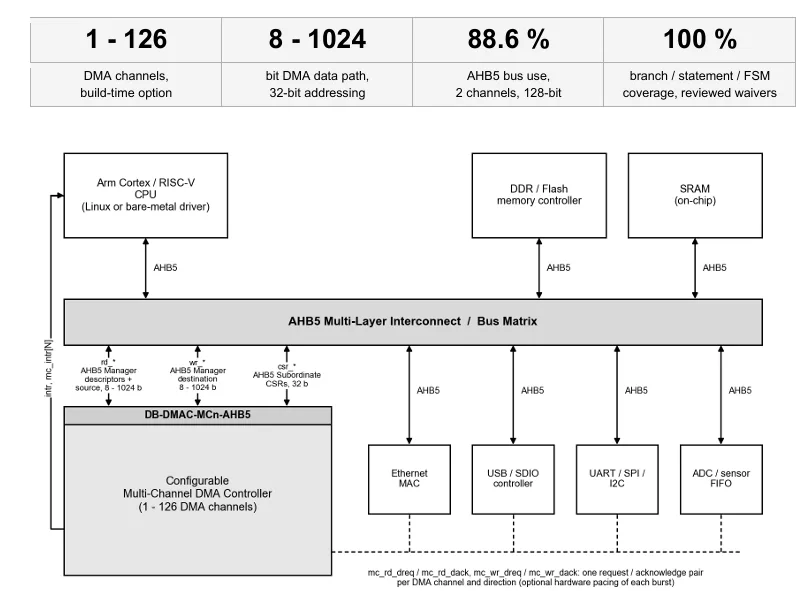
The Digital Blocks DB-DMAC-MCn-AHB5 SystemVerilog RTL IP Core is a Scatter-Gather (SG) Direct Memory Access (DMA) Controller for AMBA 5 AHB systems, with a build-time number of independent DMA Channels (1 to 126) and a DMA data path of 8 to 1024 bits. It is the AHB5 member of the DB-DMAC-MC AMBA family, next to the AXI4 and AXI5 controllers.
Each channel runs linked lists of 16-byte descriptor nodes with 32-bit addresses, any byte alignment and up to 16 MB per node, with read and write bursts of 4, 8 or 16 beats or a programmed length. A dedicated AHB5 Read Manager carries the descriptor fetches and source reads, and a dedicated AHB5 Write Manager the destination writes, so reads and writes run concurrently. Measured at 128 bits, two channels use 88.6 % of the bus and one channel 79.6 %.
Key features
AHB5 Data Engine
- Two AHB5 Managers: a Read Manager for descriptor fetches and source data and a Write Manager for destination data, running concurrently
- Programmable bursts: INCR4, INCR8 or INCR16 per channel, or a programmed 1 to 256 beats (MCn-MB-AHB5) issued as INCR bursts of up to 16 beats; every burst is clipped at the 1 KB boundary and at the end of the block
- Data FIFO: 32 words of the data width per channel, with a byte rotator between the read and the write side
- Round-robin channel arbitration with an O(log N) parallel-prefix select on each AHB5 Manager; the grant is held for the whole burst; any number of wait states
Descriptor Processing
- Descriptor nodes are fetched over the Read Manager, one burst per 16-byte node (INCR4 at 32 bits, a single beat at 128 bits and wider)
- Per-channel pre-fetch of up to 32 descriptor nodes ahead of execution
- Descriptor list start / branch (DLB), re-start (DLR) and last-node address read-back (DLAR)
Scatter-Gather and Transfer Control
- Linked lists of 16-byte descriptor nodes: 32-bit source, destination and next address, 24-bit byte length (1 byte to 16 MB per descriptor node)
- Chained and ring descriptor structures with the descriptor node's NAV, LDN and WOR flags
- Memory-to-Memory, Memory-to-Peripheral, Peripheral-to-Memory, Peripheral-to-Peripheral
- Unaligned source and destination addresses at any byte, any length (byte rotator; naturally aligned narrow SINGLE transfers for the head and tail of the destination block); no burst crosses a 1 KB boundary
- Fixed-address (FIFO) reads and writes; hardware-paced bursts with per-channel DREQ / DACK pairs for reads and writes
- CPU software or external hardware initiated transfers
Status, Interrupts and Error Handling
- Per-channel status: descriptor list complete and channel done, descriptor read, source read and destination write ERROR responses, data and descriptor parity errors, re-start failure - each with an interrupt mask; a masked error holds the channel until cleared or reset
- Per-channel interrupt outputs; global interrupt status / mask / vector registers (one bank per 32 channels) and one processor interrupt
- Event-safe write-1-to-clear: a hardware event in the same cycle as the clear is never lost
- Optional per-byte parity checking on data and descriptor reads; parity generated on writes
- TrustZone: per-channel HNONSEC and HPROT for each Manager, and a security lock that hides a channel's registers from Non-secure accesses
- Core Identification Register (CIR): vendor, channel count, data width, bus, security and unaligned-addressing flags, revision
Integration
- 1 to 126 channels (one global interrupt bank per 32); data width 8 / 16 / 32 / 64 / 128 / 256 / 512 / 1024 bits; 32-bit addressing
- SystemVerilog RTL with a flat-pin top level; AMBA 5 AHB Manager / Subordinate naming
- Elaboration-time checks reject illegal configuration values
- Fully synchronous single clock, rising-edge, no gated clocks, no internal tri-states; technology-independent RTL for ASIC and FPGA
- Sister products for AXI systems: DB-DMAC-MCn-AXI4, DB-DMAC-MCn-AXI4-HT and DB-DMAC-MCn-AXI5 HT
Block Diagram
Applications
- Memory-to-memory copy engines in AHB5 microcontroller and SoC subsystems
- Scatter-gather DMA for networking, storage and sensor data movement
- Peripheral data streaming with hardware request / acknowledge pacing
- Offload of bulk memory copies from the CPU, under Linux or bare metal
What’s Included?
- RTL: Synthesizable SystemVerilog (IEEE 1800-2012) with a flat-pin top level; or a technology-specific netlist for FPGAs
- Constraints / filelists: Synopsys Design Constraints, compile-ordered filelist, lint script and waivers
- Test bench: Self-checking directed and generic suites, AHB5 memory models, AHB5 protocol assertions, regression driver with expected results and coverage scripts
- Models: C++ cycle model build
- Software: Bare-metal C driver with reference program; Linux platform driver, UAPI header and device-tree example
- Documents: Data sheet, Technical Reference Manual, IP Integration Guide, IP-XACT component descriptor, coverage report, test matrix, regression evidence
Specifications
Identity
Files
Note: some files may require an NDA depending on provider policy.
Provider
Learn more about DMA IP core
DMA IP Integration
Using peripheral DMA boosts networked 32 bit MCU security and bandwidth
New AXI Scatter-Gather DMA Core Transfers Streaming Data to/from System Memory
Protecting Edge AI with RISC-V CHERI: See how easily memory-safe security can be added to an AI application (part 1)
The Next Leap in Datacenter AI: Orchestrating Custom Accelerators with SiFive Intelligent Control Units (ACUs)
Frequently asked questions about DMA IP
What is Configurable Multi-Channel DMA Controller?
Configurable Multi-Channel DMA Controller is a DMA IP core from Digital Blocks, Inc. listed on Semi IP Hub.
How should engineers evaluate this DMA?
Engineers should review the overview, key features, supported foundries and nodes, maturity, deliverables, and provider information before shortlisting this DMA IP.
Can this semiconductor IP be compared with similar products?
Yes. Buyers can compare this product with similar semiconductor IP cores or IP families based on category, provider, process options, and structured technical specifications.