HSCO-Bench: An Agent-Driven End-to-End Hardware-Software Co-design Benchmark for Systems-on-Chip
By Pei-Huan Tsai 1, Kuan-Lin Chiu 1, William Baisi 1, Pin-Yu Chen 2, Luca P. Carloni 1
1 Columbia University
2 IBM Research
Abstract
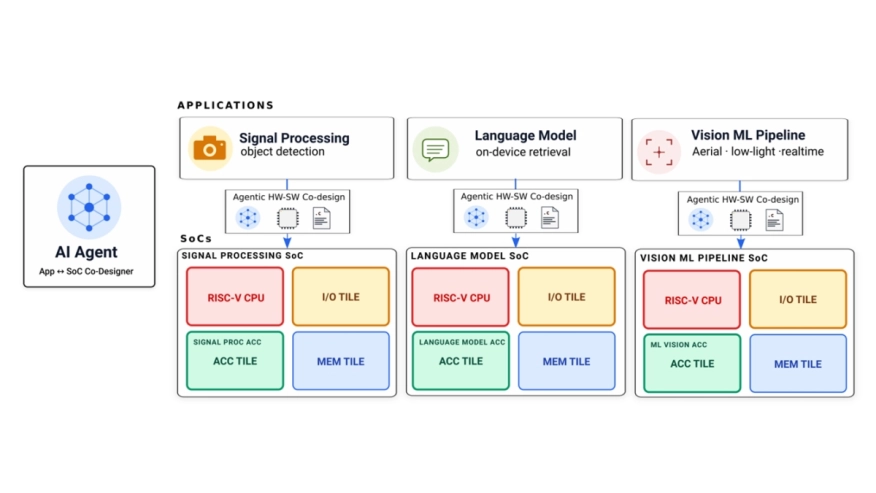
Large language models (LLMs) are adopted for software and hardware design, yet these domains are still evaluated separately. Software benchmarks typically assume fixed hardware targets, while hardware benchmarks focus on component-level optimization without considering the full hardware-software stack. Consequently, no existing benchmark evaluates whether an LLM agent can perform end-to-end, system-level hardware-software co-design. Such a process requires: 1) analyzing applications to identify kernels requiring acceleration, 2) designing and integrating heterogeneous accelerators into a System-on-Chip (SoC) under resource constraints, and 3) mapping kernels onto the generated accelerators. We present HSCO-Bench, an end-to-end hardware-software co-design benchmark for accelerator-rich heterogeneous SoC generation. Built upon an open-source SoC platform with a curated repository structure, HSCO-Bench evaluates the ability of LLMs to jointly optimize software and hardware stacks, producing SoC prototypes deployed on the AMD Virtex-7 FPGA VC707 Evaluation Kit. Experimental results show that end-to-end integration remains challenging for current models. Among the five frontier models evaluated, only two of them could successfully generate valid SoC prototypes. Yet, even in these successful instances, the generated designs are far from optimal. While we observe a promising peak speedup of 16.22X, the maximum additional resource utilization reaches only 23.67%. This highlights that while state-of-the-art models demonstrate an emerging capability for hardware acceleration, they still heavily underutilize the available hardware capacity, leaving room for future optimization. To the best of our knowledge, HSCO-Bench is the first benchmark targeting this complete co-design flow, enabling LLMs to jointly reason about and modify both the software and hardware stacks of heterogeneous SoCs.
To read the full article, click here
Related Semiconductor IP
- LPDDR6 PHY
- UMC 55nm ULP 3.3V Temperature Sensor
- High-Throughput Multi-Channel DMA Controller
- Configurable Multi-Channel DMA Controller
- Fixed-Channel Multi-Channel DMA Controller
Related Articles
- CHIA: An open-source framework for principled, agentic AI-driven hardware/software co-design research
- An FPGA-Based SoC Architecture with a RISC-V Controller for Energy-Efficient Temporal-Coding Spiking Neural Networks
- Heterogeneous SoC Integrating an Open-Source Recurrent SNN Accelerator for Neuromorphic Edge Computing on FPGA
- Hardware-Software Co-Design for Float16 On-Device Training on RISC-V Single-Core
Latest Articles
- Automated Multi-Line Bug Repair Using Model Checker Aided LLMs: A Case Study on RISC-V Processors
- Cryogenic Recharacterization of a Commercial 22 nm FD-SOI Foundry Standard-Cell Library
- A 105 MS/s 4.18 nJ/inference 0.765 mm² Mixed-Signal Streaming ML Engine for Wireless Baseband in 12LP+ FinFET
- Agentic AI for Heterogeneous System Design Across Chip, Scale-Up, and Scale-Out Domains
- Minimum RISC-V: Maximum FPGA Efficiency