Vendor: Cadence Design Systems, Inc. Category: DSP Core

Vision 341 DSP

Single 1024-bit SIMD DSP for Vision/Radar/Lidar/AI

Overview

Vision DSPs for Imaging, Computer Vision, Radar, Lidar, and AI

The Cadence Tensilica Vision 341 DSP is a 1024-bit SIMD DSP offering a single DSP for vision, radar, lidar, and AI. To address the increasing computational requirements for embedded vision, radar, lidar, and AI applications, the 1024-bit Vision 341 DSP provides up to 6X greater FFT performance compared to the Vision 230 DSP, and due to the single DSP with support for both vision and radar, it also offers tremendous area, power, and cost saving.

Key features

Single Vision DSPs for Imaging, Computer Vision, Radar, Lidar, and AI

The Vision 341 DSP has been designed to provide the best programmable solution for vision, radar, lidar, and AI. It offers a highly optimized instruction set for better performance and energy efficiency than GPUs or CPUs. With its programmability, it also offers the highest flexibility for ever-changing future workloads.

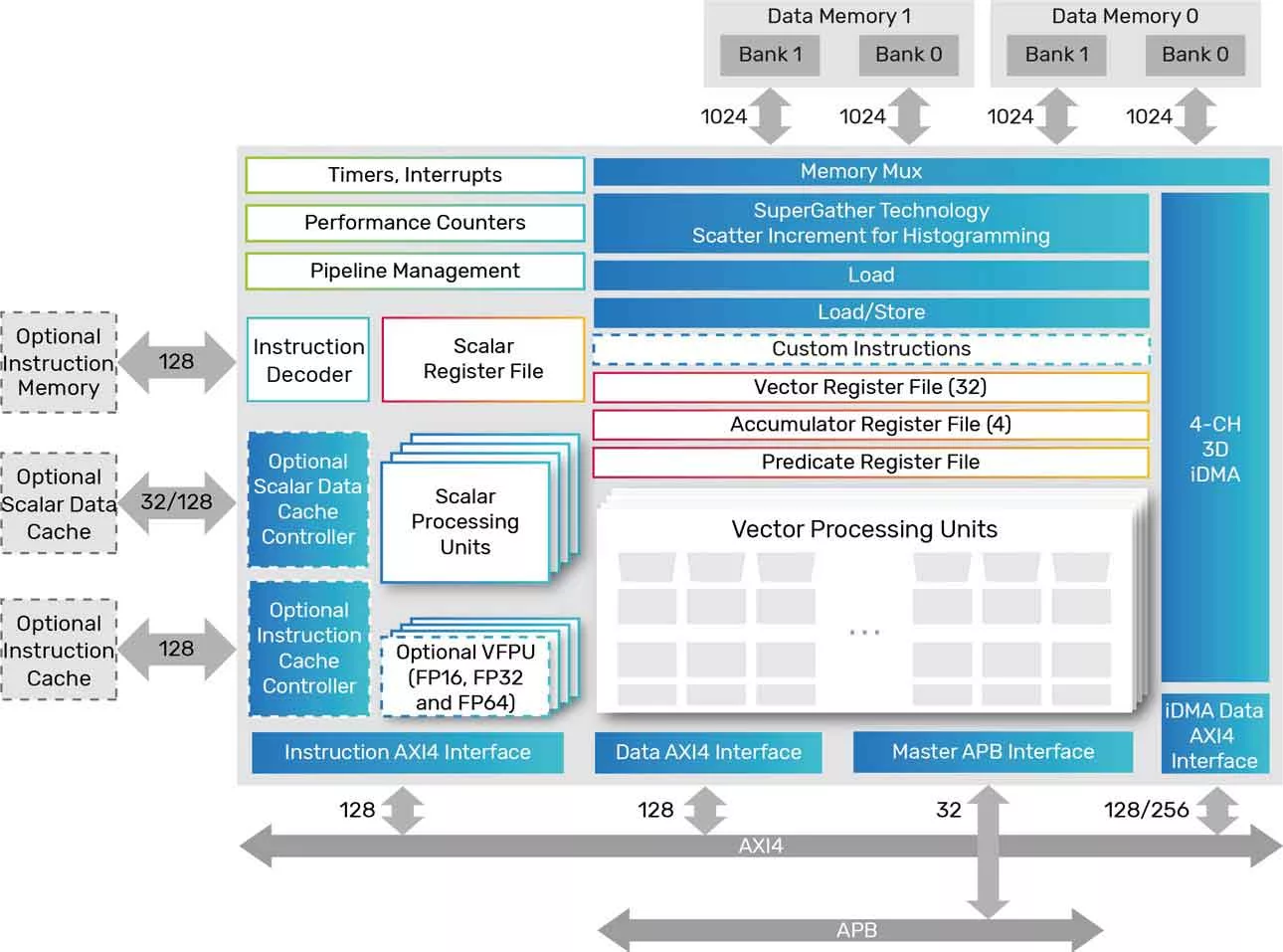
  • 2048/1024b Load/Store capabilities
  • 1024 8-bit MAC: 2X MAC capability versus Vision 230/331 DSPs
  • 8/16/32-bit fixed-point processing
  • Double-precision (FP64), single-precision (FP32), and half-precision (FP16) floating-point processing
  • Complex fixed and floating-point support
  • Option to boost FFT performance for 4D imaging radar
  • Optional performance boost for simultaneous localization and mapping (SLAM)
  • Ability to connect to Vision 4DR Accelerator to provide high-resolution imaging radar solution
  • 4-channel iDMA
  • User-defined instructions support
  • Built on NX Xtensa processor offering up to 1.5X frequency compared to Vision 130 DSP
  • ISO 26262 ready for automotive market

Block Diagram

Benefits

  • Area and Power Optimized: 1024-bit SIMD with higher energy efficiency compared to CPU/GPU single DSP for vision/radar/lidar/AI eliminates need for additional DSPs
  • Vision / Image / Radar / Lidar / AI Processing: Instructions set optimized for computer vision, image, radar, lidar, and AI processing applications
  • High Performance: 1024-bit SIMD offers the highest performance among the Vision DSP family and >2TOPS AI performance for object detection, image classification, and image segmentation

Specifications

Identity

Part Number
Vision 341 DSP
Vendor
Cadence Design Systems, Inc.
Type
Silicon IP

Files

Note: some files may require an NDA depending on provider policy.

Provider

Learn more about DSP Core IP core

Role of Time-of-Flight Sensors in Automotive

The automotive sector is undergoing a profound transformation, moving beyond basic detection to a comprehensive, real-time 3D understanding of both the external environment and the vehicle's interior. ToF is emerging as a pivotal technology, offering precise 3D depth and distance information essential for navigating complex environments and understanding in-cabin dynamics.

Building a high-performance, low-power audio/voice subsystem

With the growing popularity of applications such as mobile gaming and voice triggering, the audio/voice subsystem is playing a prominent role in many mobile system-on-chip (SoC) designs. The subsystem must be designed to meet dual demands: high-performance, high-resolution audio stream processing as well as always-on, low-power voice trigger and recognition. Customizable digital signal processing (DSP) and audio/voice subsystem solution intellectual property (IP) blocks can provide a cost-effective and efficient way to develop and deliver high-performance audio/voice products.

Frequently asked questions about DSP Core IP cores

What is Vision 341 DSP?

Vision 341 DSP is a DSP Core IP core from Cadence Design Systems, Inc. listed on Semi IP Hub.

How should engineers evaluate this DSP Core?

Engineers should review the overview, key features, supported foundries and nodes, maturity, deliverables, and provider information before shortlisting this DSP Core IP.

Can this semiconductor IP be compared with similar products?

Yes. Buyers can compare this product with similar semiconductor IP cores or IP families based on category, provider, process options, and structured technical specifications.

×
Semiconductor IP