Heterogeneous SoC Integrating an Open-Source Recurrent SNN Accelerator for Neuromorphic Edge Computing on FPGA
By Michelangelo Barocci, Vittorio Fra, Enrico Macii, Gianvito Urgese
Politecnico di Torino, Turin, Italy
Abstract
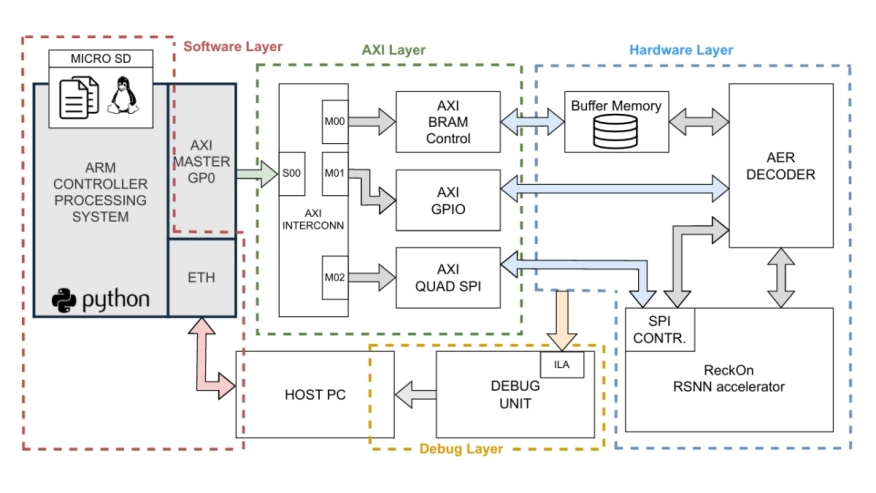
The growing popularity of Spiking Neural Networks (SNNs) and their applications has led to a significant fast-paced increase of neuromorphic architectures capable of mimicking the spike-based data processing typical of biological neurons. The efficient power consumption and parallel computing capabilities of the SNNs lead researchers towards the development of digital accelerators, which exploit such features to bring fast and low-power computation on edge devices. The spread of digital neuromorphic hardware however is slowed down by the prohibitive costs that the silicon tape out of circuits brings, that's why targeting Field Programmable Gate Arrays (FPGAs) could represent a viable alternative, offering a flexible and cost-effective platform for implementing digital neuromorphic systems and helping the spread of open-source hardware designs. In this work we present an heterogeneous System-on-Chip (SoC) where the operations of ReckOn, a Recurrent SNN accelerator, are managed through the integration with traditional processors. These include the RISC-V-based, open-source microcontroller X-HEEP and the ARM processor featured in Zynq Ultrascale systems. We validate our design by reproducing the classification results through the implementation on FPGA of the taped-out version of ReckOn in order to check the equivalence of the accuracy and the characteristics in terms of physical implementation. In a second set of experiments, we evaluate the online learning capability of the solution in classifying a subset of the Braille digit dataset recently used to compare neuromorphic frameworks and platforms.
Keywords: NeuromorphicComputing, FPGA, Edgecomputing, Spiking Neural Network
To read the full article, click here
Related Semiconductor IP
- NPU IP
- JPEG XL Encoder
- I2C Master/Slave Controller Core
- NVMe Validation Test Suite
- Hybrid Memory Cube Verification IP
Related Articles
- A Persistent-State Dataflow Accelerator for Memory-Bound Linear Attention Decode on FPGA
- VitaLLM: A Versatile and Tiny Accelerator for Mixed-Precision LLM Inference on Edge Devices
- AceleradorSNN: A Neuromorphic Cognitive System Integrating Spiking Neural Networks and Dynamic Image Signal Processing on FPGA
- HyNoC: A Hybrid Circuit-Switch/Wormhole Network-on-Chip for Distributed VLIW Computing on FPGA
Latest Articles
- Terracotta: Enabling the Adoption of New DRAM Techniques via a Flexible DRAM Interface and Memory Controller
- A Framework for Accelerating Transformer Inference on RISC-V for Edge AI
- An Interleaved Parallel Dependent Quantization Hardware Architecture for H.266/VVC
- A Formal Security Analysis of CAN XL
- A Secure dToF LiDAR SoC with Dual-Domain Fingerprinting and Event-Driven AFE Circuit Achieving Sensor-Level Attack Resilience