SPARX: Secure and Privacy-Aware Approximate CNN Acceleration with Edge RISC-V SoC
By Sonu Kumar, Akash Sankhe, Mukul Lokhande, Santosh Kumar Vishvakarma
Indian Institute of Technology Indore, India
Abstract
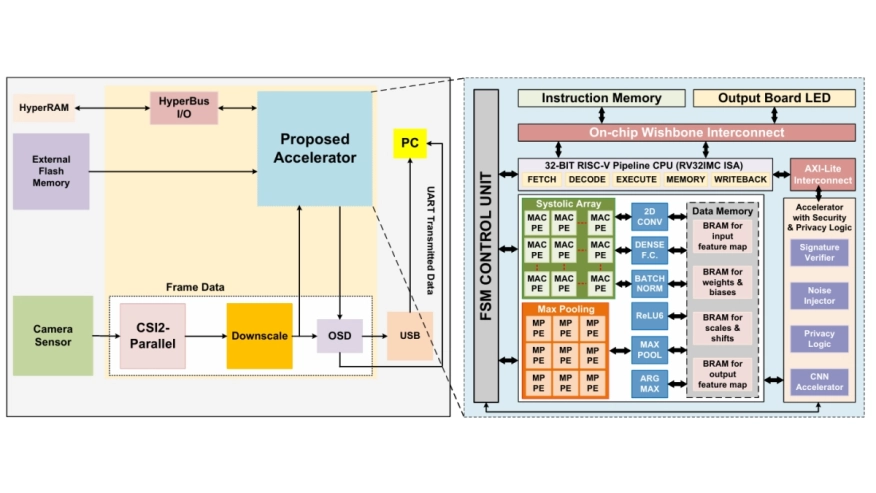
Edge-AI systems increasingly require real-time CNN inference under strict energy, performance, security, and privacy constraints. Approximate computing improves hardware efficiency by exploiting the error resilience of neural network workloads; however, most approximate CNN accelerators do not jointly consider secure, privacy-aware edge deployment. This paper presents SPARX, a Secure and Privacy-Aware Approximate CNN Acceleration framework integrated within a heterogeneous RV32IMC RISC-V System-on-Chip (SoC). SPARX combines a custom RISC-V instruction extension, an approximate logarithmic CNN acceleration unit, a lightweight differential-noise-based privacy engine, and a challenge-response authentication mechanism. To guide arithmetic selection, an approximation-aware decision framework is introduced that uses the Approximation Severity Index (ASI), Approximation Efficiency (AE), Quality of Approximation (QoA), Approximation Figure-of-Merit (AFOM), and Hardware Acceleration Efficiency (HAE). Evaluation across 11 state-of-the-art approximate MAC architectures identifies the Iterative Logarithmic Multiplier (ILM) as the most suitable design, achieving 51.7% area reduction, 81.5% power reduction, and 2.13x throughput improvement compared with an accurate radix-4 Booth MAC, while only reducing ResNet-20/CIFAR-10 accuracy by 2.82 percentage points. FPGA implementation on a Xilinx VC707 platform achieves 58.4 GOPS/W energy efficiency at 250 MHz, while 28-nm CMOS physical implementation validates ASIC feasibility
IndexTerms — Privacy-AwareApproximateComputing,Secure EdgeAIacceleration,Energy-EfficientInference,RISC-VSoC.
To read the full article, click here
Related Semiconductor IP
- Configurable CNN accelerator
- Convolutional Neural Network (CNN) Compact Accelerator
- CNN AI IP Core
- NPU IP Core for Edge
- NPU IP Core for Mobile
Related Articles
- SNAP-V: A RISC-V SoC with Configurable Neuromorphic Acceleration for Small-Scale Spiking Neural Networks
- A RISC-V Multicore and GPU SoC Platform with a Qualifiable Software Stack for Safety Critical Systems
- FeNN-DMA: A RISC-V SoC for SNN acceleration
- An FPGA-Based SoC Architecture with a RISC-V Controller for Energy-Efficient Temporal-Coding Spiking Neural Networks
Latest Articles
- Cryogenic Recharacterization of a Commercial 22 nm FD-SOI Foundry Standard-Cell Library
- A 105 MS/s 4.18 nJ/inference 0.765 mm² Mixed-Signal Streaming ML Engine for Wireless Baseband in 12LP+ FinFET
- Agentic AI for Heterogeneous System Design Across Chip, Scale-Up, and Scale-Out Domains
- Minimum RISC-V: Maximum FPGA Efficiency
- The Era of Vibe Tapeout: Dark Age or Golden Age for Analog Circuit Design?