A 65 nm Trustworthy Hypoglycemia Forecasting Engine Achieving 11.3 nJ per Inference
By Boyang Cheng, Jianbo Liu, Pengyu Ren, Xueji Zhao, Steven Davis, Likai Pei, Zephan M. Enciso, Kai Ni, Ningyuan Cao
Department of Electrical Engineering, University of Notre Dame, Notre Dame, USA
Abstract
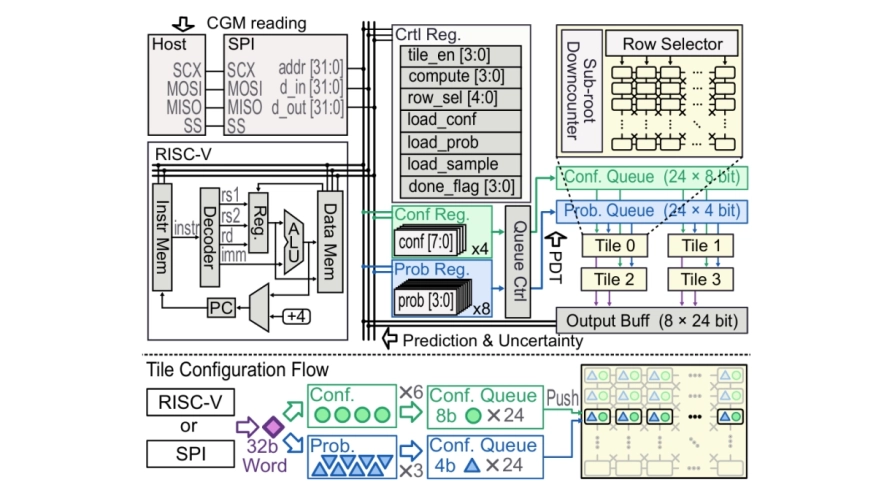
Diabetes affects millions of people and requires reliable continuous glucose monitoring for early hypoglycemia warning. However, medical AI systems must be not only accurate and energy efficient, but also explainable, noise robust, and uncertainty aware. This work presents a 65 nm hypoglycemia forecasting engine based on probabilistic decision trees for trustworthy medical inference. The proposed hybrid architecture combines exact arithmetic evaluation for shallow tree layers with sampling based inference for deeper layers, reducing soft decision tree complexity from exponential to sample efficient traversal. A reconfigurable 4 by 24 by 24 probabilistic node array supports arbitrary tree structures with a maximum depth of 12, coordinated by an on chip low power RISC V core. Fabricated in 65 nm CMOS, the chip achieves 11.3 nJ per inference and a state of the art 30 min forecasting F1 score of 0.825 on continuous glucose monitoring data. Compared with conventional decision tree and random forest models, the proposed engine improves robustness to sensor noise and data point drop off by 4.1x to 16.1x. These results demonstrate an energy efficient, explainable, and uncertainty aware edge AI engine for trustworthy hypoglycemia forecasting.
To read the full article, click here
Related Semiconductor IP
- nQrux® Root of Trust IP
- AXI to UCIe Bridge IP
- UCIe 2.x Controller IP
- SWI3S (SoundWire I3S Interface) Peripheral Controller Core IP
- OpenTitan-based RISC-V Secure Element
Related Articles
- Soc Design -> Soft design for cryptographic engine
- FPGAs: Embedded Apps : FPGA-based FFT engine handles four times more input data
- Application engine synthesis offers new design approach
- Tap into the advantages of a scalable OFDMA engine for WiMAX
Latest Articles
- Automated Pre-Silicon Verification of High-Speed DDR5 and LPDDR5/6 Memory Controllers: Closed-Loop Timing, Mode Register, and PHY Synchronization in UVM
- U-Sonic: An Open-Source 8-Channel Ultrasound Transmit IP in a 130 nm RISC-V SoC
- S-ALSA: Co-Design of Adiabatic Logic-based Sensing and Balanced Bit-Cells for Secure and Energy-Efficient MRAM
- MEGATRON: a 28nm Analog PCM CiM/Digital System-on-Chip for Edge GenAI at 57.5 TOPS/W and 1.52 Mparam/mm²
- Peregrino: A Full-Hardware Accelerator for the Complete Falcon Post-Quantum Digital Signature Scheme on Resource-Constrained Edge Devices