A Time Scaling Theory for Multi-Layer Electronic Systems
By Tingbo He, Huawei
Abstract
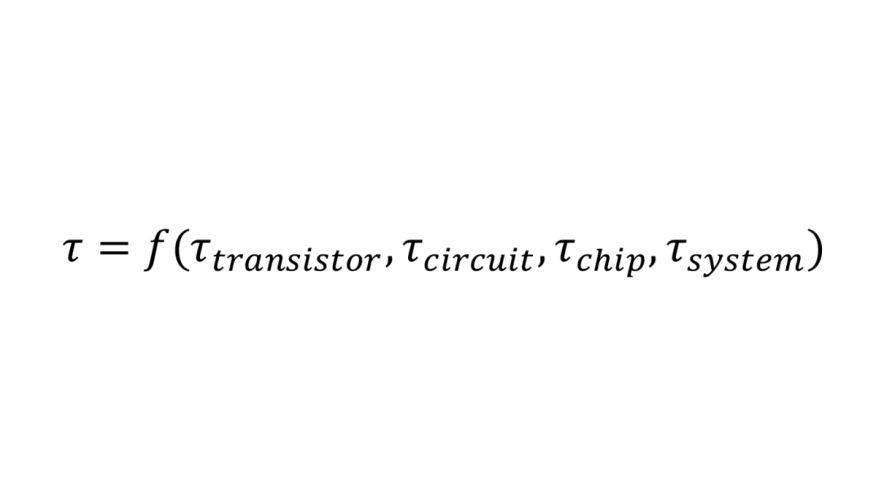
For six decades, Moore's geometric scaling drove progress in semiconductors. That industry compact no longer holds: returns from pure dimensional shrinking have flattened, leading-edge design budgets exceed one billion dollars per chip, and cost-per-transistor at the most advanced nodes is no longer falling. This perspective argues for a successor scaling principle — τ scaling —that adopts time itself, rather than transistor area, as the primary metric of progress, applying a single characteristic time constant τ as the unifying optimization target across twelve orders of magnitude, from a switching transistor to a data-center workload. Two production-scale demonstrations are presented. On a mobile SoC, LogicFolding — a methodology that partitions digital, analog, and memory circuits across vertically stacked active tiers — delivers a 55% step-wise increase in transistor density and a 41% power-efficiency gain at a fixed device node. On AI systems, a co-designed stack comprising the memory-semantic Unified Bus fabric, near-packaged Hi-ONE optical I/O, and edge-to-surface 3D Folding projects more than 100× growth in hardware integration by 2035.The deeper claim is methodological: τ scaling is the first scaling principle since Dennard to establish a shared optimization target across the entire computing stack.
To read the full article, click here
Related Semiconductor IP
- NPU IP
- JPEG XL Encoder
- I2C Master/Slave Controller Core
- NVMe Validation Test Suite
- Hybrid Memory Cube Verification IP
Related Articles
- VolTune: A Fine-Grained Runtime Voltage Control Architecture for FPGA Systems
- Vectorizing Quantum Control: A RISC-V Vector Extension Architecture for Scalable Qubit Systems
- MultiVic: A Time-Predictable RISC-V Multi-Core Processor Optimized for Neural Network Inference
- CVA6-RT: an Open-Source Time-Predictable RV64 Processor for Mixed-Criticality Systems
Latest Articles
- Terracotta: Enabling the Adoption of New DRAM Techniques via a Flexible DRAM Interface and Memory Controller
- A Framework for Accelerating Transformer Inference on RISC-V for Edge AI
- An Interleaved Parallel Dependent Quantization Hardware Architecture for H.266/VVC
- A Formal Security Analysis of CAN XL
- A Secure dToF LiDAR SoC with Dual-Domain Fingerprinting and Event-Driven AFE Circuit Achieving Sensor-Level Attack Resilience