VitaLLM: A Versatile and Tiny Accelerator for Mixed-Precision LLM Inference on Edge Devices
By Zi-Wei Lin, and Tian-Sheuan Chang
Institute of Electronics, National Yang Ming Chiao Tung University, Hsinchu, Taiwan
Abstract
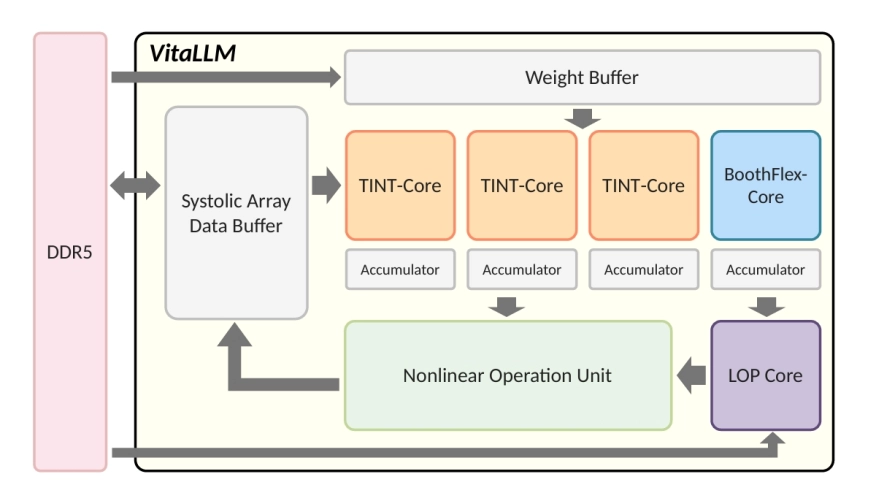
We present VitaLLM, a mixed-precision accelerator that enables ternary-weight large language models to run efficiently on edge devices. The design combines two compute cores—a multiplier-free TINT core for ternary–INT projections and a BoothFlex core that reuses a radix-4 Booth datapath for both INT8×INT8 attention and ternary–INT—sustaining utilization without duplicating arrays. A predictive sparse attention mechanism employs a leading-one (LO) surrogate with a comparison-free top-K selector to prune key/value (KV) fetches by roughly 1−K/M for M cached tokens, confining exact attention to K candidates. System-level integration uses head-level pipelining and an absmax-based quantization barrier to standardize cross-core interfaces and overlap nonlinear reductions with linear tiles. A 16nm silicon prototype at 1GHz/0.8V achieves 72.46 tokens/s in decode and 0.88 s prefill (64 tokens) within 0.214 mm² and 120 KB on-chip memory, while reducing KV traffic and improving utilization in ablations. These results demonstrate practical BitNet b1.58 (3B) inference on edge-class platforms and provide a compact blueprint for future mixed-precision LLM accelerators.
To read the full article, click here
Related Semiconductor IP
- NPU IP
- JPEG XL Encoder
- I2C Master/Slave Controller Core
- NVMe Validation Test Suite
- Hybrid Memory Cube Verification IP
Related Articles
- FPGA-Accelerated RISC-V ISA Extensions for Efficient Neural Network Inference on Edge Devices
- Peregrino: A Full-Hardware Accelerator for the Complete Falcon Post-Quantum Digital Signature Scheme on Resource-Constrained Edge Devices
- Heterogeneous SoC Integrating an Open-Source Recurrent SNN Accelerator for Neuromorphic Edge Computing on FPGA
- Hardware Acceleration of Block-Diffusion LLM for Edge Devices
Latest Articles
- Terracotta: Enabling the Adoption of New DRAM Techniques via a Flexible DRAM Interface and Memory Controller
- A Framework for Accelerating Transformer Inference on RISC-V for Edge AI
- An Interleaved Parallel Dependent Quantization Hardware Architecture for H.266/VVC
- A Formal Security Analysis of CAN XL
- A Secure dToF LiDAR SoC with Dual-Domain Fingerprinting and Event-Driven AFE Circuit Achieving Sensor-Level Attack Resilience