Vendor:
Digital Blocks, Inc.
Category:
SPI / QSPI XSPI
AMBA Bus Host to eSPI Controller/Target
eSPI Controller/Target RTL SystemVerilog IP Core
Overview
The Digital Blocks DB-eSPI-Controller-Target-AMBA is a fully compliant Intel Enhanced Serial Peripheral Interface (eSPI) Base Specification Revision 1.5 (May 2022) Controller and Target SystemVerilog RTL IP Core, with backward-compatible standard SPI Master and Slave modes for legacy SPI peripherals. The same RTL is configurable at integration time as an eSPI Controller, an eSPI Target, or a combined Controller-Target instance, with an AMBA AXI, AHB, or APB Bus Interface for connecting a host or local microprocessor to the eSPI bus.
In Controller role, the IP initiates all bus transactions: it issues PUT_* commands to write to Target peripherals (memory writes, virtual wires, Out-of-Band messages, flash requests) and GET_* commands to retrieve responses, status, and read data; it decodes Target response codes; and it can fan out to up to 8 external eSPI Targets on the shared bus.
In Target role, the IP responds to Controller commands, generates FATAL_ERROR / NON_FATAL_ERROR / DEFER / ACCEPT responses per eSPI 1.5, manages per channel AVAIL / FREE queue-status bits, and signals back to the Controller via the ALERT# sideband on local interrupt events.
The IP fully off-loads packet framing, CRC-8 generation and checking, channel arbitration, response-code decoding (Controller) or generation (Target), and queue-status tracking from the host microprocessor. It contains independent dual-clock Transmit and Receive FIFOs and multiple Finite State Machines with comprehensive status and interrupt capability. Optionally, a DMA Controller can transfer data between user memory and the eSPI / SPI Bus.
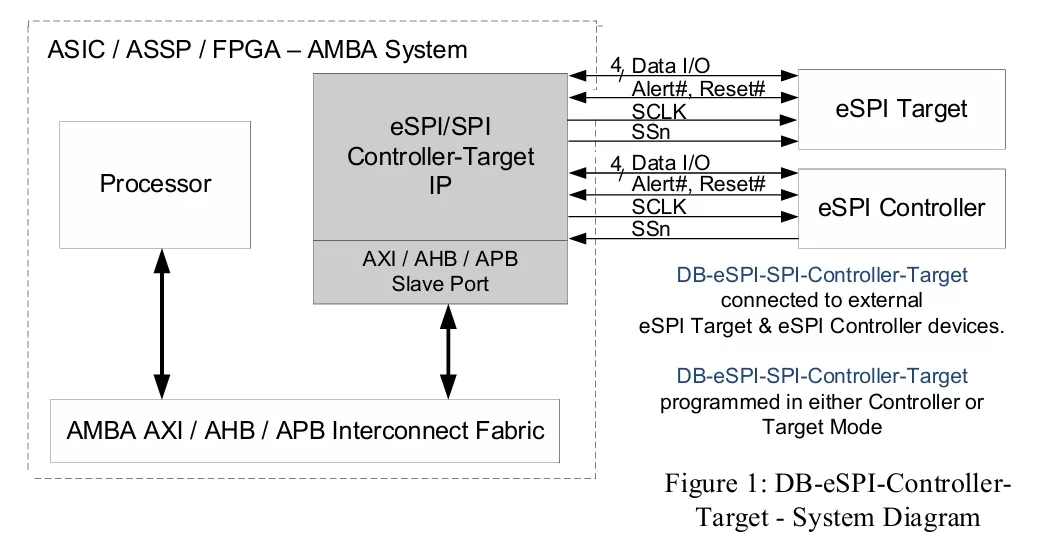
The DB-eSPI-Controller-Target targets ASIC / ASSP / FPGA integrated circuits, where typically the host or local processor is an Intel, ARM, or RISC-V processor, but any embedded processor is supported. Figure 1 depicts the system view of the DB-eSPI Controller-Target IP Core embedded within an SoC, communicating over the eSPI bus with peer eSPI Targets, Controllers, and / or legacy SPI Master/Slave devices. Separate Digital Blocks DB-eSPI-Controller-AMBA (Controller only) and DB-eSPI Target-AMBA (Target only) releases are also available.
Key features
Features – DB-eSPI-Controller-Target
The DB-eSPI-Controller-Target-AMBA is a fully compliant Intel eSPI Base Specification Rev. 1.5 (May 2022) Controller and Target IP core with backward compatible standard SPI Master and Slave modes and an AMBA APB / AHB / AXI4 Lite host-side interface.
Standards & Compliance
- Full compliance to eSPI Base Specification Rev. 1.5, both Controller and Target functions (Intel document 327432-005)
- Supports all four eSPI channels — Ch 0 Peripheral, Ch 1 Virtual Wire, Ch 2 Out of-Band Message, Ch 3 Flash Access
- Channel 3 Flash supports both CAFS (Controller-Attached Flash Sharing) and TAFS (Target-Attached Flash Sharing) modes
- Backward-compatible standard SPI Master and Slave modes for legacy SPI peripherals
Operating Modes & Throughput
- Configurable as eSPI Controller, eSPI Target, or combined Controller + Target from a single RTL (either Controller or Target programmed active)
- Selectable per-transfer I/O lane width: Single (x1), Dual (x2), or Quad (x4)
- Full-duplex eSPI transfers — Command Phase immediately followed by Response Phase on the shared bus
- Programmable channel maximum payload size: 64 / 128 / 256 bytes per packet
- Up to 64 Virtual Wire groups supported on Channel 1 (eSPI 1.5 maximum)
- In-Band Reset (IBR) generation (Controller role) and detection with interrupt (Target role) per eSPI 1.5 §3.5
eSPI Sideband Signals
- RESET# — driven by the Controller, received by the Target; I/O direction programmable to support either role
- ALERT# — driven by the Target on local event, received by the Controller and generates a host CPU interrupt on assertion
Multi-Target Topology
- Controller role: drives up to 8 external eSPI Targets on the shared bus (contact Digital Blocks for greater fan-out)
- Target role: responds to a single bus Controller per eSPI 1.5
- Per-Target chip-select (Slave Select) outputs for individual Target addressing
Bus & Clocking
- AMBA APB / AHB / AXI4-Lite slave interface for register and FIFO access on both Controller and Target sides
- Independent APB clock and SCK clock domains; safe CDC via Gray-coded pointer synchronizers throughout
- Programmable SCK divider; SCK driven from the APB clock or external clock pin (Controller drives, Target receives)
- Async-assert / sync-deassert reset synchronization on the SCK domain
FIFO Architecture
- Independent dual-clock asynchronous TX and RX FIFOs, default 256 bytes each (parameterizable 4 – 4096 B via *_FIFO_ADDRSIZE)
- Software-readable byte counts and programmable almost-empty / almost-full thresholds per FIFO
- Controller WAIT-State (0x0F) byte filtering on the RX-FIFO write path during the Response Phase
- Recommended buffer sizes for Maximum-GCC operation across all four channels documented in the TRM (Section "FIFO Sizing — eSPI Target")
Data Integrity & Protocol Error Handling
- CRC-8 generator on transmit; CRC-8 checker on receive
- Target role: hardware-generated FATAL_ERROR response on RX CRC mismatch, GET_* with channel AVAIL = 0, PUT_NP with NP RX FREE = 0, PUT_FLASH_C (CAFS) or PUT_FLASH_NP (TAFS) with Flash RX FREE = 0
- Target role: programmable WAIT-STATE response; hardware-generated DEFER on WAIT-State timeout; ACCEPT with optional channel-specific modifier
- Controller role: response-code decoder — host interrupted on Target-reported FATAL_ERROR, NON_FATAL_ERROR, DEFER, or unexpected response
- Per-channel AVAIL / FREE queue-state tracking via the Target's Status bytes
Interrupts
- Single combined Interrupt output with per-source mask, status, and vector registers
- Sources (role-dependent): TX almost-empty, RX almost-full, TX/RX overrun & underrun, master / slave transfer complete (MTC / STC), command / response error, CRC error, external ALERT# (Controller role), In-Band Reset (IBR) detected (Target role)
Synthesis & Implementation
- Selectable FIFO memory style — inferred RAM for FPGA Block-RAM / LUTRAM, or register-based for ASIC register-file
- Scan-test ready; clean lint and CDC results
- Validated on Synopsys Design Compiler (ASIC) and FPGA flows (Xilinx Vivado, Intel Quartus)
Features - DB-SPI-MS (Legacy SPI Master and Slave Modes)
- Standard SPI Master and Slave modes for backward compatibility with legacy SPI peripherals
- Half-Duplex / Full-Duplex transfers (simultaneous Transmit & Receive in FD mode)
- Four-signal SPI interface: MOSI, MISO, SCK, SS[N-1:0]
- Up to N = 8 Slave Select outputs for multiple SPI Slaves on the bus (Master mode)
- Programmable SPI frame formats
- Programmable LSB-first or MSB-first byte order, per word
- Two clock domains: AMBA Bus clock and SCK clock
- Independent dual-clock Transmit / Receive FIFOs — 8-bit data width, configurable depth 4 – 256 bytes, implemented as registers or SRAM
- Optional DMA Controller for memory ↔ SPI Bus transfers
- Internal interrupts with masking control
- Available AMBA / Avalon Microprocessor Interfaces: AXI / AHB / APB / Avalon Buses
- 8-bit / 32-bit Data Interface
- Fully-synchronous, synthesizable SystemVerilog RTL core, with rising-edge clocking, no gated clocks, and no internal tri-states, for easy integration into FPGA or ASIC design flows.
Block Diagram
Click to open fullscreen
What’s Included?
- The DB-eSPI-Controller-Target-AMBA is available in synthesizable SystemVerilog RTL or a technology-specific netlist for FPGAs, along with a simulation testbench with expected results, integration guide, C-code bare-metal and Linux driver, and Technical Reference Manual.
Specifications
Identity
Part Number
DB-eSPI-SPI-Controller-Target-AMBA
Vendor
Digital Blocks, Inc.
Type
Silicon IP
Files
Note: some files may require an NDA depending on provider policy.
Provider

HQ:
USA
Learn more about SPI / QSPI XSPI IP core
Unleashing the Power of Communication: Exploring the XSPI Protocol and Arasan Chip Systems' XSPI IP Portfolio
Frequently asked questions about SPI / QSPI / xSPI IP cores
What is AMBA Bus Host to eSPI Controller/Target?
AMBA Bus Host to eSPI Controller/Target is a SPI / QSPI XSPI IP core from Digital Blocks, Inc. listed on Semi IP Hub.
How should engineers evaluate this SPI / QSPI XSPI?
Engineers should review the overview, key features, supported foundries and nodes, maturity, deliverables, and provider information before shortlisting this SPI / QSPI XSPI IP.
Can this semiconductor IP be compared with similar products?
Yes. Buyers can compare this product with similar semiconductor IP cores or IP families based on category, provider, process options, and structured technical specifications.