Hardware Acceleration of Block-Diffusion LLM for Edge Devices
By Wei-Hsing Huang 1, Kiseok Lee 1, Ming-Yen Lee 1, Weiyu Sun 2, Cheng-Jhih Shih 2, Gayatri Tanksali 1, Arpit Khandelwal 2, Pin-Jun Chen 1, Yingyan Celine Lin 2, Shimeng Yu 1
1 School of Electrical and Computer Engineering, Georgia Institute of Technology, Atlanta, USA
2 School of Computer Science, Georgia Institute of Technology, Atlanta, USA
Abstract
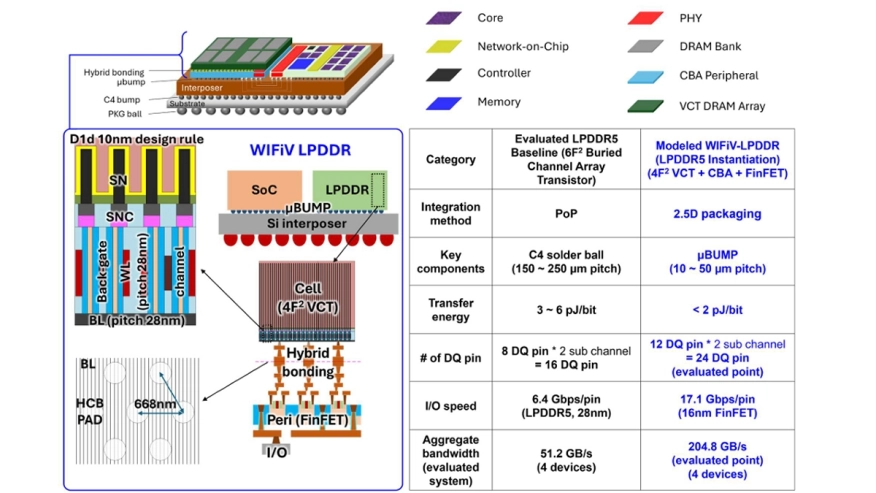
Single-stream (batch-one) edge inference cannot amortize weight traffic across requests. Full-attention diffusion LLMs recompute the entire sequence at every step; native block diffusion makes completed blocks immutable and exactly cacheable, yet refinement still streams prefix KV and FFN weights. We co-design WIFiV-LPDDR, a wide-I/O LPDDR system for precision-tagged reads, BRQ-KV for a canonical low-rank-plus-INT8-residual prefix with query-dependent per-entry precision, and DAT-FFN for drift-mapped canonical replacement, adjacent-stage-corrected low-bit delta, or cached-state carry while keeping live activations unquantized. Both map to an input-stationary mixed-precision systolic array. For the evaluated 1.5B/7B models on modeled Jetson-class platforms, the full stack provides arithmetic-mean energy-reduction factors of 3.79x/3.96x and arithmetic-mean latency speedups of 2.88x/4.44x at the reported DAT-FFN settings; every corresponding compressed model-benchmark score drops by less than one absolute percentage point from its baseline.
Index Terms—Large language models, Diffusion models, Edge AI, Hardware acceleration.
To read the full article, click here
Related Semiconductor IP
- Verification IP for MIPI SoundWire
- 100M/1G/ TSN Endpoint DO-254 IP Core
- Image Signal Processor
- H.265 / HEVC Video Codec
- H.264 / AVC Video Encoder
Related Articles
- VitaLLM: A Versatile and Tiny Accelerator for Mixed-Precision LLM Inference on Edge Devices
- CD-PIM: A High-Bandwidth and Compute-Efficient LPDDR5-Based PIM for Low-Batch LLM Acceleration on Edge-Device
- Hardware Acceleration of Kolmogorov-Arnold Network (KAN) in Large-Scale Systems
- FPGA-Accelerated RISC-V ISA Extensions for Efficient Neural Network Inference on Edge Devices
Latest Articles
- Minimum RISC-V: Maximum FPGA Efficiency
- The Era of Vibe Tapeout: Dark Age or Golden Age for Analog Circuit Design?
- Understanding the Power Consumption of Modern High Bandwidth Memory: Experimental Analysis and Modeling Using Real HBM2 DRAM Chips
- BARE-AI: Bit-Flip Attack Resilience in AI Hardware through Built-in Performance Monitors
- RFChipAgent: Multi-Agentic AI Flow for Analog/RF Chip Design