Can Agents Design Better Chips with a Higher Level Abstraction?
By Zijian Ding, Yang Zou, Yizhou Sun, Jason Cong
UCLA, Los Angeles, CA, USA
Abstract
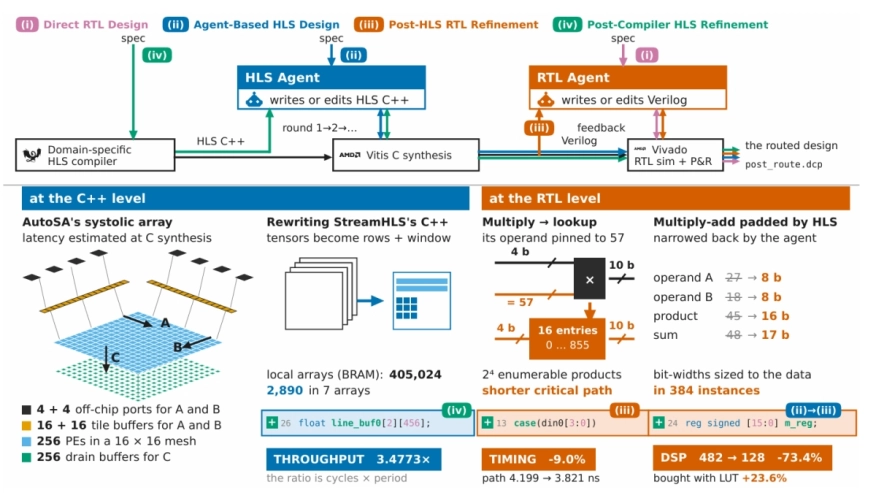
Large Language Model (LLM) agents are increasingly being explored for chip design, but most existing approaches operate directly at RTL. We ask whether agents can design better chips by leveraging higher-level abstractions. We compare Direct RTL Design, Agent-based HLS Design, Post-Compiler HLS Refinement, and Post-HLS RTL Refinement, and combine Agent-based HLS Design with Post-HLS RTL Refinement as Agent-based HLS with RTL Refinement (AHRR). We use FPGAs as a practical, easy-to-deploy platform for end-to-end evaluation, but note that the design-flow tradeoffs we study are largely independent of the target technology. Across a diverse 11-tasks benchmark suite, AHRR achieves a 2.6× geometric-mean speedup over Direct RTL Design across our benchmark suite. Case studies show that HLS distills design knowledge into abstractions that agents can leverage, while RTL refinement recovers lower-level optimization opportunities. Together, these results make AHRR a promising workflow for agentic chip design. The code and evaluation artifacts are available at this https URL.
To read the full article, click here
Related Semiconductor IP
- UALink 200G v1.0 Verification IP
- CCSDS SCCC Demapper and Turbo Decoder
- NPU IP
- JPEG XL Encoder
- I2C Master/Slave Controller Core
Related Articles
- Design and Implementation of Test Infrastructure for Higher Parallel Wafer Level Testing of System-on-Chip
- Get More Reliable Automotive ICs with a Shift Left Design Approach
- David vs. Goliath: Can Small Models Win Big with Agentic AI in Hardware Design?
- TeraPool: A Physical Design Aware, 1024 RISC-V Cores Shared-L1-Memory Scaled-up Cluster Design with High Bandwidth Main Memory Link
Latest Articles
- Anechoic: Onsager-Corrected Parallel Annealing for Sub-0.1 ms Dense Max-Cut on an FPGA
- Power, Performance, and Area of HPC-Based Malware Detectors: An FPGA and Open-PDK ASIC Study
- Terracotta: Enabling the Adoption of New DRAM Techniques via a Flexible DRAM Interface and Memory Controller
- A Framework for Accelerating Transformer Inference on RISC-V for Edge AI
- An Interleaved Parallel Dependent Quantization Hardware Architecture for H.266/VVC