Agentic AI-based Coverage Closure for Formal Verification
By Sivaram Pothireddypalli 1, Ashish Raman 2, Deepak Narayan Gadde 3, Aman Kumar 1
1 Infineon Technologies India Private Limited, India
2 Dr. B R Ambedkar National Institute of Technology Jalandhar, India
3 Infineon Technologies Dresden AG & Co. KG, Germany
Abstract
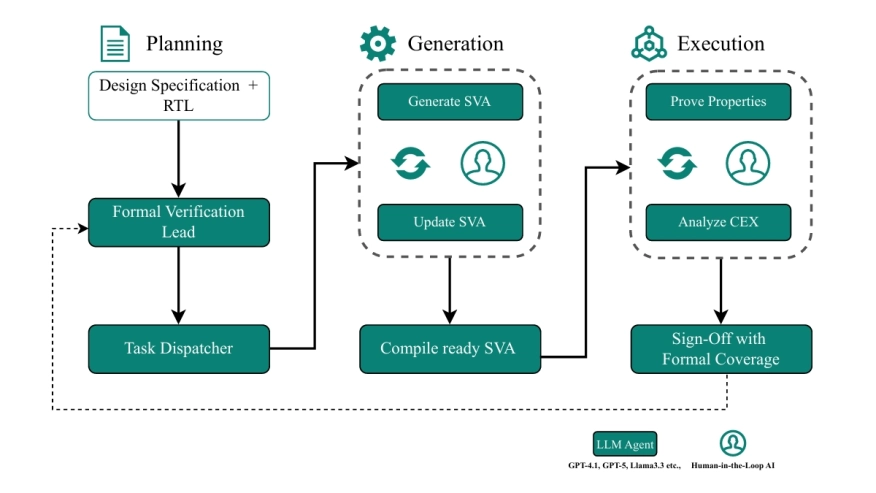
Coverage closure is a critical requirement in Integrated Chip (IC) development process and key metric for verification sign-off. However, traditional exhaustive approaches often fail to achieve full coverage within project timelines. This study presents an agentic AI-driven workflow that utilizes Large Language Model (LLM)-enabled Generative AI (GenAI) to automate coverage analysis for formal verification, identify coverage gaps, and generate the required formal properties. The framework accelerates verification efficiency by systematically addressing coverage holes. Benchmarking open-source and internal designs reveals a measurable increase in coverage metrics, with improvements correlated to the complexity of the design. Comparative analysis validates the effectiveness of this approach. These results highlight the potential of agentic AI-based techniques to improve formal verification productivity and support comprehensive coverage closure.
Index Terms — Agentic AI, LLM, Hardware Design, Formal Verification, Coverage
To read the full article, click here
Related Semiconductor IP
- NPU IP
- JPEG XL Encoder
- I2C Master/Slave Controller Core
- NVMe Validation Test Suite
- Hybrid Memory Cube Verification IP
Related Articles
- How formal verification saves time in digital IP design
- Don't over-constrain in formal property verification (FPV) flows
- Formal Verification Has It Covered!
- Formal property verification: A tale of two methods
Latest Articles
- Terracotta: Enabling the Adoption of New DRAM Techniques via a Flexible DRAM Interface and Memory Controller
- A Framework for Accelerating Transformer Inference on RISC-V for Edge AI
- An Interleaved Parallel Dependent Quantization Hardware Architecture for H.266/VVC
- A Formal Security Analysis of CAN XL
- A Secure dToF LiDAR SoC with Dual-Domain Fingerprinting and Event-Driven AFE Circuit Achieving Sensor-Level Attack Resilience