ObfAx: Obfuscation and IP Piracy Detection in Approximate Circuits
By Lukas Sekanina and Vojtech Mrazek
Brno University of Technology, Czech Republic
Abstract
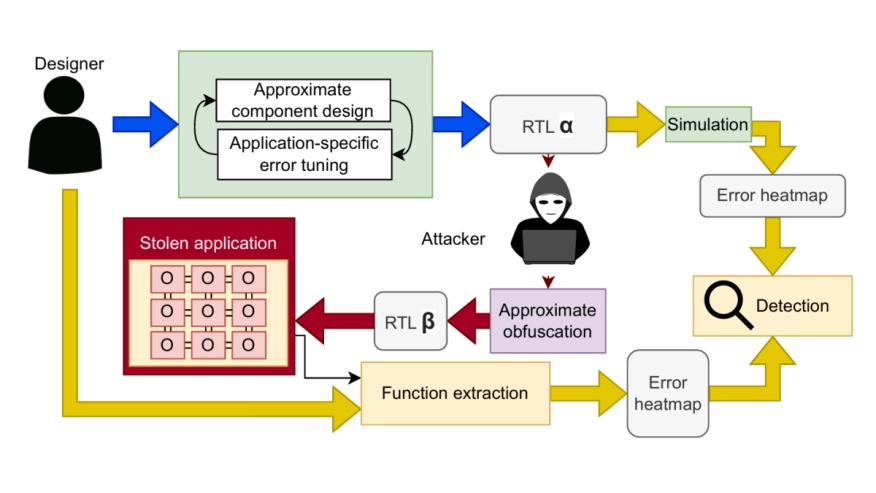
Approximate circuits often achieve exceptional trade-offs between computational accuracy and hardware efficiency, making them attractive for deployment as reusable Intellectual Property (IP) cores. However, safeguarding such circuits against piracy is critical for enabling sustainable commercialization of approximate computing. This work addresses the emerging challenge of IP protection and piracy detection in the context of approximate hardware. We introduce a novel adversarial threat model, approximate obfuscation, in which an attacker not only conceals the design through structural obfuscation but also introduces functional modifications to ensure that the resulting circuit exhibits nearly identical error characteristics and hardware metrics as the original IP. To counter this threat, we propose an automated framework that extracts and compares statistical error profiles of protected IP cores and suspicious circuits, enabling systematic detection of potential IP theft. Through extensive experiments on a diverse set of approximate multipliers, we analyze the resilience of different approximate multipliers against approximate obfuscation. Our results provide new insights into the interplay between obfuscation, approximation, and IP protection.
Keywords: Approximate computing, IP theft attack, Approximate obfuscation
To read the full article, click here
Related Semiconductor IP
- UALink 200G v1.0 Verification IP
- CCSDS SCCC Demapper and Turbo Decoder
- NPU IP
- JPEG XL Encoder
- I2C Master/Slave Controller Core
Related Articles
- The Growing Imperative Of Hardware Security Assurance In IP And SoC Design
- Real-Time ESD Monitoring and Control in Semiconductor Manufacturing Environments With Silicon Chip of ESD Event Detection
- DRsam: Detection of Fault-Based Microarchitectural Side-Channel Attacks in RISC-V Using Statistical Preprocessing and Association Rule Mining
- A 0.32 mm² 100 Mb/s 223 mW ASIC in 22FDX for Joint Jammer Mitigation, Channel Estimation, and SIMO Data Detection
Latest Articles
- BARE-AI: Bit-Flip Attack Resilience in AI Hardware through Built-in Performance Monitors
- RFChipAgent: Multi-Agentic AI Flow for Analog/RF Chip Design
- Anechoic: Onsager-Corrected Parallel Annealing for Sub-0.1 ms Dense Max-Cut on an FPGA
- Power, Performance, and Area of HPC-Based Malware Detectors: An FPGA and Open-PDK ASIC Study
- Terracotta: Enabling the Adoption of New DRAM Techniques via a Flexible DRAM Interface and Memory Controller