A Reconfigurable Multiplier Architecture for Error-Resilient Applications in RISC-V Core
By Pragun Jaswal, L. Hemanth Krishna, B. Srinivasu
Indian Institute of Technology Mandi, India
Abstract
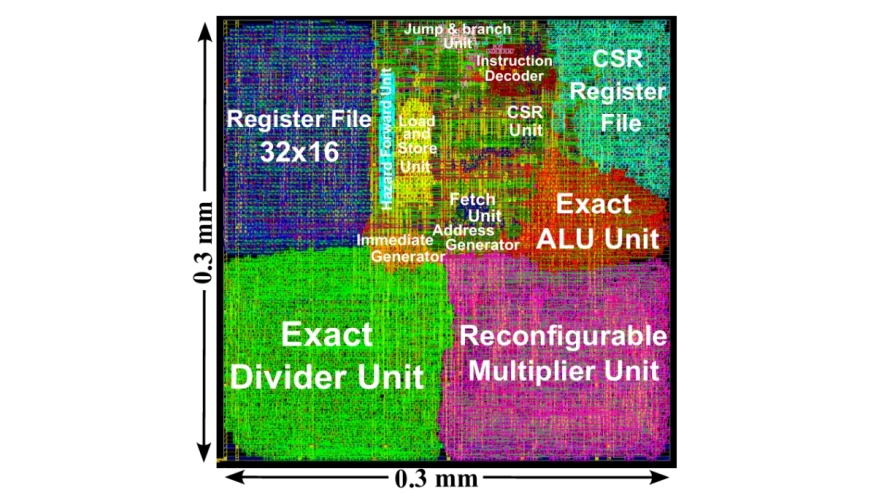
Neural Networks (NNs) have been widely adopted due to their outstanding efficacy and adaptability across computer vision and deep learning applications. The optimization of NNs is necessary to enable their deployment on energy constrained embedded devices, where the limited available energy poses a significant challenge for efficient inference. This paper presents a runtime reconfigurable multiplier architecture integrated into the RISC-V core, targeting energy efficient neural network inference and edge AI applications. The proposed multiplier supports adaptability for exact and approximate computation with multiple configurable accuracy levels via a dedicated mulscr, enabling fine-grained energy accuracy control within a standard processor pipeline. The proposed design achieves 44%-52% and 62%-68% power reduction in exact and approximate modes respectively, while maintaining the computational performance of 1.89 DMIPS/MHz. Evaluations on error-tolerant workloads including 2d convolution and matrix multiplication demonstrate up to 63% reduction in energy consumption, with the proposed design achieving 1.21 pJ/instruction for matrix multiplication, confirming its effectiveness for energy-constrained edge AI deployments.
Index Terms — Hardware Accelerator, Low Power Design, Ap proximate Multiplier, Approximate Computing, RISC-V, Embed ded Processor.
To read the full article, click here
Related Semiconductor IP
- NPU IP
- JPEG XL Encoder
- I2C Master/Slave Controller Core
- NVMe Validation Test Suite
- Hybrid Memory Cube Verification IP
Related Articles
- An FPGA-Based SoC Architecture with a RISC-V Controller for Energy-Efficient Temporal-Coding Spiking Neural Networks
- Vectorizing Quantum Control: A RISC-V Vector Extension Architecture for Scalable Qubit Systems
- Why RISC-V is a viable option for safety-critical applications
- Design and implementation of a hardened cryptographic coprocessor for a RISC-V 128-bit core
Latest Articles
- Terracotta: Enabling the Adoption of New DRAM Techniques via a Flexible DRAM Interface and Memory Controller
- A Framework for Accelerating Transformer Inference on RISC-V for Edge AI
- An Interleaved Parallel Dependent Quantization Hardware Architecture for H.266/VVC
- A Formal Security Analysis of CAN XL
- A Secure dToF LiDAR SoC with Dual-Domain Fingerprinting and Event-Driven AFE Circuit Achieving Sensor-Level Attack Resilience