Rethinking RTL flows with AI-driven hybrid formal verification

Modern RTL verification flows generate more evidence than engineers can always review with equal priority. Simulation, assertions, coverage, and formal analysis each expose different classes of behavior, but a large design can produce hundreds or thousands of properties.
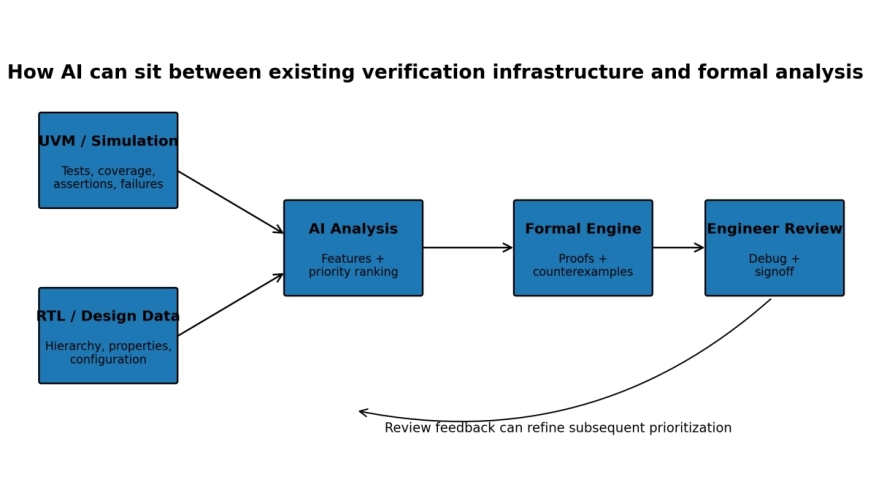 This article describes an AI-assisted workflow that uses machine learning to prioritize those properties while leaving proof and counterexample generation to the formal engine. The approach is intended to complement, not replace, established SystemVerilog, Universal Verification Methodology (UVM), simulation, and formal verification practices.
The problem: too many properties, too little verification time
Verification teams face a practical allocation problem. A complex subsystem may include control-state logic, FIFO interfaces, arbitration, multiple clock domains, configuration registers, error handling, and protocol checks. Each area can generate assertions, and each assertion can have a different verification cost and value. Some properties prove quickly. Others expose difficult corner cases or consume substantial solver resources.
To read the full article, click here
Related Semiconductor IP
- High-Throughput Multi-Channel DMA Controller
- Configurable Multi-Channel DMA Controller
- Fixed-Channel Multi-Channel DMA Controller
- Verification IP for MIPI SoundWire
- 100M/1G/ TSN Endpoint DO-254 IP Core
Related Blogs
- How to Speed Up Simulation Coverage Closure with Formal Verification Tools
- Raising RISC-V processor quality with formal verification
- How Qualcomm Accelerated Coverage Closure with AI-Driven Verification
- Introducing Next-Generation Verdi Platform for AI-Driven Debug and Verification Management
Latest Blogs
- Data Movement Enabling Physical AI
- How a Multi-Protocol PHY Simplifies Physical AI Connectivity
- Secure Boot on AMD Artix-7 FPGA: Getting started with KiviBoot-Tiny and MicroBlaze CPU
- From Perception to Driving Actions: Alpamayo on Chimera
- Protecting Edge AI with RISC-V CHERI: See how easily memory-safe security can be added to an AI application (part 1)