Extending Ethernet Security to the Automotive Edge

Ethernet is becoming the communications backbone of the software-defined vehicle. What began with high-bandwidth connections between central compute, domain controllers and advanced sensors is now extending much further toward the edge.
 10BASE-T1S is an important part of that transition. Designed for 10 Mbps single-pair Ethernet, it enables Ethernet connectivity to reach cost- and space-sensitive edge nodes such as sensors, actuators, lighting controls and other peripheral functions. Its multidrop architecture can also replace point-to-point connections, reducing the number of links and switch ports needed to connect these devices.
The result is a simpler proposition: extend Ethernet farther through the vehicle rather than maintaining islands of different communications technologies and bridging between them. But as the Ethernet network expands, its security architecture needs to expand with it.
The Security Boundary Moves to the Edge
Securing high-speed Ethernet links between major vehicle subsystems is only part of the challenge. Once Ethernet reaches edge nodes, those connections become part of the Ethernet attack surface as well. This matters because the physical wiring used for 10BASE-T1S can connect remote devices located around the vehicle. Access to that connectivity could potentially allow an attacker not only to observe traffic, but also to inject traffic onto the network.
For sensor and actuator networks, integrity and authenticity can be every bit as important as confidentiality. A manipulated sensor frame, replayed command or traffic injected by a compromised device can undermine trust in the information moving between the edge and the rest of the vehicle. Stopping the security boundary at the zonal controller therefore leaves an important part of the network outside that boundary. Security must extend to the Ethernet endpoint itself.
MACsec provides a natural way to do this. Based on IEEE 802.1AE, MACsec protects Ethernet traffic at Layer 2. This allows the same basic Ethernet security architecture used elsewhere in the vehicle to extend toward 10BASE-T1S connections at the edge.
10 Mbps Creates a Different MACsec Design Challenge
The challenge is that a 10BASE-T1S endpoint is a very different design environment from a high-speed Ethernet interface. MACsec implementations designed to process gigabit or multi-gigabit traffic can provide the required cryptographic capabilities, but simply scaling down a high-speed architecture does not necessarily produce an implementation optimized for a 10 Mbps edge port.
At the edge, every part of the implementation matters. Silicon area affects the economics of putting security into large numbers of devices. Latency must remain predictable for time-sensitive applications. Half-duplex operation and the MII interface introduce specific integration requirements. And at the same time, reducing throughput requirements should not mean reducing the level of MACsec functionality available.
The design question therefore changes. Rather than asking how an existing MACsec engine can be made to work at 10 Mbps, what if the MACsec engine were designed specifically for that environment from the start?
Explore Rambus IP:
- MACsec Engine optimized for 10Base-T1S/T1L applications
- 1G to 100G Single-Port MACsec Engine
- 1G to 50G Single-Port MACsec Engine with TSN support
- 1G to 50G Single-Port MACsec Engine with xMII interface and TSN support
Purpose-Built MACsec for 10BASE-T1S
That is the idea behind the new Rambus MACsec-IP-360. MACsec-IP-360 is a 10 Mbps MACsec engine designed specifically for 10BASE-T1S/T1L applications, covering both the shared multidrop (T1S) and point-to-point (T1L) variants of single-pair Ethernet. Rather than scaling down a high-speed implementation, Rambus designed the datapath around the performance, area and interface requirements of a 10 Mbps port.
The engine supports full- and half-duplex operation over a standard MII interface and provides line-rate MACsec processing with fixed low latency. It supports IEEE 802.1AE-2018 with all MACsec cipher modes, VLAN-in-clear operation and configurable numbers of secure connections and security associations. It also supports the Open Alliance Automotive MACsec profile.
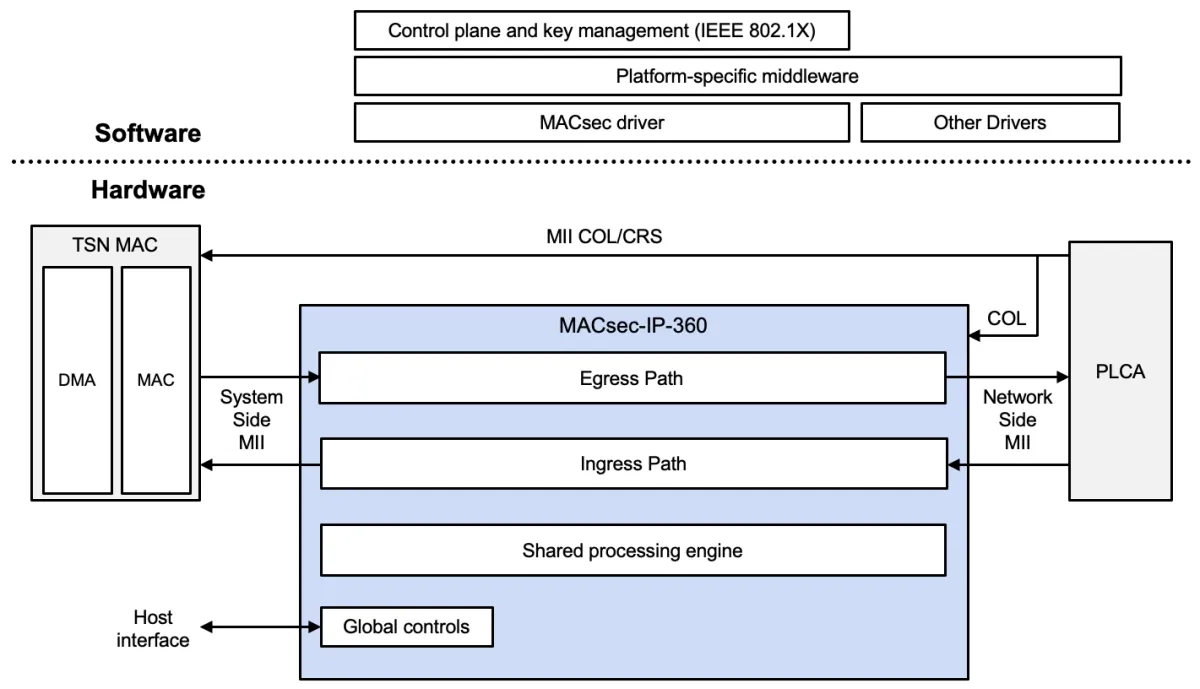
MACsec-IP-360 engine block diagram
That purpose-built architecture has an important practical benefit: silicon area. Internal comparisons for configurations with 4 to 16 security associations show MACsec-IP-360 using up to three times less area than the general-purpose implementations used for comparison. The goal is not to trade functionality for size. It is to right-size the implementation for the port.
Timing behavior was also designed into the architecture. MACsec-IP-360 operates as a fixed-delay component and preserves the accuracy of PTP timestamping and TSN scheduling generated by the TSN MAC subsystem.
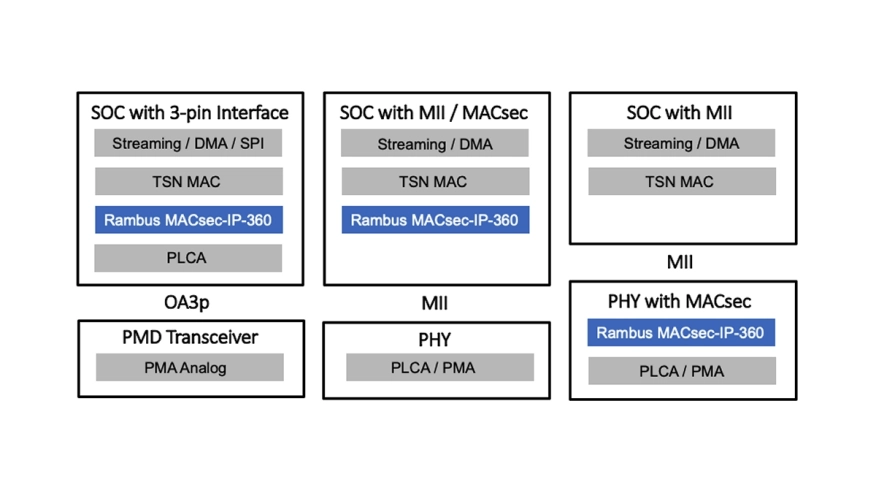
MACsec-IP-360 can be integrated between the Ethernet MAC and the PCS/PLCA on the MII side of the subsystem. This makes it possible to use a standard MAC controller while adding MACsec processing directly into the Ethernet path. The IP can be integrated as part of the SoC or PHY architecture depending on the implementation.
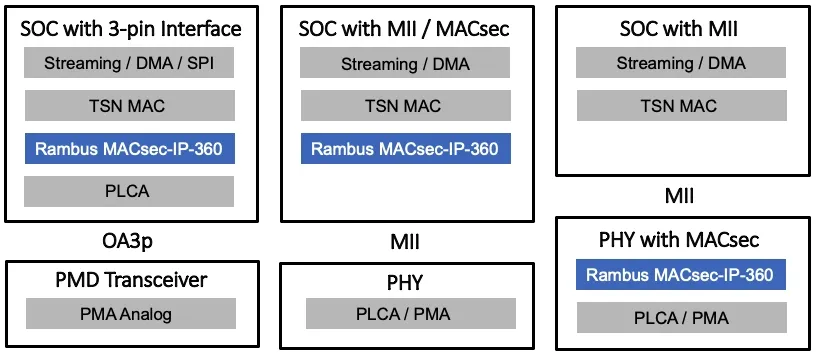
Figure 2. Rambus MACsec-IP-360 integration options
And because deploying security IP involves more than integrating RTL, MACsec-IP-360 comes with integration and verification collateral, with cybersecurity and functional-safety support also available.
The result is full MACsec functionality designed around the constraints of the 10 Mbps Ethernet edge rather than inherited from a higher-speed design point.
Extending Ethernet Security from Host to Edge
Automotive Ethernet does not stop at a single speed or a single part of the vehicle. High-speed links connect increasingly powerful compute and networking devices, while 10BASE-T1S allows Ethernet to extend toward smaller edge nodes. The security architecture needs to span that same range.
MACsec-IP-360 extends the Rambus MACsec portfolio with a purpose-built 10 Mbps MII implementation, alongside Rambus MACsec solutions addressing Ethernet rates up to 3.2 Tbps. That enables designers to apply standards-based MACsec protection across very different classes of Ethernet connections while selecting an implementation appropriate for each part of the network.
As 10BASE-T1S pushes Ethernet toward the smallest nodes in the vehicle, securing only the center of the network is no longer enough. Security needs to reach the endpoint.
With the MACsec-IP-360, Rambus brings full, line-rate MACsec to the 10BASE-T1S edge in an implementation designed specifically for the area, latency and integration requirements of a 10 Mbps port. Learn more here.
Related Semiconductor IP
- MACsec Engine optimized for 10Base-T1S/T1L applications
- 1G to 100G Single-Port MACsec Engine
- 1G to 50G Single-Port MACsec Engine with TSN support
- 1G to 50G Single-Port MACsec Engine with xMII interface and TSN support
- 1.6T/3.2T Multi-Channel MACsec Engine with TDM Interface (MACsec-IP-364)
Related Blogs
- Comcores: The One-Stop Shop for Automotive Ethernet and Security
- What Does a GPU Have to Do With Automotive Security?
- The On-Device LLM Revolution: Why 3B-30B Models Are Moving to the Edge
- The Silent Guardian of AI Compute - PUFrt Unifies Hardware Security and Memory Repair to Build the Trust Foundation for AI Factories