Vendor: CAST Category: Ethernet

TSN Ethernet Endpoint Controller

The TSN-EP implements a configurable controller meant to ease the implementation of endpoints for networks complying to the Time …

Overview

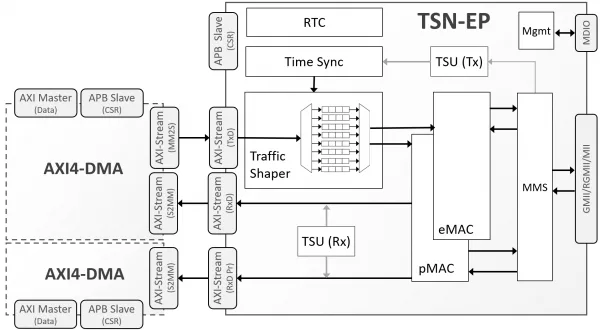
The TSN-EP implements a configurable controller meant to ease the implementation of endpoints for networks complying to the Time Sensitive Networking (TSN) standards. It integrates hardware stacks for timing synchronization (IEEE 802.1AS-2020) and traffic shaping (IEEE 802.1Qav and 802.1Qbv), frame-preemption (IEEE 802.1Qbu and IEEE 802.3br) and a low-latency Ethernet MAC. Enhanced reliability features can also be supported, using the optional hardware modules for Frame Replication and Elimination for Reliability (IEEE 802.1CB) and Per-Stream Filtering and Policing (IEEE 802.1Qci).

The controller core is designed to enable high-precision timing synchronization and flexible yet accurate traffic scheduling. Requiring minimal software assistance for its initialization, it features extremely low and deterministic ingress and egress latencies and simplifies the development of time-aware applications. While operating autonomously, the TSN-EP provides the system with timing information (timestamps, alarms, etc.) that is typically required for the operation of a TSN network endpoint device. Furthermore, it allows the system to define and tune in real time the traffic shaping parameters according to an application’s requirements. 

The TSN-EP uses standard AMBA® interfaces to ease integration. Its configuration and status registers are accessible via a 32-bit-wide APB bus, and packet data are input and output via 32-bit-wide AXI-Streaming buses. To further expedite and ease the implementation of customer applications, DMA engines providing access to the stream interfaces via a memory-mapped AXI4 master port, and software stacks supporting higher-layer protocols, such as IEEE 802.1Qcc, IEEE 802.1Qca and SNMP, are optionally available.

The TSN-EP is designed with industry best practices and is available in synthesizable RTL (Verilog 2001) source code or as a targeted FPGA netlist. Deliverables provide everything required for a successful implementation, including sample scripts, an extensive testbench, and comprehensive documentation.  
Key features

  • TSN Ethernet Endpoint 
    • One Ethernet port & one host processor port
    • Suitable for star-topology networks
    • 10/100/1000 Mbps (10+ Gbps soon)
  • Time Synchronization
    • Implements IEEE 802.1AS-2020 
    • Grandmaster or Slave functionality
    • Highly accurate synchronization. Accuracy is typically in the order of a few tens ns.
    • Provides the system with timestamps, periodic event triggers and alarms 
  • Traffic Shaping
    • Implements Traffic Scheduling as per IEEE 802.1Qav and IEEE 802.1Qbv
    • Implements Frame Preemption as per IEEE 802.1Qbu and IEEE 802.3br
    • Supports up to 8 traffic classes, as per VLAN (IEEE 802.1Q)
    • Enables bandwidth reservation and allocation per traffic class, and deterministic, low-latency, low-jitter communication for all traffic classes 
  • Optional TSN Protocols
    • Frame Replication and Elimination (IEEE 802.1CB) and Per-Stream Filtering and Policing (IEEE 802.1Qci) optionally implemented in hardware
    • Path Control and Reservation per IEEE 802.1Qca, and Enhancements to Stream Reservation Protocol per EEE 802.1Qcc are optionally implemented in software
  • Easy System Integration
    • AMBA/AXI4 Interfaces
      • 32-bit APB for control/status registers
      • 32-bit AXI4-Stream for packet data
      • Optional AXI4 DMA engine
    • MII, GMII and RGMIII Ethernet PHY interface
    • Requires minimal host assistance for its initialization
    • Complete FPGA reference designs available

Block Diagram

Specifications

Identity

Part Number
TSN-EP
Vendor
CAST
Type
Silicon IP

Files

Note: some files may require an NDA depending on provider policy.

Provider

HQ: USA

Learn more about Ethernet IP core

TSN Ethernet Controller Cores Gain Frame Preemption and Linux Driver

Two recent additions have improved the endpoint controllers we offer for Time-Sensitive Networking over Ethernet: Frame Preemption makes them better for highly demanding real-time operation, and a Linux Driver and support package facilitate integrating TSN in a Linux environment.

From Classical CAN and CAN FD to CAN XL: Functional Safety and Security for Next-Generation In-Vehicle Communication

This article reviews the functional-safety attributes of Classical CAN and CAN FD, then explains how CAN XL preserves and extends them. It also discusses higher-layer safety protocols, fault-tolerant CAN XL controller implementations, and CANsec, the CAN XL security extension inspired by the MACsec model. Finally, it highlights how the CAST CAN XL controller IP and CANsec acceleration IP can support the efficient deployment of safety- and security-capable in-vehicle networks.

CANsec: Security for the Third Generation of the CAN Bus

CANsec is a resource-efficient solution for securing the CAN bus against the most common cyber security threats on software-defined vehicles. Here we show that the encryption and authentication of CAN XL frames are possible without latencies or loss...

Time Sensitive Networking for Aerospace

This white paper highlights the integration of Time-Sensitive Networking (TSN) in the aerospace industry. It provides an overview of TSN standards and profiles and the IEEE P802.1DP standard relevant to aerospace applications. It also discusses key topics such as time synchronization, latency, resource management, and reliability in the context of TSN.

Frequently asked questions about Ethernet IP cores

What is TSN Ethernet Endpoint Controller?

TSN Ethernet Endpoint Controller is a Ethernet IP core from CAST listed on Semi IP Hub.

How should engineers evaluate this Ethernet?

Engineers should review the overview, key features, supported foundries and nodes, maturity, deliverables, and provider information before shortlisting this Ethernet IP.

Can this semiconductor IP be compared with similar products?

Yes. Buyers can compare this product with similar semiconductor IP cores or IP families based on category, provider, process options, and structured technical specifications.

×
Semiconductor IP