Single Pair Ethernet and TSN: The In-Robot Network Behind the Next Humanoid Robots
Humanoid robots are moving from research demos toward real products, and the network inside them is becoming the hard problem. Single Pair Ethernet and Time-Sensitive Networking are emerging as the answer, and CAST already builds the IP cores that make it deterministic.
A humanoid robot is one of the most demanding embedded systems an engineer can design. A single machine can carry dozens of actuators, a dense array of sensors, and strict limits on weight, heat, and latency, all while its joints move in real time. Connecting that many nodes reliably, inside a body that has to stay light and cool, is quickly becoming the central design challenge for the next generation of robots.
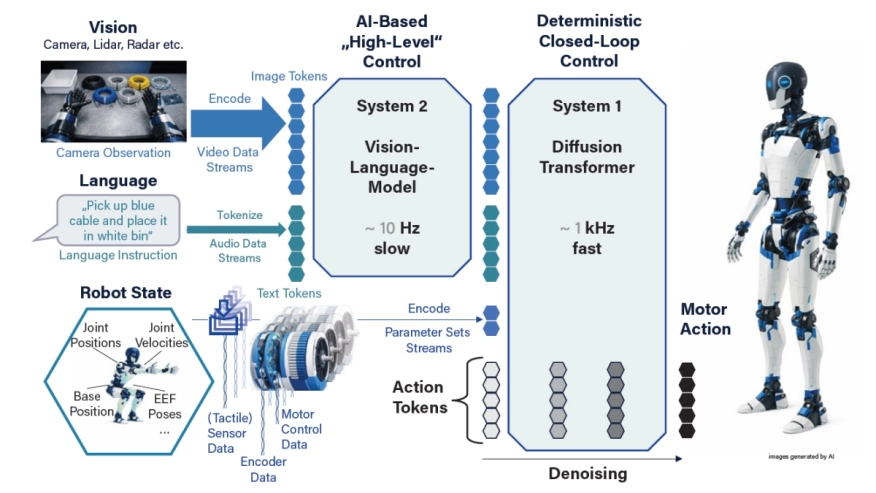 The industry is converging on an answer: Single Pair Ethernet (SPE) as the physical layer, and Time-Sensitive Networking (TSN) as the layer that makes it deterministic. CAST contributed to a recent Single Pair Ethernet System Alliance (SPESA) white paper that lays out this architecture for humanoid in-robot networks, with input from engineers across the SPE ecosystem, including CAST TSN product manager Alexander Mozgovenko. This post summarizes the case for that approach and looks at the CAST IP cores that implement it in silicon.
Why humanoids need a new in-robot network
Traditional multicore cabling does not scale well inside a humanoid. A single robot can involve up to 72 degrees of freedom, 50 to 80 actuators under real-time control, and sensor streams from cameras, IMUs, force and torque sensors, and tactile arrays. Wired point to point, that adds weight, stiffness, and failure points in exactly the places a moving robot can least afford them, and it can require well over 100 in-robot network ports.
The SPESA white paper makes the case for a different approach, built on three ideas:
- Single Pair Ethernet carries both data and power over a single twisted pair using Power over Data Line (PoDL). That means thinner, lighter cabling with a smaller bend radius, which suits the tight, constantly moving joints of a humanoid.
- Time-Sensitive Networking adds determinism on top of standard Ethernet. Standard Ethernet is asynchronous and offers no guarantee of when a packet arrives; TSN provides the synchronized, scheduled delivery that real-time motion control depends on across every node.
- A zonal network structure, borrowed from automotive architectures, replaces sprawling harnesses with fewer, smarter nodes, which keeps the network scalable and serviceable as robots grow more complex.
Together, these give a humanoid a communication backbone that stays light and predictable under continuous motion. For the full analysis, including the market context and the detailed requirements, we recommend reading the SPESA white paper directly (linked below).
Where CAST fits: deterministic Ethernet in silicon
SPE defines how the signal travels. TSN defines how it stays deterministic. Turning that into a working SoC or FPGA is where CAST’s IP comes in. Engineered by our long-term partner Fraunhofer IPMS and proven at industry interoperability plugfests, CAST’s TSN family covers the endpoints and switches an in-robot network needs, and each core is delivered as synthesizable RTL for ASIC and FPGA designs, or as netlists.
TSN-EP — 1G TSN Ethernet Endpoint. A compact endpoint controller with one Ethernet port and one host-processor port, suited to star-topology networks at 10/100/1000 Mbps. It implements IEEE 802.1AS-2020 time synchronization (as grandmaster or slave) with accuracy on the order of single-digit nanoseconds, and traffic scheduling per IEEE 802.1Qav (Credit-Based Shaper) and IEEE 802.1Qbv (Time-Aware Scheduling) across up to eight traffic classes, all built around a low-latency Ethernet MAC. Standard AMBA interfaces (an APB bus for configuration and status registers, AXI-Streaming for packet data) keep integration straightforward.
TSN-EP-10G — 10 Gbps TSN Endpoint. For the high-bandwidth links that vision systems and sensor fusion increasingly demand, the TSN-EP-10G extends the endpoint to 10-Gigabit Ethernet, a tenfold increase over the 1G core while preserving deterministic behavior. It integrates a low-latency MAC with hardware support for IEEE 802.1AS-2020 gPTP, 802.1Qav CBS, and 802.1Qbv TAS, achieving time-synchronization accuracy under 10 nanoseconds, with further capabilities such as 802.1CB Frame Replication and Elimination for Reliability (FRER) and IEEE 802.1Qci Per-Stream Filtering and Policing (PSFP) available through optional modules and software. It connects to PHYs via XGMII, uses 128-bit AXI-Streaming for packet data, and ships with FreeRTOS and Linux support, including a gPTP stack, drivers, and CLI, to speed bring-up.
TSN-SE — TSN Switched Endpoint. A two-port switched endpoint controller that combines endpoint and bridging functions, implementing timing synchronization (802.1AS), traffic shaping (802.1Qav and 802.1Qbv), and frame preemption (802.1Qbu and 802.1Qbr) in hardware. CAST believes it to be among the smallest and most energy-efficient cores of its kind, and its endpoint has been proven across multiple industry plugfests.
TSN-SW — TSN Ethernet Switch. A configurable three- to twenty-four-port Layer-2 switch supporting Ethernet bridging per IEEE 802.1Q-2018, with versatile frame forwarding and filtering and all the essential TSN protocols for timing synchronization, traffic-shaping, preemption, and redundancy. An all-hardware, cut-through architecture gives it what we believe is the lowest sub-microsecond port-to-port latency available, which matters as the number of nodes in a robot climbs.
Because the same cores are already deployed in automotive, industrial, aerospace, and other real-time systems, they bring a proven, standards-based foundation to a robotics market that is still taking shape. They also integrate cleanly with the rest of the CAST portfolio, including our UDP/IP 1G/10G hardware protocol stack and DMA engines, so a design team can assemble a complete in-robot data path from silicon-proven building blocks.
Explore CAST IP:
- TSN Ethernet Endpoint Controller
- TSN Ethernet Endpoint Controller 10Gbps
- TSN Ethernet Switched Endpoint Controller
- Multiport TSN Ethernet Switch
From white paper to production silicon
The SPESA white paper describes where humanoid in-robot networks are heading. CAST’s TSN IP is how a design team gets there today: deterministic, standards-based Ethernet endpoints and switches, portable to any ASIC or FPGA, and backed by plugfest interoperability and long field experience.
- Read the SPESA white paper on Single Pair Ethernet for humanoid in-robot networks: SPESA’s site
- Explore CAST’s TSN IP cores: TSN-EP · TSN-EP-10G · TSN-SE · TSN-SW
- Talk to us about deterministic Ethernet: contact CAST
Related Semiconductor IP
- TSN Ethernet Endpoint Controller
- TSN Ethernet Endpoint Controller 10Gbps
- TSN Ethernet Switched Endpoint Controller
- Multiport TSN Ethernet Switch
- MACsec Protocol Engine for 1G/10G+ Ethernet
Related Blogs
- Enabling the Next Generation of AI Infrastructure with Ethernet for Scale-Up Networking (ESUN)
- UWB and 6G: Why Precision Sensing Will Define the Next Wireless Revolution
- SerDes, Ethernet and the silicon that connects them: Why SerDes for high-bandwidth sensors?
- The Architectural Evolution of 16GHz PLLs for Next-Gen AI and SerDes SoCs