Vendor: CAST Category: Bus Fabric

AHB Subsystem

The AHB-SBS is an integrated, verified, AMBA® 3.0 interconnect and peripherals subsystem ready for embedded applications using pr…

Overview

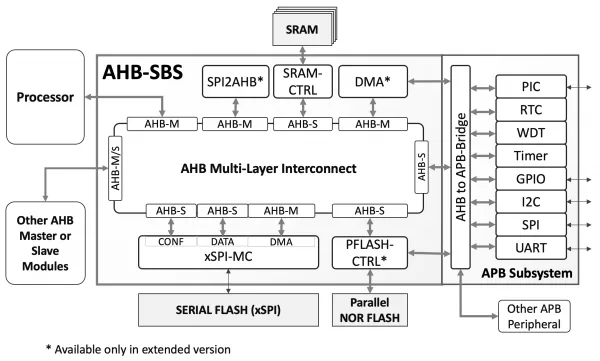
The AHB-SBS is an integrated, verified, AMBA® 3.0 interconnect and peripherals subsystem ready for embedded applications using processors with AHB bus interfaces such as the BA22-DE, BA22-CE, ARM Cortex-M0/M0+/M1/M3/M4, and several RISC-V processors.

The AHB subsystem is available in two versions: Base and Extended. The Base version (AHB-SBS-BASE) integrates a 32-bit multilayer AHB fabric with an xSPI Flash Memory Controller, an SRAM controller, and a set of APB peripherals. This version allows the host processor to boot directly from the flash, and execute code from the flash (eXecute In Place -XIP), or from an on-chip shadow SRAM. Furthermore, it provides access to essential microcontroller peripherals, such as serial interfaces and timers.

The Extended version, the AHB-SBS-EXT, adds a DMA controller, an SPI-to-AHB bridge, and an external memory controller, suitable for accessing off-chip parallel NOR-flash devices or SRAMs.

The AHB-SBS was designed with industry best practices, and its reliability and low risk have been proven through both rigorous verification and customer production. It is delivered in human-readable Verilog source code, along with comprehensive documentation for each module, example drivers, and. software exercising all the peripherals.

This subsystem can be mapped to any Intel, Lattice, Microsemi, or Xilinx programmable device, or to any ASIC technology, provided sufficient silicon resources are available. Please contact CAST Sales to get accurate characterization data for your specific implementation requirements. 
Key features

  • Subsystem for microprocessors with 32-bit AMBA® 3.0 AHB-Lite or AHB Interfaces, such as:  
    • BA20, BA22-DE, BA22-CE  
    • ARM Cortex-M0/M1M3/M4  
    • Several RISC-V processors Integrated Modules  
  • AHB-SBS-BASE integrates:
    • AHB Multi-Layer Interconnect
    • xSPI Flash Memory Controller
    • Internal SRAM Controller
    • APB Subsystem (APB-SBS):
      • APB bridge.
      • I2C Master/Slave,
      • Octal SPI Master/Slave,
      • 16550 UART,
      • GPIO,
      • Real-Time Clock,
      • Generic Timer,
      • Watchdog Timer,
      • Programmable Interrupt Controller  
  • AHB-SBS-EXT adds:
    • DMA Controller
    • SPI-to-AHB bridge
    • External parallel flash or SRAM controller
  • Configuration Options  
    • Number of extra AHB master and slave, and APB slave ports for user's modules  
    • AHB-slave port access per master
    • Arbitration scheme per AHB slave-port  
    • Base address and size of address space per AHB and APB slave port.
  • Customization Options  
    • Integration with CAST or 3rd party IPs

Block Diagram

Specifications

Identity

Part Number
AHB-SBS
Vendor
CAST
Type
Silicon IP

Files

Note: some files may require an NDA depending on provider policy.

Provider

HQ: USA

Learn more about Bus Fabric IP core

From Classical CAN and CAN FD to CAN XL: Functional Safety and Security for Next-Generation In-Vehicle Communication

This article reviews the functional-safety attributes of Classical CAN and CAN FD, then explains how CAN XL preserves and extends them. It also discusses higher-layer safety protocols, fault-tolerant CAN XL controller implementations, and CANsec, the CAN XL security extension inspired by the MACsec model. Finally, it highlights how the CAST CAN XL controller IP and CANsec acceleration IP can support the efficient deployment of safety- and security-capable in-vehicle networks.

Moving to AMBA® 5? Your AMBA® 4 IP Can Still Come With You

As SoC architectures adopt AMBA® 5 fabrics and components, many proven IP blocks still rely on AMBA® 4 or earlier interfaces. That creates a common integration problem: how do designers connect newer AMBA® 5 system components to existing IP without redesigning the IP or replacing verified blocks?

A Time Scaling Theory for Multi-Layer Electronic Systems

For six decades, Moore's geometric scaling drove progress in semiconductors. That industry compact no longer holds: returns from pure dimensional shrinking have flattened, leading-edge design budgets exceed one billion dollars per chip, and cost-per-transistor at the most advanced nodes is no longer falling.

CSoC Platform / Digital Subsystem IP for IoT

This paper describes a CSoC platform and configurable digital subsystem IP which can be deployed for development of IOT edge devices. The paper encompasses the different attributes of IOT edge device that can cater multiple industry segments, key features and benefits of CSoC platform, components of the digital subsystem IP that enables rapid prototyping of SoCs for IOT applications.

Secure Mobile Payments - Protecting display data in TrustZone-enabled SoCs with the Evatronix PANTA Family of Display Processors

Secure System-on-Chips (SoCs) based on ARM® TrustZone® technology enable both hardware and software components to be isolated as a secure subsystem within a complex SoC and as such focus on processing protected, sensitive and valuable assets, such as payment credentials, whenever these might be endangered with an attack, modification or capture. At the same time the main system software may be an open Rich OS platform that enables downloading and use of arbitrary third-party and non-trusted applications which can gain access to almost all system hardware elements.

Frequently asked questions about On-Chip Bus IP cores

What is AHB Subsystem?

AHB Subsystem is a Bus Fabric IP core from CAST listed on Semi IP Hub.

How should engineers evaluate this Bus Fabric?

Engineers should review the overview, key features, supported foundries and nodes, maturity, deliverables, and provider information before shortlisting this Bus Fabric IP.

Can this semiconductor IP be compared with similar products?

Yes. Buyers can compare this product with similar semiconductor IP cores or IP families based on category, provider, process options, and structured technical specifications.

×
Semiconductor IP