Vendor: CAST Category: Bus Fabric

AHB Multilayer Interconnect

The AHB-MLIC is a multi-layer AMBA® AHB bus fabric connecting an arbitrary number of bus masters to an arbitrary number of slaves.

Overview

The AHB-MLIC is a multi-layer AMBA® AHB bus fabric connecting an arbitrary number of bus masters to an arbitrary number of slaves. 

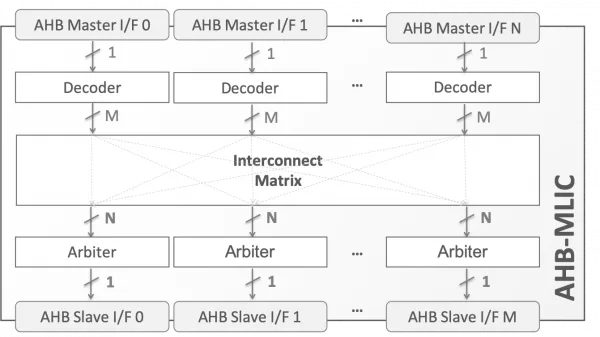
The multilayer fabric offers higher interconnect throughput than a typical AHB bus, as arbitration is performed at the slave port and therefore masters do not compete for bus control. In practice, each master accesses the peripherals connected to the slave ports via a dedicated bus, and only competes with others when they attempt to access the same peripheral at the same time. 

The highly-configurable AHB-MLIC allows users not only to define the number of master ports and the number of slave ports, but also to define the slaves’ addresses per master port and the arbitration scheme per slave port. Also, it is possible to enable or disable slave access per master. To ease the core configuration, the deliverables include a software application that enables users to configure the fabric via an intuitive HTML interface and automatically generate the corresponding Verilog parameter values.  

The LINT-clean and scan-ready AHB-MLIC core is extensively verified and proven in multiple production designs. It can be mapped to any ASIC or FPGA, provided sufficient silicon resources are available, and it is delivered with everything required for successful implementation including a test-bench and comprehensive documentation. 

The AHB-MLIC as delivered is warranted against defects for ninety days from purchase. Thirty days of phone and email technical support are included, starting with the first interaction. Additional maintenance and support options are available. 
 

Key features

  • Configurable AMBA® 3 AHB Interconnect Fabric
    • Arbitrary number of AHB-Lite master ports 
    • Full AHB masters can also be connected 
    • Arbitrary number of AHB slave ports
    • User-defined slave to master mapping 
    • Slaves access can be disabled to one or more masters.
    • User-defined slave address per master 
    • A slave address can be different between masters.
    • Round-robin or priority-based arbitration selectable per slave 
    • AHB data bus-width (8 to 1024 bits)
  • Higher Throughput 
    • Less arbitration overhead between masters, as arbitration is done at each slave port
  • Easy to Use and Integrate 
    • Requires no run-time programming or initialization 
    • HTML configuration tool generates Verilog parameters 
    • Fully synchronous, scan-ready, LINT-clean design
    • Delivered with sample scripts, RTL testbench and sample test-cases

Block Diagram

Specifications

Identity

Part Number
AHB-MLIC
Vendor
CAST
Type
Silicon IP

Files

Note: some files may require an NDA depending on provider policy.

Provider

HQ: USA

Learn more about Bus Fabric IP core

From Classical CAN and CAN FD to CAN XL: Functional Safety and Security for Next-Generation In-Vehicle Communication

This article reviews the functional-safety attributes of Classical CAN and CAN FD, then explains how CAN XL preserves and extends them. It also discusses higher-layer safety protocols, fault-tolerant CAN XL controller implementations, and CANsec, the CAN XL security extension inspired by the MACsec model. Finally, it highlights how the CAST CAN XL controller IP and CANsec acceleration IP can support the efficient deployment of safety- and security-capable in-vehicle networks.

Moving to AMBA® 5? Your AMBA® 4 IP Can Still Come With You

As SoC architectures adopt AMBA® 5 fabrics and components, many proven IP blocks still rely on AMBA® 4 or earlier interfaces. That creates a common integration problem: how do designers connect newer AMBA® 5 system components to existing IP without redesigning the IP or replacing verified blocks?

A Time Scaling Theory for Multi-Layer Electronic Systems

For six decades, Moore's geometric scaling drove progress in semiconductors. That industry compact no longer holds: returns from pure dimensional shrinking have flattened, leading-edge design budgets exceed one billion dollars per chip, and cost-per-transistor at the most advanced nodes is no longer falling.

CSoC Platform / Digital Subsystem IP for IoT

This paper describes a CSoC platform and configurable digital subsystem IP which can be deployed for development of IOT edge devices. The paper encompasses the different attributes of IOT edge device that can cater multiple industry segments, key features and benefits of CSoC platform, components of the digital subsystem IP that enables rapid prototyping of SoCs for IOT applications.

Secure Mobile Payments - Protecting display data in TrustZone-enabled SoCs with the Evatronix PANTA Family of Display Processors

Secure System-on-Chips (SoCs) based on ARM® TrustZone® technology enable both hardware and software components to be isolated as a secure subsystem within a complex SoC and as such focus on processing protected, sensitive and valuable assets, such as payment credentials, whenever these might be endangered with an attack, modification or capture. At the same time the main system software may be an open Rich OS platform that enables downloading and use of arbitrary third-party and non-trusted applications which can gain access to almost all system hardware elements.

Frequently asked questions about On-Chip Bus IP cores

What is AHB Multilayer Interconnect?

AHB Multilayer Interconnect is a Bus Fabric IP core from CAST listed on Semi IP Hub.

How should engineers evaluate this Bus Fabric?

Engineers should review the overview, key features, supported foundries and nodes, maturity, deliverables, and provider information before shortlisting this Bus Fabric IP.

Can this semiconductor IP be compared with similar products?

Yes. Buyers can compare this product with similar semiconductor IP cores or IP families based on category, provider, process options, and structured technical specifications.

×
Semiconductor IP