Toki: Profiling HBM Performance on FPGA Systems with RISC-V Soft Cores and PCIe Host DMA Traffic
By Andrea Galimberti, Andrea Motta, Gianni Antichi, Davide Zoni
Politecnico di Milano, Milan, Italy
Abstract
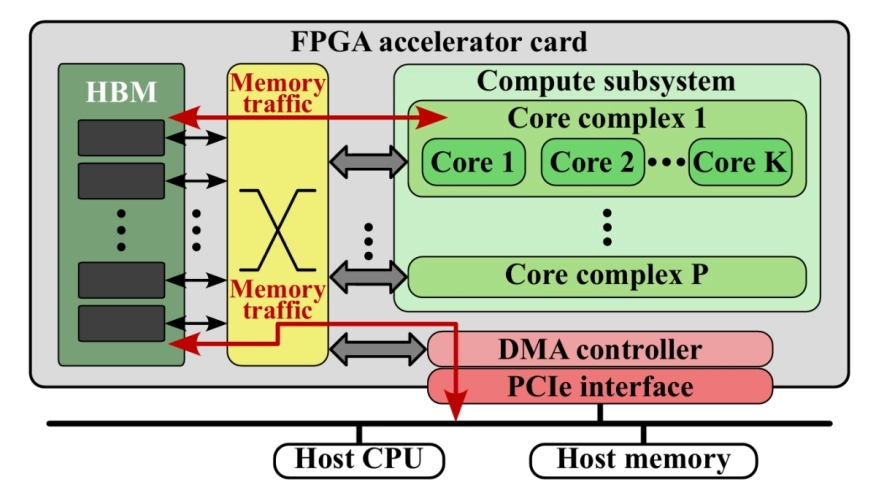
Programmable RISC-V soft cores are becoming more widespread in data-center scenarios, making it crucial to design efficient systems that deploy them on FPGA chips with HBM memory. Toki, released as open source, is the first hardware-software framework that enables profiling the performance of HBM on FPGA accelerator cards by jointly considering (i) the execution of workloads on RISC-V soft cores instantiated on the FPGA and (ii) the injection of memory traffic from the host system via DMA over PCIe, providing insights that cannot be obtained with synthetic traffic generators alone. Extensive experiments target an AMD Alveo U55C card, deploying up to 60 RISC-V compute cores and stressing its HBM2 memory through real-world applications and microbenchmarks with user-defined access patterns. Results showcase how Toki can effectively profile the impact on HBM performance of the compute cores' organization, the workload's memory access patterns, data locality, contention over the memory controllers, and host traffic.
To read the full article, click here
Related Semiconductor IP
- UALink 200G v1.0 Verification IP
- CCSDS SCCC Demapper and Turbo Decoder
- NPU IP
- JPEG XL Encoder
- I2C Master/Slave Controller Core
Related Articles
- A RISC-V Multicore and GPU SoC Platform with a Qualifiable Software Stack for Safety Critical Systems
- Balancing Power and Performance With Task Dependencies in Multi-Core Systems
- Retention-Aware RISC-V ISA Extension and Memory Controller on FPGA for MLC NVM
- Interstellar: Fully Partitioned and Efficient Security Monitoring Hardware Near a Processor Core for Protecting Systems against Attacks on Privileged Software
Latest Articles
- Anechoic: Onsager-Corrected Parallel Annealing for Sub-0.1 ms Dense Max-Cut on an FPGA
- Power, Performance, and Area of HPC-Based Malware Detectors: An FPGA and Open-PDK ASIC Study
- Terracotta: Enabling the Adoption of New DRAM Techniques via a Flexible DRAM Interface and Memory Controller
- A Framework for Accelerating Transformer Inference on RISC-V for Edge AI
- An Interleaved Parallel Dependent Quantization Hardware Architecture for H.266/VVC