Balancing Power and Performance With Task Dependencies in Multi-Core Systems
By Gokhan Akgun and Diana Göhringer
Technische Universität Dresden, Germany
Abstract:
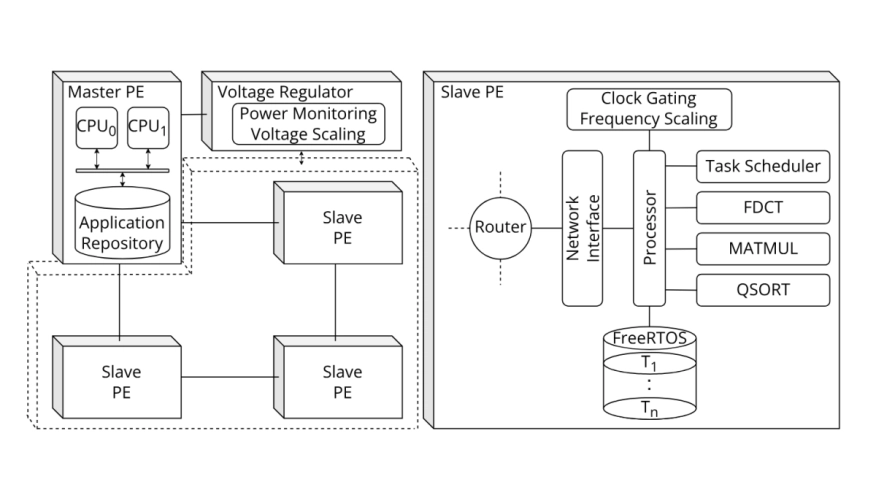
The increasing use of FPGAs necessitates energy-efficient solutions, particularly for battery-powered applications. Although power dissipation is often perceived as a hardware issue, it can be mitigated through power-saving techniques such as dynamic voltage and frequency scaling and clock gating. In real-time systems, these strategies must reduce the power consumption and meet strict timing requirements to avoid deadline violations. However, hardware constraints and variability in execution times complicate their implementation, particularly in multi-core systems where task dependencies and inter-processor communication introduce delays and unpredictability. Real-time Operating Systems (RTOSs) manage task execution using scheduling algorithms, periodically checking task queues during context switches. Incoming messages trigger sporadic tasks that the RTOS must prioritize immediately, while regular tasks are executed, or power-saving strategies are applied during idle phases. Handling these diverse tasks in multi-core systems adds complexity, making it challenging to balance between predictability, energy efficiency, and system performance. This work introduces a heterogeneous multi-core architecture that integrates power-aware task scheduling algorithms, such as the Look-Ahead algorithm or Race-to-Idle strategy, to optimize power consumption while addressing task dependencies and inter-core communication. A hardware-based task scheduler improves scheduling performance and predictability, while tasks leverage the reconfigurable capabilities of FPGAs and are executed as hardware accelerators to further enhance energy efficiency. The experimental results demonstrate an improvement in scheduling performance of 64.91% and energy efficiency of 92% compared to a baseline without power optimization, highlighting the effectiveness of the proposed approach.
To read the full article, click here
Related Semiconductor IP
- NPU IP
- JPEG XL Encoder
- I2C Master/Slave Controller Core
- NVMe Validation Test Suite
- Hybrid Memory Cube Verification IP
Related Articles
- A RISC-V Multicore and GPU SoC Platform with a Qualifiable Software Stack for Safety Critical Systems
- Achieving Lower Power, Better Performance, And Optimized Wire Length In Advanced SoC Designs
- Toki: Profiling HBM Performance on FPGA Systems with RISC-V Soft Cores and PCIe Host DMA Traffic
- How silicon and circuit optimizations help FPGAs offer lower size, power and cost in video bridging applications
Latest Articles
- Terracotta: Enabling the Adoption of New DRAM Techniques via a Flexible DRAM Interface and Memory Controller
- A Framework for Accelerating Transformer Inference on RISC-V for Edge AI
- An Interleaved Parallel Dependent Quantization Hardware Architecture for H.266/VVC
- A Formal Security Analysis of CAN XL
- A Secure dToF LiDAR SoC with Dual-Domain Fingerprinting and Event-Driven AFE Circuit Achieving Sensor-Level Attack Resilience