LIB-TRAP: Standard Cell Library Hardware Trojan Risk Assessment and Prevention
By Harish Kumar Dharavath, Md Muhtasim Alam Chowdhury, Rozhin Yasaei, Soheil Salehi
University of Arizona, USA
Abstract
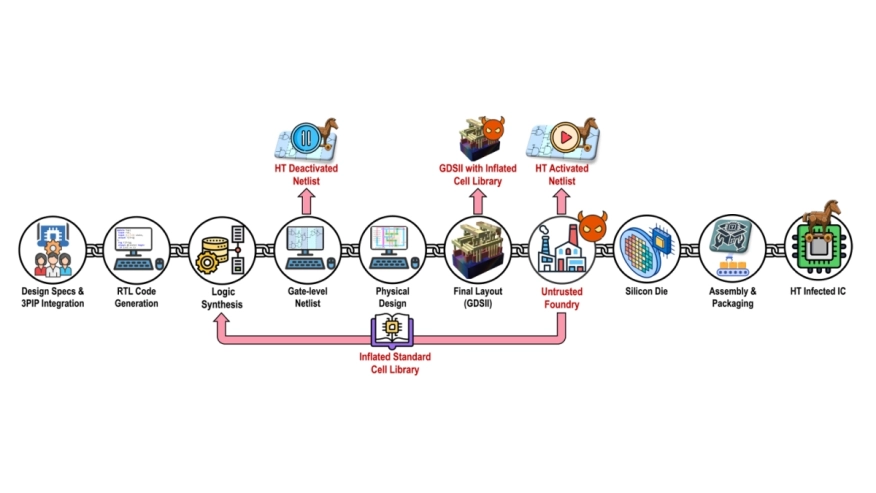
Vulnerabilities inherent to the fabless semiconductor manufacturing model have significantly increased the risk of malicious Hardware Trojan (HT) insertion, posing severe threats to hardware security. Several HT mitigation and detection strategies have been developed, and existing works explore the insertion of HTs in the space between standard cells in an integrated circuit. However, there is a lack of research into the vulnerabilities posed by the building blocks of most digital designs on the market today, the standard cells. This work investigates a novel threat model in which standard cells are considered untrusted. Our proposed threat model provides the design house with a tampered standard cell library. The intended netlist is synthesized and implemented using the tampered library. During fabrication, a nefarious foundry replaces the library's deactivated HT cells with activated counterparts. Using open-source and industry-standard Electronic Design Automation (EDA) tools, existing standard cell libraries, Saed32nm and Sky130nm, are converted into malicious libraries capable of masking the presence of arbitrary HTs from IC designers. The malicious library is then applied and characterized in multiple standard benchmark designs. To demonstrate the efficacy and stealthiness of this standard cell-based attack vector, three benchmark circuits, an AES-128 encryption core, an Ethernet controller, and a WISHBONE DMA engine, were synthesized using both clean and Trojan-infected libraries across Synopsys 32nm and SkyWater 130nm technologies. Design-level features, including total cell count, total area, dynamic power consumption, and static power, were extracted from these synthesized circuits to serve as inputs for binary classification
To read the full article, click here
Related Semiconductor IP
- NPU IP
- JPEG XL Encoder
- I2C Master/Slave Controller Core
- NVMe Validation Test Suite
- Hybrid Memory Cube Verification IP
Related Articles
- A Survey on the Design, Detection, and Prevention of Pre-Silicon Hardware Trojans
- Designing Low Power Standard Cell Library With Improved Drive Granularity
- Choosing the best Standard Cell Library without falling into the traps of traditional benchmarking methods
- Library promotes common standard for design properties
Latest Articles
- Terracotta: Enabling the Adoption of New DRAM Techniques via a Flexible DRAM Interface and Memory Controller
- A Framework for Accelerating Transformer Inference on RISC-V for Edge AI
- An Interleaved Parallel Dependent Quantization Hardware Architecture for H.266/VVC
- A Formal Security Analysis of CAN XL
- A Secure dToF LiDAR SoC with Dual-Domain Fingerprinting and Event-Driven AFE Circuit Achieving Sensor-Level Attack Resilience