A Centralized Performance Monitoring Architecture for Heterogeneous Multicore SoCs
By Mohammed Sajjad Jafri, Abdur Rahman, Emon Sarkar, Mahdi Hassen, Gopishankar Thayyil, Ashwin Krishna Mani, Rodolfo Pellizzoni
University of Waterloo, Waterloo, Canada
Abstract
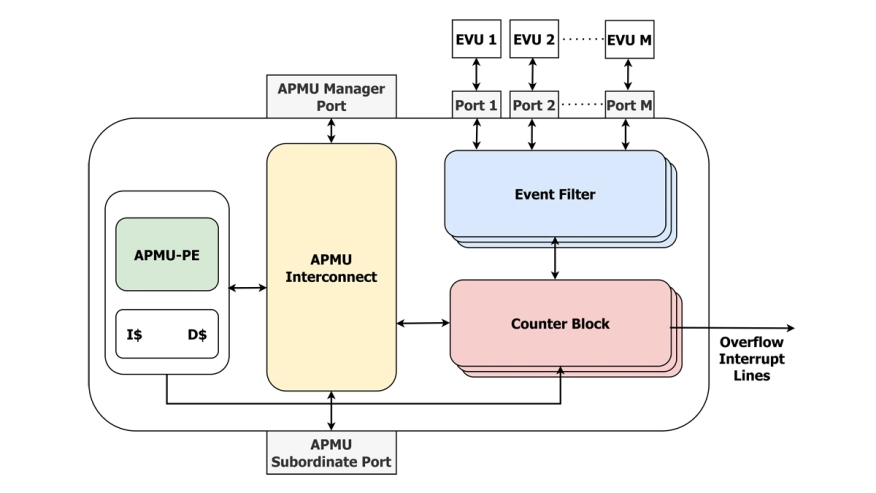
Hardware Performance Counters (HPCs) are widely used to enable event-driven software mechanisms such as profile guided optimization, performance analysis, and dynamic resource management in real-time systems. However, in modern embedded System-on-a-Chip (SoCs), different components - including processors, accelerators, interconnects, and memory controllers - typically implement separate and heterogeneous HPC modules. This distributed monitoring infrastructure requires multiple software interfaces and complicates the collection, synchronization, and correlation of performance data across the system. In this work, we propose a centralized performance monitoring architecture to efficiently collect, correlate, and process architectural events across multiple hardware components. Our design introduces Event Monitoring Units (EVUs) that capture and forward microarchitectural events to an Advanced Performance Monitoring Unit (APMU). The APMU integrates programmable counters and a specialized processing element to support flexible, event-driven software mechanisms. We implement our design for an AXI4-based system and integrate it into a RISC-V based SoC platform, which lacks advanced cross-component performance monitoring support. We demonstrate the effectiveness of our approach through case studies on real-time resource regulation, application profiling, and counter attribution.
To read the full article, click here
Related Semiconductor IP
- RISC-V Debug & Trace IP
- RISC-V IOPMP IP
- Gen#2 of 64-bit RISC-V core with out-of-order pipeline based complex
- 64-bit RISC-V core with in-order single issue pipeline. Tiny Linux-capable processor for IoT applications.
- Multi-core capable RISC-V processor with vector extensions
Related Articles
- Using dynamic run-time scheduling to improve the price-performance-power efficiency of heterogeneous multicore SoCs
- MultiVic: A Time-Predictable RISC-V Multi-Core Processor Optimized for Neural Network Inference
- SynapticCore-X: A Modular Neural Processing Architecture for Low-Cost FPGA Acceleration
- IMS: Intelligent Hardware Monitoring System for Secure SoCs
Latest Articles
- RFChipAgent: Multi-Agentic AI Flow for Analog/RF Chip Design
- Anechoic: Onsager-Corrected Parallel Annealing for Sub-0.1 ms Dense Max-Cut on an FPGA
- Power, Performance, and Area of HPC-Based Malware Detectors: An FPGA and Open-PDK ASIC Study
- Terracotta: Enabling the Adoption of New DRAM Techniques via a Flexible DRAM Interface and Memory Controller
- A Framework for Accelerating Transformer Inference on RISC-V for Edge AI