A Low-Latency ASIC Architecture for Real-Time Line Segment Detection
By Amir Hossein Jalilvand 1, Parsa Hassani Shariat Panahi 1, M. Hassan Najafi 2
1 School of Computer Engineering, Iran University of Science and Technology, Tehran, Iran
2 Electrical, Computer, and Systems Engineering Department, Case Western Reserve University, OH, USA
Abstract
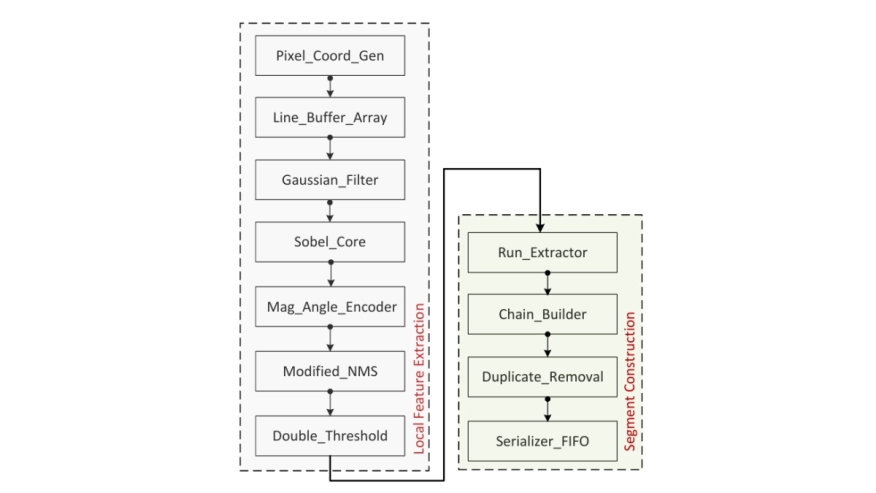
Line segment detection is a critical preprocessing step in embedded vision applications such as autonomous navigation, visual SLAM, and industrial inspection. Deep learning methods achieve high accuracy but require substantial resources, limiting their deployment on resource-constrained platforms. Classical algorithms are efficient but exhibit content-dependent latency. This paper presents a low-latency ASIC architecture for real-time line segment detection. The proposed design is based on the step-length algorithm and incorporates five ASIC-specific features: register-based line buffering with data reuse, multiplierless MCM-based filtering, 8-class angle quantization, a CAM-like associative memory for single-cycle matching, and an optimized duplicate removal mechanism. The architecture is fully pipelined and processes one pixel per clock cycle with deterministic latency. Synthesized in a 45nm CMOS process, the design achieves 325 FPS at VGA resolution and 48 FPS at Full HD, with 25.54 mW power consumption and 0.412 mm\textsuperscript{2} area. At 125 MHz, the throughput increases to 406 FPS at VGA resolution with 31.48 mW power consumption. Compared with a 90nm ASIC implementation based on the Line Hough Transform, the proposed design reduces power consumption by 49\% and delivers over 1.6 times higher frame rate. The architecture is well suited for edge-computing applications requiring real-time performance, low power, and minimal area.
Index Terms — line segment detection (LSD), ASIC design, hardware accelerator, real-time vision, low-power design, edge computing.
To read the full article, click here
Related Semiconductor IP
- NPU IP
- JPEG XL Encoder
- I2C Master/Slave Controller Core
- NVMe Validation Test Suite
- Hybrid Memory Cube Verification IP
Related Articles
- Mapping LMS Adaptive Filter IP Core to Multiplier-Array FPGA Architecture for High Channel-Density VOIP Line Echo Cancellation
- Real-Time Face Detection Using Six-Segmented Rectangular Filter (SSR Filter)Real-Time Face Detection Using Six-Segmented Rectangular Filter (SSR Filter)
- Build Complex ASICs Without ASIC Design Expertise, Expensive Tools - Take advantage of an architecture comparable to your original FPGA prototype design by migrating to a structured ASIC
- A Real-Time Image Processing with a Compact FPGA-Based Architecture
Latest Articles
- Terracotta: Enabling the Adoption of New DRAM Techniques via a Flexible DRAM Interface and Memory Controller
- A Framework for Accelerating Transformer Inference on RISC-V for Edge AI
- An Interleaved Parallel Dependent Quantization Hardware Architecture for H.266/VVC
- A Formal Security Analysis of CAN XL
- A Secure dToF LiDAR SoC with Dual-Domain Fingerprinting and Event-Driven AFE Circuit Achieving Sensor-Level Attack Resilience