Reducing Power Consumption of Embedded Dynamic Memories with ECCs
By Wenqing Song, Yifei Shen, Andreas Burg
EPFL, Switzerland
Abstract
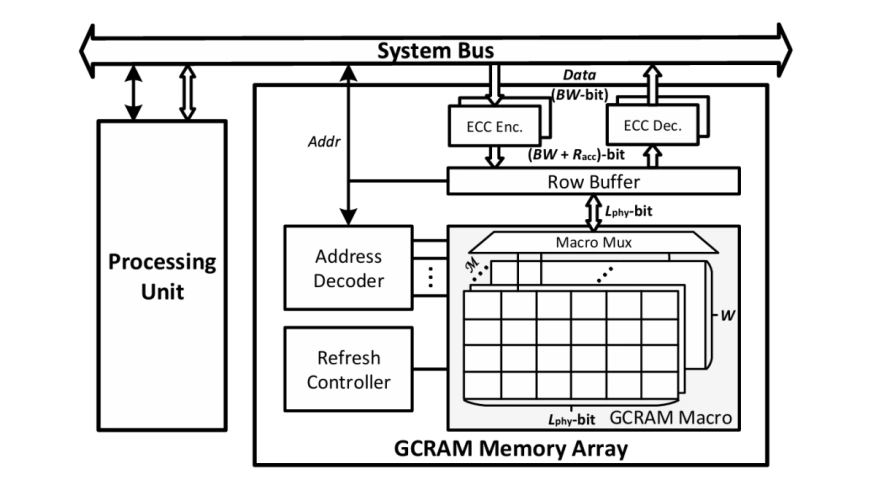
Gain-cell embedded dynamic random-access memory (GCRAM) offers dense and energy-efficient on-chip storage, but retention-time variations force frequent refresh operations to cover worst-case bits. Error-correction codes (ECCs) can alleviate this limitation by masking bit errors from weak cells and thereby reduce refresh cost. However, the trade-off between the additional access and logic energy introduced by ECCs and the power savings from longer refresh intervals is nontrivial, especially considering the wide range of available ECC options. To optimize overall power consumption, we propose an ECC selection method that combines a refresh-interval model with power analysis to identify the minimum-power ECC configurations under a given yield constraint. Across different memory bandwidths, activity factors, and read/write ratios, the evaluation results show that the best ECC option shifts from stronger codes in refresh-dominated operating regions to lower-overhead codes in access-dominated regions and achieves 46.8% to 94.8% reduction in total power relative to the no-ECC reference.
Index Terms — ECC, GCRAM, reliability, power optimization
To read the full article, click here
Related Semiconductor IP
- Elliptic Curve Point Multiply and Verify Core
- high-performance solution for elliptic curve cryptography
- BCH ECC Core IP
- NIST P-256/P-384 ECDH+ECDSA - Compact ECC IP Cores supporting ECDH and ECDSA on NIST P-256/P-384
- Error Correction Checking (ECC) Core
Related Articles
- How Low Can You Go? Pushing the Limits of Transistors - Deep Low Voltage Enablement of Embedded Memories and Logic Libraries to Achieve Extreme Low Power
- Reducing Power Consumption while increasing SoC Performance
- Reducing IC power consumption: Low-power design techniques
- Revolutionizing Consumer Electronics with the power of AI Integration
Latest Articles
- Terracotta: Enabling the Adoption of New DRAM Techniques via a Flexible DRAM Interface and Memory Controller
- A Framework for Accelerating Transformer Inference on RISC-V for Edge AI
- An Interleaved Parallel Dependent Quantization Hardware Architecture for H.266/VVC
- A Formal Security Analysis of CAN XL
- A Secure dToF LiDAR SoC with Dual-Domain Fingerprinting and Event-Driven AFE Circuit Achieving Sensor-Level Attack Resilience