Overview
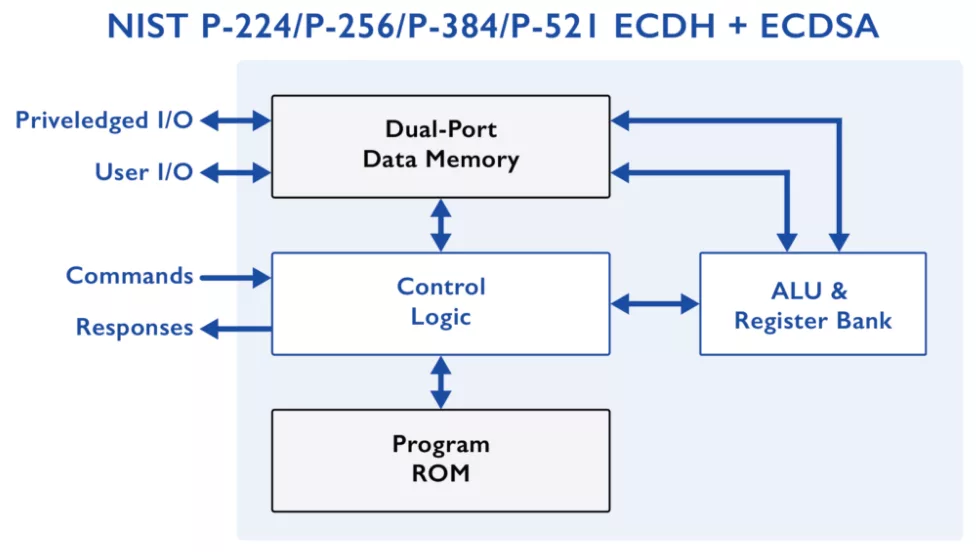
XIP41x3C are a family of compact Intellectual Property (IP) cores implementing Elliptic Curve Diffie-Hellman (ECDH) and Elliptic Curve Digital Signature Algorithm (ECDSA) on NIST prime curves [2]. ECDH and ECDSA on NIST prime curves are widely used in various cryptographic protocols and systems.
The XIP41x3C family currently includes two IP cores:
- XIP4123C for ECDH and ECDSA on the NIST P-256 elliptic curve and
- XIP4133C for ECDH and ECDSA on the NIST P-384 elliptic curve.
These two curves are the most commonly used NIST curves today. XIP41x3C has been designed for easy integration with FPGA- and ASIC-based designs in a vendor-agnostic design methodology, and the functionality of XIP41x3C does not rely on any FPGA manufacturer-specific features
Functionality
XIP41x3C can be used for elliptic curve key generation, computation of Diffie-Hellman shared secrets as well as for ECDSA signature generation and verification. Hence, they are very versatile IP cores that can be used in a variety of cryptographic protocols and systems. The NIST prime curves are arguably still the most used elliptic curves and it is common for practical systems using ECC to support P-256 and/or P-384.
The main optimization objective for XIP41x3C has been on reducing the resource requirements and XIP41x3C require only very few resources considering the complexity of the operations that they support. They also include various security checks for the input values that prevent acci dental misuses that could compromise the security of the cryptosystem. These include validations that the input points are in fact a valid point on the curve and in-built prevention of accidential misuse of values that should be used only once (ECDSA nonces). XIP41x3C also include protections against side-channel attacks, the most important of which is the fully constant-time operation of all operations that use secret values.
XIP41x3C implements the main elliptic curve operations. XIP41x3C requires an external random number generator (for example, XIP8001B) and ECDSA also requires an external hash function.
Learn more about Public Key IP core
Xiphera announces the launch of nQrux® Root of Trust, the latest addition to its nQrux® product family. Designed for ASIC and SoC implementations, the new IP provides a hardware-based foundation of trust for secure hardware systems.
Trust is the foundation of any secure computing system, but that trust has to start somewhere. This article explores the role of a Hardware Root of Trust, why that starting point must be built into hardware, and why it matters more than ever as device lifecycles grow longer, the EU Cyber Resilience Act introduces new security requirements, and the transition to quantum-resistant cryptography moves forward.
Xiphera has achieved ISO/IEC 27001:2022 certification, the internationally recognised standard for information security management, following an independent audit conducted by Into Certification Oy, an accredited certification body and subsidiary of Into Security Oy.
Japan is a focus market for Xiphera’s cryptographic hardware security solutions, and we are pleased to welcome Yasuhiro Okumura as our new Country Manager for Japan. His appointment strengthens our local presence and supports our continued growth in the region.
The project will develop a high-speed security IP core for optical satellite links, enabling secure data transfer at speeds of up to 100 Gbit/s. The technology is intended to support future satellite constellations and space systems that require both high-performance communications and strong cybersecurity.
The integration of Xiphera’s digital cryptographic cores and Agile Analog’s agileSecure anti-tamper sensor IP creates a unified defense solution for the next generation of semiconductor security. This is particularly important as the industry transitions to Post-Quantum Cryptography (PQC).