Quantifying Uncertainty in FMEDA Safety Metrics: An Error Propagation Approach for Enhanced ASIC Verification
By Antonino Armato 1, Christian Kehl 2, Sebastian Fischer 2
1 Functional Safety, Robert Bosch GmbH, Milan,Italy
2 Functional Safety, Robert Bosch GmbH, Reutlingen, Germany
Abstract
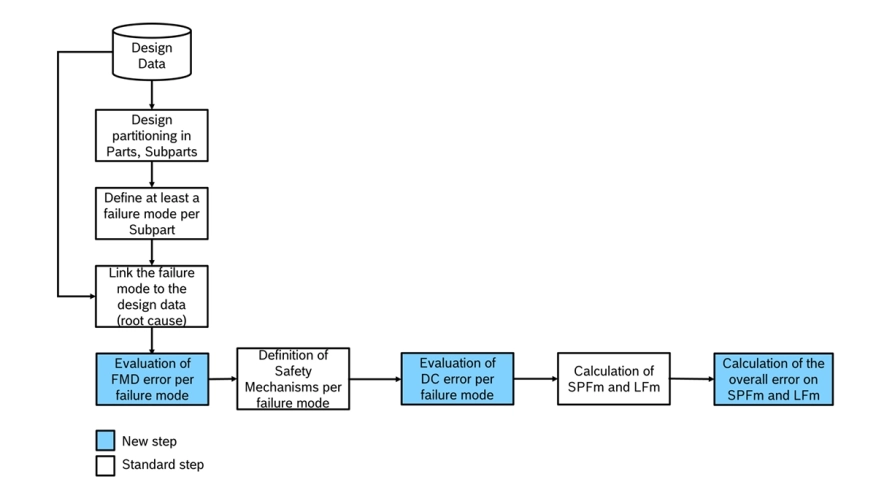
Accurate and reliable safety metrics are paramount for functional safety verification of ASICs in automotive systems. Traditional FMEDA (Failure Modes, Effects, and Diagnostic Analysis) metrics, such as SPFM (Single Point Fault Metric) and LFM (Latent Fault Metric), depend on the precision of failure mode distribution (FMD) and diagnostic coverage (DC) estimations. This reliance can often leads to significant, unquantified uncertainties and a dependency on expert judgment, compromising the quality of the safety analysis. This paper proposes a novel approach that introduces error propagation theory into the calculation of FMEDA safety metrics. By quantifying the maximum deviation and providing confidence intervals for SPFM and LFM, our method offers a direct measure of analysis quality. Furthermore, we introduce an Error Importance Identifier (EII) to pinpoint the primary sources of uncertainty, guiding targeted improvements. This approach significantly enhances the transparency and trustworthiness of FMEDA, enabling more robust ASIC safety verification for ISO 26262 compliance, addressing a longstanding open question in the functional safety community.
To read the full article, click here
Related Semiconductor IP
- NPU IP
- JPEG XL Encoder
- I2C Master/Slave Controller Core
- NVMe Validation Test Suite
- Hybrid Memory Cube Verification IP
Related Articles
- Efficient methodology for design and verification of Memory ECC error management logic in safety critical SoCs
- SV-LLM: An Agentic Approach for SoC Security Verification using Large Language Models
- How a Standardized Approach Can Accelerate Development of Safety and Security in Automotive Imaging Systems
- A 0.32 mm² 100 Mb/s 223 mW ASIC in 22FDX for Joint Jammer Mitigation, Channel Estimation, and SIMO Data Detection
Latest Articles
- Terracotta: Enabling the Adoption of New DRAM Techniques via a Flexible DRAM Interface and Memory Controller
- A Framework for Accelerating Transformer Inference on RISC-V for Edge AI
- An Interleaved Parallel Dependent Quantization Hardware Architecture for H.266/VVC
- A Formal Security Analysis of CAN XL
- A Secure dToF LiDAR SoC with Dual-Domain Fingerprinting and Event-Driven AFE Circuit Achieving Sensor-Level Attack Resilience