VIPER: Architecture-Aware Performance Modeling for Processing-in-Memory Design-Space Exploration
By Haoran Geng †, Tomas Sousa Pereira †, Xiaoyang Lu ‡, Xian-He Sun ‡, Michael Niemier †, and X. Sharon Hu †
† University of Notre Dame, Notre Dame, IN, USA
‡ Illinois Institute of Technology, Chicago, IL, USA
Abstract
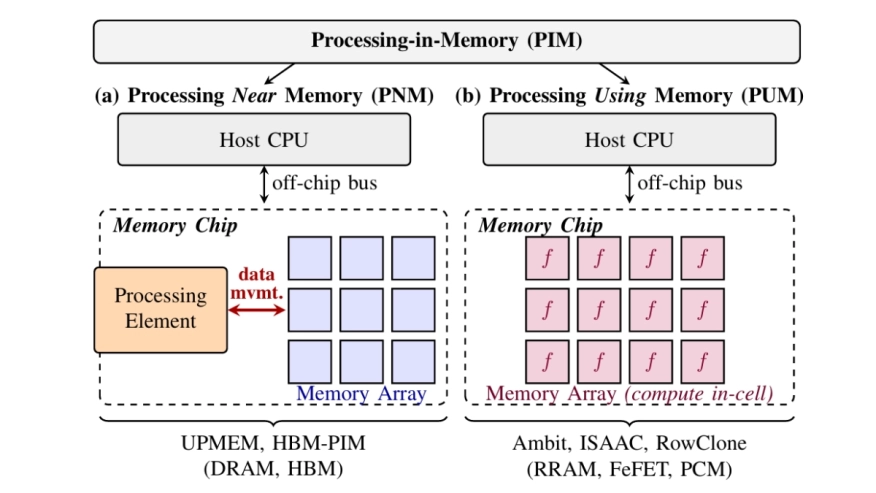
Processing-in-Memory (PIM) promises to reduce data movement overhead by executing computation in or near memory, but its realized application speedup remains highly design-dependent. Non-offloadable host execution, host-PIM transfers, limited PIM capacity, and device programming latency can limit end-to-end speedup, making fast early-stage design-space exploration (DSE) essential. However, existing PIM evaluation methods remain limited: circuit- and device-level tools cannot capture these end-to-end PIM performance factors, while cycle-accurate simulation is too slow for iterative DSE. To address this gap, we present VIPER, a unified, lightweight, and architecture-aware performance evaluation framework for PIM DSE. VIPER profiles host execution once and combines the measured host behavior with a PIM-aware analytical engine that sweeps PIM-side parameters across candidate designs. It supports both Processing Near Memory (PNM) and Processing Using Memory (PUM) under task-offloading and data-triggered execution by capturing host-PIM transfer, array access, in-memory computation, device programming latency, and capacity-induced partitioning, providing rapid architecture-aware performance estimates for iterative DSE without repeated cycle-accurate simulation. We validate VIPER against a commercial UPMEM system and more than 400 cycle-accurate gem5 configurations. VIPER predicts the UPMEM offloading decision and break-even region a priori, and, with a refined transfer model, captures the measured peak-and-rolloff behavior with 12\% mean speedup error across the DPU sweep (6% up to the 256-DPU peak). Against gem5, VIPER achieves less than 10% error while reducing evaluation time from hours to under one minute. Case studies of UPMEM, ReRAM/FeFET crossbars, and IMCRYPTO show that architecture-aware DSE reveals key performance trade-offs that device-level evaluation misses.
To read the full article, click here
Related Semiconductor IP
- UMC 55nm ULP 3.3V Temperature Sensor
- High-Throughput Multi-Channel DMA Controller
- Configurable Multi-Channel DMA Controller
- Fixed-Channel Multi-Channel DMA Controller
- Verification IP for MIPI SoundWire
Related Articles
- Modeling and Optimizing Performance Bottlenecks for Neuromorphic Accelerators
- Simultaneous Exploration of Power, Physical Design and Architectural Performance Dimensions of the SoC Design Space using SEAS
- SystemC: Key modeling concepts besides TLM to boost your simulation performance
- A Performance Architecture Exploration and Analysis Platform for Memory Sub-systems
Latest Articles
- Cryogenic Recharacterization of a Commercial 22 nm FD-SOI Foundry Standard-Cell Library
- A 105 MS/s 4.18 nJ/inference 0.765 mm² Mixed-Signal Streaming ML Engine for Wireless Baseband in 12LP+ FinFET
- Agentic AI for Heterogeneous System Design Across Chip, Scale-Up, and Scale-Out Domains
- Minimum RISC-V: Maximum FPGA Efficiency
- The Era of Vibe Tapeout: Dark Age or Golden Age for Analog Circuit Design?