MultiVic: A Time-Predictable RISC-V Multi-Core Processor Optimized for Neural Network Inference
By Maximilian Kirschner 1,2, Konstantin Dudzik 1,2, Ben Krusekamp 1,2, and Jürgen Becker 1,2
1 FZI Research Center for Information Technology, Karlsruhe, Germany
2 Karlsruhe Institute for Information Technology, Karlsruhe, Germany
Abstract
Real-time systems, particularly those used in domains like automated driving, are increasingly adopting neural networks. From this trend arises the need for high-performance hardware exhibiting predictable timing behavior. While state-of-the-art real-time hardware often suffers from limited memory and compute resources, modern AI accelerators typically lack the crucial predictability due to memory interference.
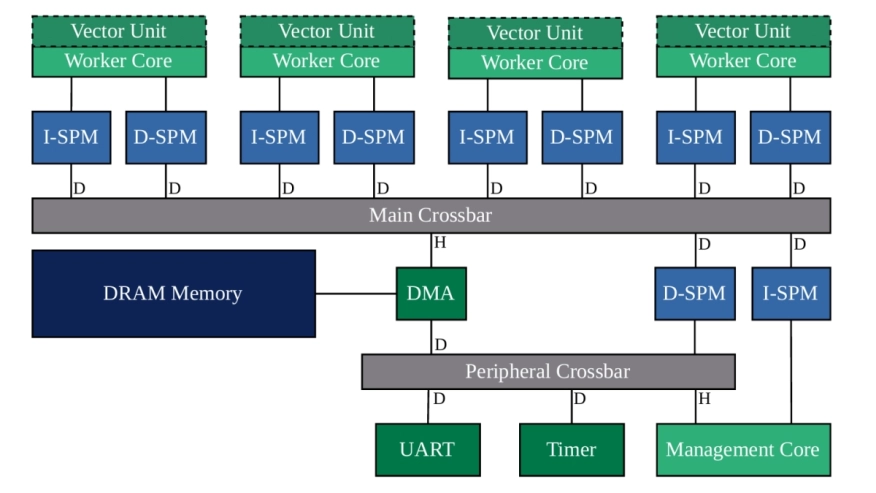
We present a new hardware architecture to bridge this gap between performance and predictability. The architecture features a multi-core vector processor with predictable cores, each equipped with local scratchpad memories. A central management core orchestrates access to shared external memory following a statically determined schedule.
To evaluate the proposed hardware architecture, we analyze different variants of our parameterized design. We compare these variants to a baseline architecture consisting of a single-core vector processor with large vector registers. We find that configurations with a larger number of smaller cores achieve better performance due to increased effective memory bandwidth and higher clock frequencies. Crucially for real-time systems, execution time fluctuation remains very low, demonstrating the platform's time predictability.
To read the full article, click here
Related Semiconductor IP
- RISC-V Debug & Trace IP
- RISC-V IOPMP IP
- Gen#2 of 64-bit RISC-V core with out-of-order pipeline based complex
- 64-bit RISC-V core with in-order single issue pipeline. Tiny Linux-capable processor for IoT applications.
- Multi-core capable RISC-V processor with vector extensions
Related Articles
- FPGA-Accelerated RISC-V ISA Extensions for Efficient Neural Network Inference on Edge Devices
- SNAP-V: A RISC-V SoC with Configurable Neuromorphic Acceleration for Small-Scale Spiking Neural Networks
- An FPGA-Based SoC Architecture with a RISC-V Controller for Energy-Efficient Temporal-Coding Spiking Neural Networks
- AIA: A 16nm Multicore SoC for Approximate Inference Acceleration Exploiting Non-normalized Knuth-Yao Sampling and Inter-Core Register Sharing
Latest Articles
- Terracotta: Enabling the Adoption of New DRAM Techniques via a Flexible DRAM Interface and Memory Controller
- A Framework for Accelerating Transformer Inference on RISC-V for Edge AI
- An Interleaved Parallel Dependent Quantization Hardware Architecture for H.266/VVC
- A Formal Security Analysis of CAN XL
- A Secure dToF LiDAR SoC with Dual-Domain Fingerprinting and Event-Driven AFE Circuit Achieving Sensor-Level Attack Resilience