64-bit RISC-V core with in-order single issue pipeline. Tiny Linux-capable processor for IoT applications.
64-bit RISC-V core with in-order single issue pipeline based complex.
Overview
64-bit RISC-V core with in-order single issue pipeline based complex. Tiny Linux-capable processor optimized for low power and small area. Ideally fits IoT applications requiring Linux.
SMP support
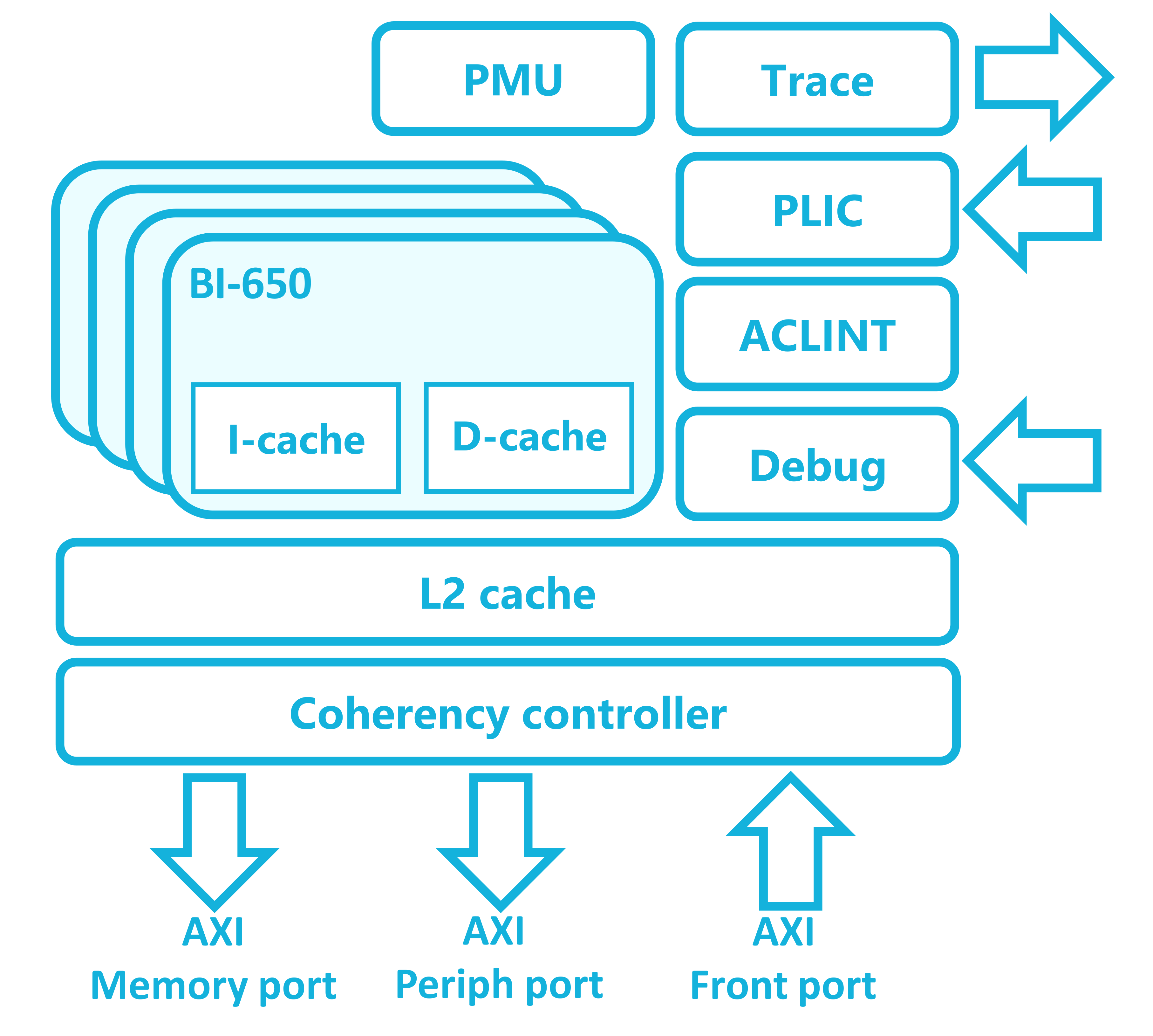
BI-650 has up to 4 cores, each with an L1 caches and a single shared L2 cache implementing fully coherent memory system. Memory coherency between cores allows to use core complex in SMP mode and run common operation system on all cores.
Coherency with peripherals and accelerators
Core complex has special AXI front port connected to coherency controller which provides coherent access for peripherals and accelerators to cached memory ranges simplifies software development and improves performance.
Memory subsystem
Fully non-blocking L1/L2 caches with out-of-order requests processing. Multiple "on-the-fly" requests in L1/L2 caches. L2 cache prefetcher with stride detection of stream and with configurable number of streams. Parallel hardware page table walk for several TLB misses. L1 and L2 TLBs.
Power management
Several power saving modes:
- After WFI instruction core stops its clock (WFI state)
- WFI state + core memories in retention state
- WFI state + core memories in shutdown state
- Core is power-off
- L2 cache memories are shutdown (with ¼ granularity)
- Core complex is power-off
Safe enter/exit from/to these modes:
- Cache flushes to prevent data loss
- "Wave"-based memories on/off
Test platform and software package
FPGA testbed for BI series includes complete set of tools to run OS Linux and communicate with it using Ethernet. All necessary software including Linux build, drivers and manuals are provided.
Development Tools
Complete set of RISC-V tools for fast and convenient software development. Compatible with upstream standard development and debug tools: OpenOCD, GCC, GDB, Eclipse. CloudBEAR also provides pre-configured Eclipse-based IDE with prebuilt toolchain and example projects for easy development start.
Key features
- Configurable instruction set architecture:
- 64-bit RISC-V with 32 integer registers (I extension)
- Integer multiplication and division (M extension)
- Atomic operation support (A extension)
- Compressed mode for better code density (C extension)
- IEEE 754-2008 compliant single precision floating point (F extension)
- IEEE 754-2008 compliant double precision floating point (D extension)
- Bit manipulation instructions support (B extension)
- Scalar cryptography instructions support (K extension)
- Digital signal processing instructions support (P extension)
- Decode: up to 1 instruction at cycle
- Execute: up to 1 instruction at cycle
- Up to 4 cores in complex
- Machine, Supervisor and User modes
- 8 stage in-order pipeline
- Advanced branch predictor: BTB, BHT, RAS
- Sv39 Virtual Memory support
- 4 to 32 KiB, 2 to 8-way L1 I-cache
- 4 to 32 KiB, 2 to 8-way L1 D-cache
- Integrated 128 KiB to 2 MiB L2 Cache
- L2 stride prefetcher
- Interrupts
- Platform Level Interrupt Controller (PLIC)
- Multi-Core Local Interruptor (CLINT): timer + software interrupts
- Local interrupt support to provide fast handling
- Core Local Interrupt Controller (CLIC)
- Non-Maskable Interrupts (NMIs)
- ECC memory protection (SEC-DED)
- Enhanced physical memory protection (Smepmp support)
- Integrated debug controller including HW breakpoints
- System bus access
- Compact JTAG support
- Trace support
- Power management support
- AXI system interface
- AXI peripheral interface
- AXI front-port interface for peripheral coherent access
- Performance
- 1.8 DMIPS/MHz
- 3.5 CoreMark/MHz
Block Diagram
Benefits
- SMP support and accelerator coherency
- BI-651 has up to 4 cores, each with an L1 caches and a single shared L2 cache implementing fully coherent memory system. Additional coherency controller provides coherent access for accelerators via AXI front port to cached memory ranges simplifies software development and improves performance.
- Development Tools
- Complete set of RISC-V tools for fast and convenient software development. Compatible with upstream standard development and debug tools: OpenOCD, GCC, GDB, Eclipse. CloudBEAR also provides pre-configured Eclipse-based IDE with prebuilt toolchain and example projects for easy development start.
- 3rd Party Development Tools
- IAR Embedded Workbench®
- SEGGER Embedded Studio for RISC-V
- TRACE32® debugger for RISC-V.
- Compatible Debug Probes
- BI-651 has integrated Debug module (compliant with RISC-V specification) that allows to use most of standard debug probes. The following debug probes are verified:
- Digilent HS2
- Digilent HS3
- Olimex ARM-USB-TINY
- Olimex ARM-USB-TINY-H
- Olimex ARM-USB-OCD
- Olimex ARM-USB-OCD-H
- SEGGER J-Link
- TRACE32® debugger for RISC-V
- BI-651 has integrated Debug module (compliant with RISC-V specification) that allows to use most of standard debug probes. The following debug probes are verified:
Specifications
Identity
Compute
Files
Note: some files may require an NDA depending on provider policy.

Provider
Learn more about CPU IP core
Announcing Arm AGI CPU: The silicon foundation for the agentic AI cloud era
ChiPy®: Bridge Neural Networks and C++ on Silicon — Full Inference Pipelines with Zero CPU Round-Trips
Unleashing Leading On-Device AI Performance and Efficiency with New Arm C1 CPU Cluster
Encarsia: Evaluating CPU Fuzzers via Automatic Bug Injection
Introducing Cortex-A320: Ultra-efficient Armv9 CPU Optimized for IoT
Frequently asked questions about CPU IP cores
What is 64-bit RISC-V core with in-order single issue pipeline. Tiny Linux-capable processor for IoT applications.?
64-bit RISC-V core with in-order single issue pipeline. Tiny Linux-capable processor for IoT applications. is a CPU IP core from CloudBEAR, LLC listed on Semi IP Hub.
How should engineers evaluate this CPU?
Engineers should review the overview, key features, supported foundries and nodes, maturity, deliverables, and provider information before shortlisting this CPU IP.
Can this semiconductor IP be compared with similar products?
Yes. Buyers can compare this product with similar semiconductor IP cores or IP families based on category, provider, process options, and structured technical specifications.