SPARC: Automated Root-Cause Analysis of Pre-Silicon Power Side-Channel Leakage in the Processor Design Flow
By Andrija Nešković, Christian Ewert, Mladen Berekovic, Saleh Mulhem
Institute of Computer Engineering, Universität zu Lübeck
Lübeck, Germany
Abstract
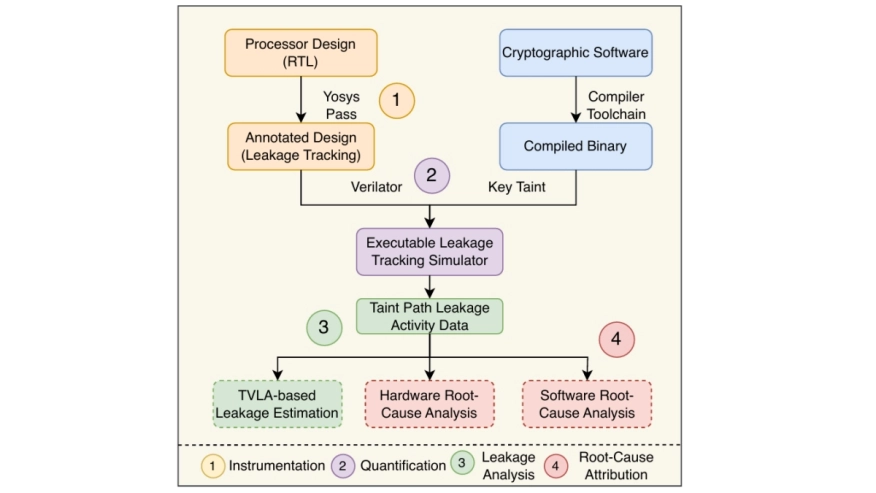
Power-Side-Channel Leakage (PSCL) originates from architectural and micro-architectural artifacts in a processor and poses a severe threat to the confidentiality of cryptographic software. Consequently, pre-silicon PSCL evaluation is indispensable for secure hardware design. Existing frameworks are either limited by poor simulation scalability or fail to attribute leakage to the correct hardware signals and software instructions, thereby impeding a comprehensive root-cause analysis. This paper presents SPARC, an automated framework for pre-silicon PSCL evaluation and root-cause analysis. SPARC leverages macro-cell-level Information Flow Tracking (IFT) augmented with enhanced shadow logic that tags switching activity originating from secret-dependent data. By isolating this activity, SPARC applies statistical leakage tests to detect PSCL, while simultaneously attributing the leakage to specific hardware signals and mapping those signals to the corresponding software instructions. This approach thus delivers a full end-to-end leakage evaluation and root-cause analysis for both hardware and software. To demonstrate and validate SPARC, PSCL of multiple open-source RISC-V CPUs, encompassing 32-bit and 64-bit cores with both in-order and out-of-order pipelines, is evaluated across a range of cryptographic workloads, including masked and unmasked AES and ML-KEM (CRYSTALS-Kyber-512). SPARC recovers known leakage sources as a sanity check and identifies specific microarchitectural leakage sources, achieving an 8x per-trace simulation speedup over previously shown approaches on comparable designs. By enabling precise and scalable root-cause analysis at the pre-silicon stage, this work provides a practical framework to mitigate PSCL early in the design flow, thereby strengthening the security of future processors.
Keywords: Power side-channel analysis, Information flow tracking, Pre-silicon evaluation, Root-cause analysis, RISC-V
To read the full article, click here
Related Semiconductor IP
- PQC HW/SW IP Core
- PUF-based Post-Quantum Cryptography (PQC) Solution
- Highly configurable HW PQC acceleration with RISC-V processor for full CPU offload
- Agile PQC Public Key Accelerator
- Highly configurable HW Lattice PQC ultra acceleration in AXI4 & PCIe systems
Related Articles
- The role of cache in AI processor design
- An Outline of the Semiconductor Chip Design Flow
- Understanding the Importance of Prerequisites in the VLSI Physical Design Stage
- The Growing Imperative Of Hardware Security Assurance In IP And SoC Design
Latest Articles
- Terracotta: Enabling the Adoption of New DRAM Techniques via a Flexible DRAM Interface and Memory Controller
- A Framework for Accelerating Transformer Inference on RISC-V for Edge AI
- An Interleaved Parallel Dependent Quantization Hardware Architecture for H.266/VVC
- A Formal Security Analysis of CAN XL
- A Secure dToF LiDAR SoC with Dual-Domain Fingerprinting and Event-Driven AFE Circuit Achieving Sensor-Level Attack Resilience