Breaking the HBM Bit Cost Barrier: Domain-Specific ECC for AI Inference Infrastructure
By Rui Xie †, Asad Ul Haq †, Yunhua Fang †, Linsen Ma †, Sanchari Sen ∗, Swagath Venkataramani ∗, Liu Liu †, Tong Zhang †
† Rensselaer Polytechnic Institute, NY, USA,
∗ IBM, NY, USA
Abstract
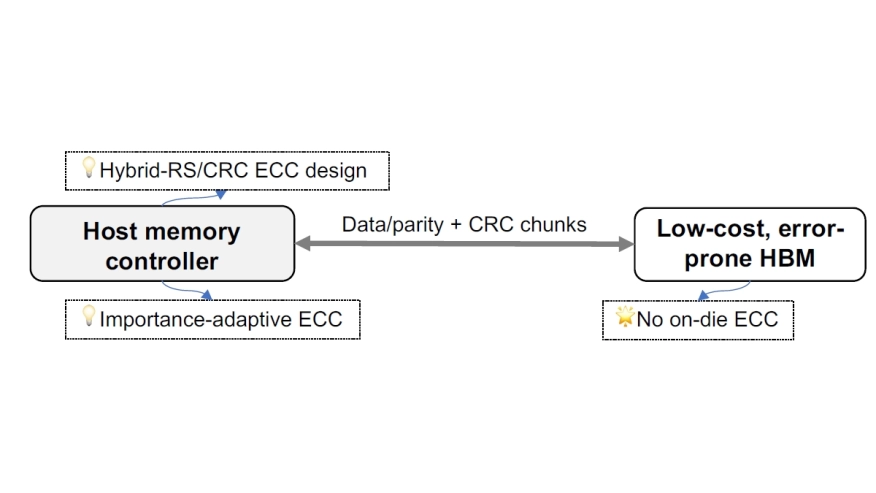
High-Bandwidth Memory (HBM) delivers exceptional bandwidth and energy efficiency for AI workloads, but its high cost per bit, driven in part by stringent on-die reliability requirements, poses a growing barrier to scalable deployment. This work explores a systemlevel approach to cost reduction by eliminating on-die ECC and shifting all fault management to the memory controller. We introduce a domainspecific ECC framework combining large-codeword Reed–Solomon (RS) correction with lightweight fine-grained CRC detection, differential parity updates to mitigate write amplification, and tunable protection based on data importance. Our evaluation using LLM inference workloads shows that, even under raw HBM bit error rates up to 10−3, the system retains over 78% of throughput and 97% of model accuracy compared with systems equipped with ideal error-free HBM. By treating reliability as a tunable system parameter rather than a fixed hardware constraint, our design opens a new path toward low-cost, high-performance HBM deployment in AI infrastructure.
Index Terms — HBM, Error-Correcting Code, CRC, Reliability
To read the full article, click here
Related Semiconductor IP
- HBM Memory Model
- HBM DFI Verification IP
- HBM 4 Verification IP
- HBM Synthesizable Transactor
- HBM DFI Synthesizable Transactor
Related Articles
- REACH: Controller-Managed Long-Span ECC for HBM AI Inference
- Making Strong Error-Correcting Codes Work Effectively for HBM in AI Inference
- TensorPool: A 3D-Stacked 8.4TFLOPS/4.3W Many-Core Domain-Specific Processor for AI-Native Radio Access Networks
- AIA: A 16nm Multicore SoC for Approximate Inference Acceleration Exploiting Non-normalized Knuth-Yao Sampling and Inter-Core Register Sharing
Latest Articles
- FlexSpIM: An Event-Based Digital Compute-In-Memory Accelerator with Flexible Operand Resolution and Layer-Wise Hybrid Stationarity
- MeshKV: A Network-on-Chip KV Cache Fabric for Scalable Transformer Decoding Accelerators
- Analog Pin Directionality as an Exfiltration Attack Surface in Mixed-Signal ICs
- SIMT-Aware Lockstep Verification and Functional-Coverage Closure Methodology for an Open-Source RISC-V GPGPU: A UVM 1.2 Environment
- Efficient Hardware Information-Flow Tracking for Pre-Silicon Security Testing