GenAI for Systems: Recurring Challenges and Design Principles from Software to Silicon
By Arya Tschand, Chenyu Wang, Zishen Wan, Andrew Cheng, Ioana Cristescu, Kevin He, Howard Huang, Alexander Ingare, Akseli Kangaslahti, Sara Kangaslahti, Theo Lebryk, Hongjin Lin, Jeffrey Jian Ma, Alexandru Meterez, Clara Mohri, Depen Morwani, Sunny Qin, Roy Rinberg, Paula Rodriguez-Diaz, Alyssa Mia Taliotis, Pernille Undrum Fathi, Rosie Zhao, Todd Zhou, Vijay Janapa Reddi
Harvard University
Abstract
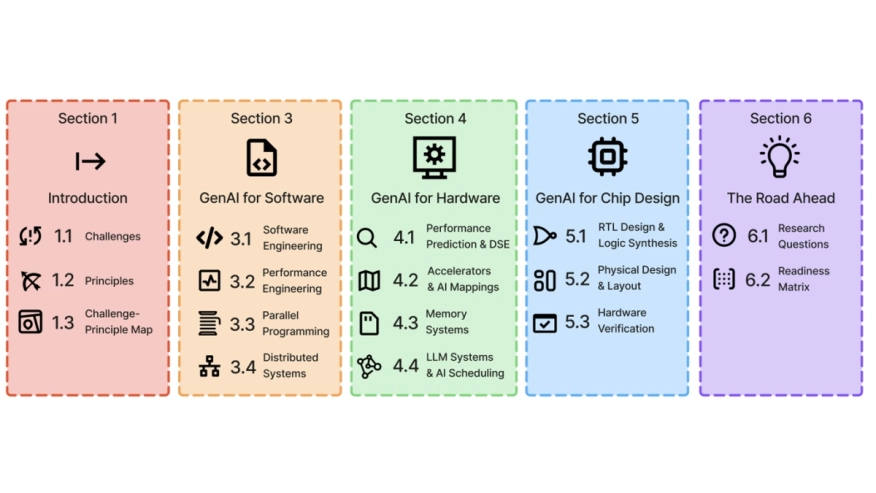
Generative AI is reshaping how computing systems are designed, optimized, and built, yet research remains fragmented across software, architecture, and chip design communities. This paper takes a cross-stack perspective, examining how generative models are being applied from code generation and distributed runtimes through hardware design space exploration to RTL synthesis, physical layout, and verification. Rather than reviewing each layer in isolation, we analyze how the same structural difficulties and effective responses recur across the stack. Our central finding is one of convergence. Despite the diversity of domains and tools, the field keeps encountering five recurring challenges (the feedback loop crisis, the tacit knowledge problem, trust and validation, co-design across boundaries, and the shift from determinism to dynamism) and keeps arriving at five design principles that independently emerge as effective responses (embracing hybrid approaches, designing for continuous feedback, separating concerns by role, matching methods to problem structure, and building on decades of systems knowledge). We organize these into a challenge--principle map that serves as a diagnostic and design aid, showing which principles have proven effective for which challenges across layers. Through concrete cross-stack examples, we show how systems navigate this map as they mature, and argue that the field needs shared engineering methodology, including common vocabularies, cross-layer benchmarks, and systematic design practices, so that progress compounds across communities rather than being rediscovered in each one. Our analysis covers more than 275 papers spanning eleven application areas across three layers of the computing stack, and distills open research questions that become visible only from a cross-layer vantage point.
To read the full article, click here
Related Semiconductor IP
- NPU IP
- JPEG XL Encoder
- I2C Master/Slave Controller Core
- NVMe Validation Test Suite
- Hybrid Memory Cube Verification IP
Related Articles
- Designing low-energy embedded systems from silicon to software
- SoK: From Silicon to Netlist and Beyond Two Decades of Hardware Reverse Engineering Research
- LLMs for Secure Hardware Design and Related Problems: Opportunities and Challenges
- Agile Analog's Approach to Analog IP Design and Quality --- Why "Silicon Proven" is NOT What You Think
Latest Articles
- Terracotta: Enabling the Adoption of New DRAM Techniques via a Flexible DRAM Interface and Memory Controller
- A Framework for Accelerating Transformer Inference on RISC-V for Edge AI
- An Interleaved Parallel Dependent Quantization Hardware Architecture for H.266/VVC
- A Formal Security Analysis of CAN XL
- A Secure dToF LiDAR SoC with Dual-Domain Fingerprinting and Event-Driven AFE Circuit Achieving Sensor-Level Attack Resilience