Efficient Hardware Information-Flow Tracking for Pre-Silicon Security Testing
By Yu-Wei Fan 1, Yuheng Yang 2, Christine Guo 1, SooHyuk Cho 1, Thomas Bourgeat 3, Mengjia Yan 2, Sharad Malik 1
1 Princeton University
2 MIT CSAIL
3 EPFL
Abstract
Register-Transfer Level (RTL) simulation is widely used to test hardware before it is fabricated. To allow testing for security related information flow properties, such as confidentiality and integrity, taint logic can be automatically added to the design to track how information flows through it. However, taint logic instrumented by the state-of-the-art, such as CellIFT, makes simulation-based testing prohibitively expensive: On our evaluation of Mega-BOOM (136K cells), it increases the instrumented design to 5.81x the original cell count and causes a 143.72x simulation slowdown. The taint logic could be simplified to improve simulation speed, but it will inevitably trade off its precision. This lightweight, imprecise taint logic will introduce false positives and may eventually result in even more overhead to check these false positives.
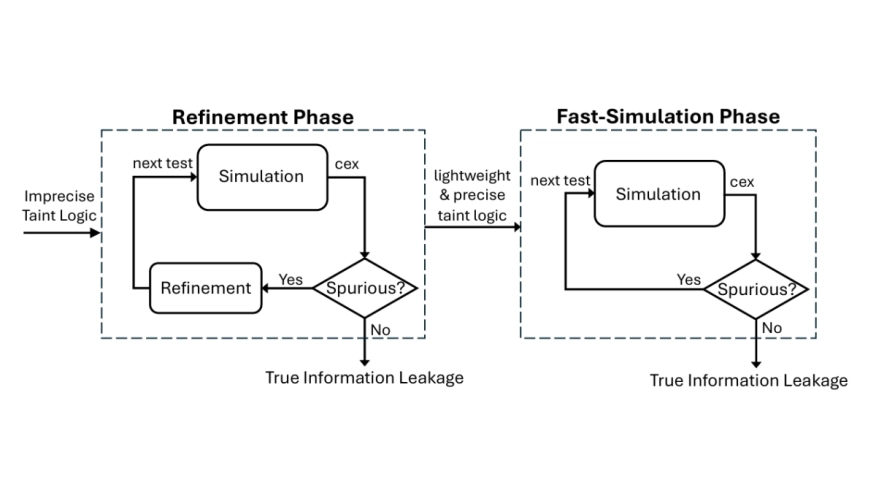
This paper explores the research question of where precision is actually needed in the design to overcome the overhead of false positives. It presents CEGAR-T, a framework that automatically synthesizes taint logic that minimizes the taint-logic instrumentation overhead while guaranteeing no false positives (relative to the precise CellIFT baseline). We have implemented CEGAR-T and evaluated it on the safe instruction set problem for timing side-channel security across open-source RISC-V cores. Over all evaluated cores, CEGAR-T reduces both instrumentation and simulation overhead, in geometric-mean, from 5.64x to 1.42x and from 34.65x to 1.79x, respectively, without compromising the precision benefit of the CellIFT baseline.
To read the full article, click here
Related Semiconductor IP
- nQrux® Root of Trust IP
- AXI to UCIe Bridge IP
- UCIe 2.x Controller IP
- SWI3S (SoundWire I3S Interface) Peripheral Controller Core IP
- OpenTitan-based RISC-V Secure Element
Related Articles
- Interstellar: Fully Partitioned and Efficient Security Monitoring Hardware Near a Processor Core for Protecting Systems against Attacks on Privileged Software
- FastPath: A Hybrid Approach for Efficient Hardware Security Verification
- High Quality IP creation through Efficient Packaging and Multiple Configuration Testing
- Hardware Security Requirements for Embedded Encryption Key Storage
Latest Articles
- A Secure dToF LiDAR SoC with Dual-Domain Fingerprinting and Event-Driven AFE Circuit Achieving Sensor-Level Attack Resilience
- ZTA-Q: an Open-source RISC-V Platform for Accurate Quantized CNN Inference
- Automated Pre-Silicon Verification of High-Speed DDR5 and LPDDR5/6 Memory Controllers: Closed-Loop Timing, Mode Register, and PHY Synchronization in UVM
- U-Sonic: An Open-Source 8-Channel Ultrasound Transmit IP in a 130 nm RISC-V SoC
- S-ALSA: Co-Design of Adiabatic Logic-based Sensing and Balanced Bit-Cells for Secure and Energy-Efficient MRAM