SIMT-Aware Lockstep Verification and Functional-Coverage Closure Methodology for an Open-Source RISC-V GPGPU: A UVM 1.2 Environment
By Samuel Moussa ∗, Steven Ibrahim ∗, Ahmad Sudky ∗, Ahmad Fawzy ∗, Abanoub Nabil ∗, Alhassan Sayed ∗, Hossam Hassan †, and Hyung-Min Yoon ‡
∗ Faculty of Engineering, Minia University, Egypt
† Independent Researcher, South Korea
‡ Siliconarts, Inc., South Korea
Abstract
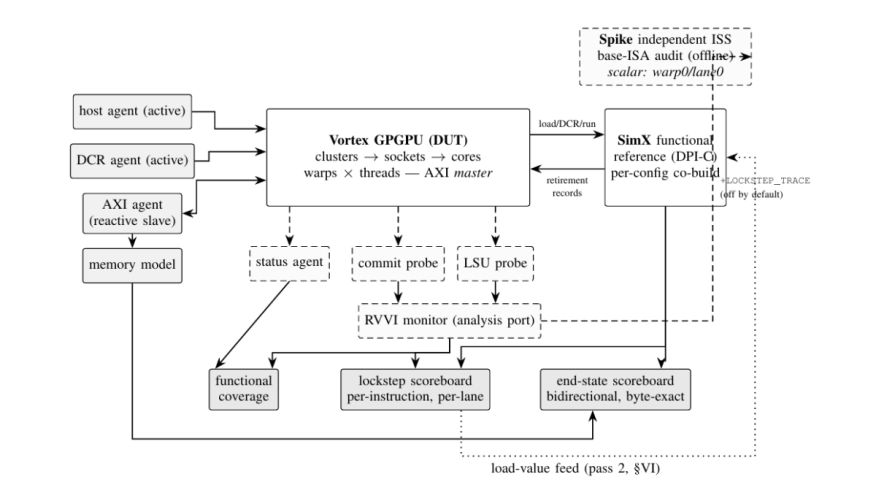
Open-source RISC-V GPGPUs such as Vortex ship with directed-kernel regressions but no reference-model checking, functional-coverage model, or sign-off discipline. This paper presents a UVM 1.2 environment and methodology that closes that gap. The environment wraps a bus-master SIMT DUT with role-inverted agents, integrates Vortex's functional simulator (SimX) as a per-configuration golden model over DPI-C, and renders verdicts via two injection-qualified checkers: a bidirectional end-state scoreboard and a per-instruction, per-lane lockstep comparator under five SIMT alignment rules. A two-pass load-value feed makes racy fenceless multi-core programs instruction-granularity verifiable (residual zero over 5,432 retirements), with the interrupt-timing boundary stated. A three-layer coverage model adds, to our knowledge, the first published SIMT functional-coverage layer for RTL GPU verification (divergence depth, bank conflicts, coalescing classes), closing its own layers at 98.1% covergroup-bin / 94.7% total (ISA layer separately: 83.1% bins / 89.3% weighted) under machine-generated, RTL-cited exclusions and a blocking waiver-integrity gate; an unstimulated D-extension elaboration affects no functional bin, only lowering totals. The checking depth surfaced real defects on both sides of the comparison: a JALR LSB ISA deviation, a non-scaling watchdog constant (since fixed upstream), a reset-relay X window found by restoring a silenced assertion, a missing AXI error path proven by fault injection, and a reference-model fetch bug found by the lockstep itself. FuzzGPU (USENIX Security 2026), a concurrent RTL GPU fuzzer on the same DUT, is complementary: fuzzing finds bugs, this methodology quantifies sign-off; both independently found the JALR deviation. All findings ship in an evidence-cited register; every number carries provenance and the method's boundaries are stated rather than waived.
Index Terms—UVM, RISC-V, GPGPU, SIMT, functional ver ification, lockstep co-simulation, functional coverage, coverage closure, fault injection, open-source hardware
To read the full article, click here
Related Semiconductor IP
- RISC-V Debug & Trace IP
- RISC-V IOPMP IP
- Gen#2 of 64-bit RISC-V core with out-of-order pipeline based complex
- 64-bit RISC-V core with in-order single issue pipeline. Tiny Linux-capable processor for IoT applications.
- Multi-core capable RISC-V processor with vector extensions
Related Articles
- Learning Not to Fear PCI Express Compliance Using a Predictable, Metrics Based Verification Closure Methodology
- Efficient methodology for verification of Dynamic Frequency Scaling of clocks in SoC
- Metric Driven Verification of Reconfigurable Memory Controller IPs Using UVM Methodology for Improved Verification Effectiveness and Reusability
- Efficient methodology for design and verification of Memory ECC error management logic in safety critical SoCs
Latest Articles
- Terracotta: Enabling the Adoption of New DRAM Techniques via a Flexible DRAM Interface and Memory Controller
- A Framework for Accelerating Transformer Inference on RISC-V for Edge AI
- An Interleaved Parallel Dependent Quantization Hardware Architecture for H.266/VVC
- A Formal Security Analysis of CAN XL
- A Secure dToF LiDAR SoC with Dual-Domain Fingerprinting and Event-Driven AFE Circuit Achieving Sensor-Level Attack Resilience