Emulation-based System-on-Chip Security Verification: Challenges and Opportunities
By Tanvir Rahman, Shuvagata Saha, Ahmed Y. Alhurubi, Sujan Kumar Saha, Farimah Farahmandi, Mark Tehranipoor
Department of Electrical and Computer Engineering, University of Florida, Gainesville, FL 32611, USA
Abstract
Increasing system-on-chip (SoC) heterogeneity, deep hardware/software integration, and the proliferation of third-party intellectual property (IP) have brought security validation to the forefront of semiconductor design. While simulation and formal verification remain indispensable, they often struggle to expose vulnerabilities that emerge only under realistic execution conditions, long software-driven interactions, and adversarial stimuli. In this context, hardware emulation is emerging as an increasingly important pre-silicon verification technology because it enables higher-throughput execution of RTL designs under realistic hardware/software workloads while preserving sufficient fidelity for security-oriented analysis.
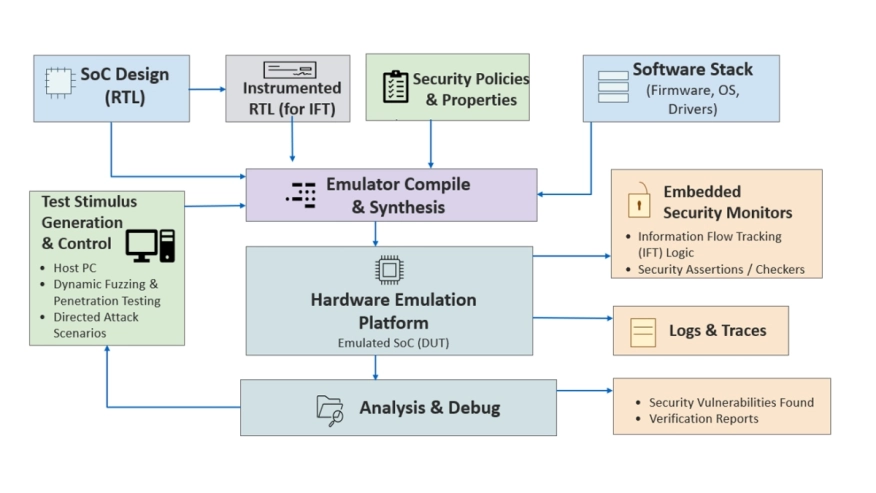
This paper presents a comprehensive survey and perspective on emulation-based security verification and validation. We organize the landscape of prior work across assertion-based security checking, coverage-driven exploration, adversarial testing, information-flow tracking, fault injection, and side-channel-oriented evaluation. We provide a structured view of emulation-enabled security verification workflows, including instrumentation, stimulus generation, runtime monitoring, and evidence-driven analysis. We also examine practical challenges related to observability, scalability, property specification, and the definition of security-oriented coverage metrics for emulation-based verification. Finally, we discuss emerging directions such as AI-assisted emulation, digital security twins, chiplet-scale security exploration, automated vulnerability assessment, and cloud-scale secure emulation. Overall, this paper positions emulation as a promising foundation for the next generation of pre-silicon hardware security assurance.
Keywords: Hardware emulation, SoC security, pre-silicon validation, fuzzing, fault injection, in formation flow tracking, hardware vulnerability analysis.
To read the full article, click here
Related Semiconductor IP
- NPU IP
- JPEG XL Encoder
- I2C Master/Slave Controller Core
- NVMe Validation Test Suite
- Hybrid Memory Cube Verification IP
Related Articles
- AI in VLSI Physical Design: Opportunities and Challenges
- LLMs for Secure Hardware Design and Related Problems: Opportunities and Challenges
- Triple play - How FPGAs can tackle the challenges of network security
- Going multicore presents challenges and opportunities
Latest Articles
- Terracotta: Enabling the Adoption of New DRAM Techniques via a Flexible DRAM Interface and Memory Controller
- A Framework for Accelerating Transformer Inference on RISC-V for Edge AI
- An Interleaved Parallel Dependent Quantization Hardware Architecture for H.266/VVC
- A Formal Security Analysis of CAN XL
- A Secure dToF LiDAR SoC with Dual-Domain Fingerprinting and Event-Driven AFE Circuit Achieving Sensor-Level Attack Resilience