CRADLE: Conversational RTL Design Space Exploration with LLM-based Multi-Agent Systems
By Lukas Krupp, Maximilian Schoffel, Elias Biehl, and Norbert Wehn ¨
RPTU University of Kaiserslautern-Landau, Kaiserslautern, Germany
Abstract
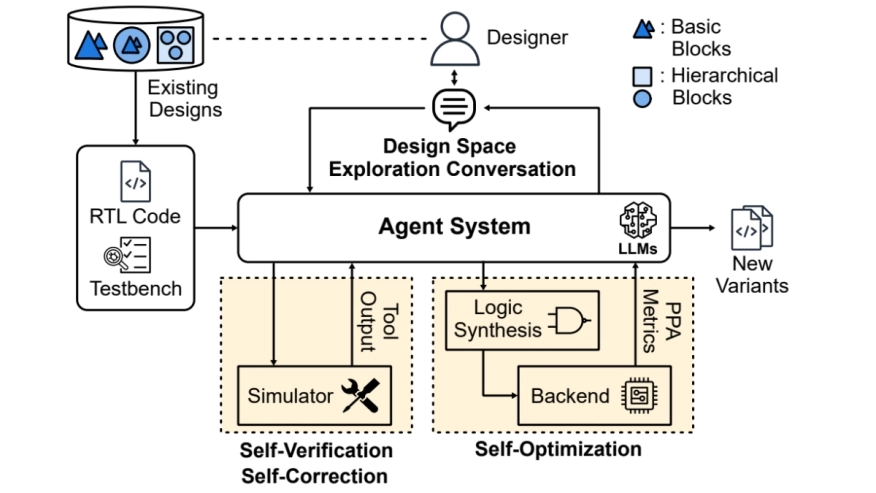
This paper presents CRADLE, a conversational framework for design space exploration of RTL designs using LLM-based multi-agent systems. Unlike existing rigid approaches, CRADLE enables user-guided flows with internal selfverification, correction, and optimization. We demonstrate the framework with a generator-critic agent system targeting FPGA resource minimization using state-of-the-art LLMs. Experimental results on the RTLLM benchmark show that CRADLE achieves significant reductions in resource usage with averages of 48% and 40% in LUTs and FFs across all benchmark designs.
Index Terms—LLM, Agents, Design Space Exploration, RTL
To read the full article, click here
Related Semiconductor IP
- nQrux® Root of Trust IP
- AXI to UCIe Bridge IP
- UCIe 2.x Controller IP
- SWI3S (SoundWire I3S Interface) Peripheral Controller Core IP
- OpenTitan-based RISC-V Secure Element
Related Articles
- Veri-Sure: A Contract-Aware Multi-Agent Framework with Temporal Tracing and Formal Verification for Correct RTL Code Generation
- Simultaneous Exploration of Power, Physical Design and Architectural Performance Dimensions of the SoC Design Space using SEAS
- Simultaneous Exploration of Power, Physical Design and Architectural Performance Dimensions of the SoC Design Space using SEAS
- Configure, Confirm, Ship: Build Secure Processor-Based Systems with Faster Time-to-Market
Latest Articles
- Automated Pre-Silicon Verification of High-Speed DDR5 and LPDDR5/6 Memory Controllers: Closed-Loop Timing, Mode Register, and PHY Synchronization in UVM
- U-Sonic: An Open-Source 8-Channel Ultrasound Transmit IP in a 130 nm RISC-V SoC
- S-ALSA: Co-Design of Adiabatic Logic-based Sensing and Balanced Bit-Cells for Secure and Energy-Efficient MRAM
- MEGATRON: a 28nm Analog PCM CiM/Digital System-on-Chip for Edge GenAI at 57.5 TOPS/W and 1.52 Mparam/mm²
- Peregrino: A Full-Hardware Accelerator for the Complete Falcon Post-Quantum Digital Signature Scheme on Resource-Constrained Edge Devices