Veri-Sure: A Contract-Aware Multi-Agent Framework with Temporal Tracing and Formal Verification for Correct RTL Code Generation
By Jiale Liu 1, Taiyu Zhou 2, Tianqi Jiang 3
1 School of Physics and Astronomy, The University of Edinburgh, Edinburgh, UK
2 State Key Laboratory of Analog and Mixed-Signal VLSI, University of Macau, Macau
3 School of Science and Engineering, The Chinese University of Hong Kong, Shenzhen, Shenzhen, China.
Abstract
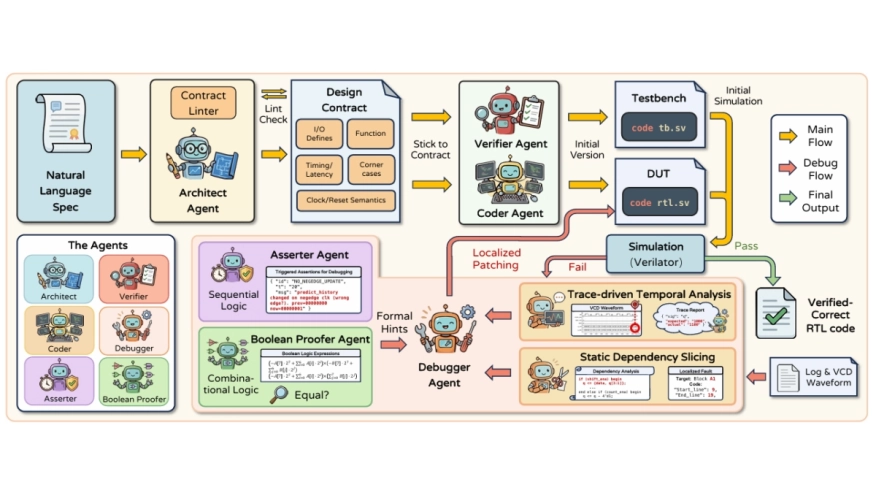
In the rapidly evolving field of Electronic Design Automation (EDA), the deployment of Large Language Models (LLMs) for Register-Transfer Level (RTL) design has emerged as a promising direction. However, silicon-grade correctness remains bottlenecked by: (i) limited test coverage and reliability of simulation-centric evaluation, (ii) regressions and repair hallucinations introduced by iterative debugging, and (iii) semantic drift as intent is reinterpreted across agent handoffs. In this work, we propose Veri-Sure, a multi-agent framework that establishes a design contract to align agents' intent and uses a patching mechanism guided by static dependency slicing to perform precise, localized repairs. By integrating a multi-branch verification pipeline that combines trace-driven temporal analysis with formal verification consisting of assertion-based checking and boolean equivalence proofs, Veri-Sure enables functional correctness beyond pure simulations. We also introduce VerilogEval-v2-EXT, extending the original benchmark with 53 more industrial-grade design tasks and stratified difficulty levels, and show that Veri-Sure achieves state-of-the-art verified-correct RTL code generation performance, surpassing standalone LLMs and prior agentic systems.
To read the full article, click here
Related Semiconductor IP
- NPU IP
- JPEG XL Encoder
- I2C Master/Slave Controller Core
- NVMe Validation Test Suite
- Hybrid Memory Cube Verification IP
Related Articles
- Lyra: A Hardware-Accelerated RISC-V Verification Framework with Generative Model-Based Processor Fuzzing
- A Reconfigurable Framework for AI-FPGA Agent Integration and Acceleration
- ZK-Flex: A Flexible and Scalable Framework for Accelerating Zero-Knowledge Proofs
- BitFair: A 12nm Bit-Serial CNN Accelerator with Learnable Early Termination and Adaptive Bit Ordering for Ultra-Low-Power XR Vision
Latest Articles
- Terracotta: Enabling the Adoption of New DRAM Techniques via a Flexible DRAM Interface and Memory Controller
- A Framework for Accelerating Transformer Inference on RISC-V for Edge AI
- An Interleaved Parallel Dependent Quantization Hardware Architecture for H.266/VVC
- A Formal Security Analysis of CAN XL
- A Secure dToF LiDAR SoC with Dual-Domain Fingerprinting and Event-Driven AFE Circuit Achieving Sensor-Level Attack Resilience