1G to 100G Single-Port MACsec Engine
The MACsec-IP-160 is a versatile MACsec solution for silicon devices that require plug-and-play MACsec processing for an Ethernet…
Overview
The MACsec-IP-160 is a versatile MACsec solution for silicon devices that require plug-and-play MACsec processing for an Ethernet port at full line rate. It provides classification, transformation and statistics for the IEEE0802.1AE standard MACsec. Additionally, it supports VLAN-in-clear use cases. The IP-160 is available in numerous configurations optimized for desired throughput range and number of secure connections. Supplied with software support, the MACsec-160 is the ideal solution for Ethernet PHYs, switches, automotive and 5G SoCs, broadband access chipsets and many other Ethernet-connected applications.
How the MACsec-IP-160 works
The MACsec-IP-160 engine provides complete MACsec processing for a port. It contains a flexible classifier with a table of programable rules with the programmable actions. The transformation engine supports all features and ciphers of the standard MACsec and VLAN-in-clear extension. The processing results are reflected in the MACsec-compliant statistics as additional non-standard counters. MACsec-IP-160 offers optional post-decryption consistency checking with a set of programmable rules.
The MACsec-IP-160 engine is a basis for building various use cases. Beside traditional point-to-point and point-to-multipoint use cases, it is also deployed in protecting carrier networks with bypass/drop/protect policy that is controlled per VLAN EVC.
The MACsec-IP-160 can be used in combination with external classifier and accepts secure channel pointer or packet bypass indication.
Integration
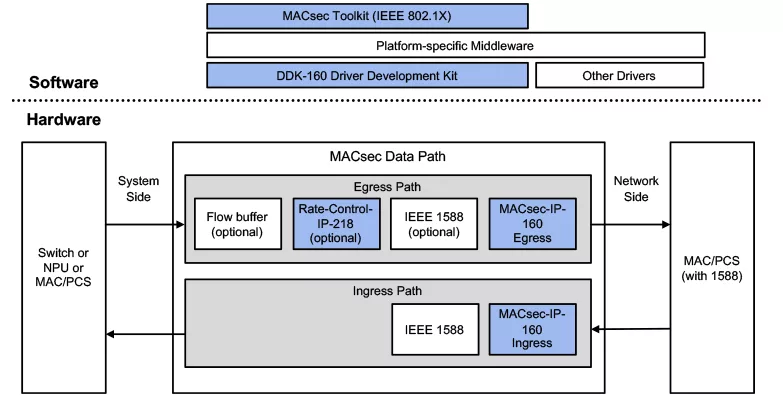
The MACsec-IP-160 engines offers flexibility on integration into the customer’s Ethernet subsystem. It can be used as a FIFO-like component, or a fixed-latency engine with a push interface.
Customers can implement MACsec processing with IEEE1588 timestamping in the Tx MAC (unencrypted PTP) as well as timestamping ahead of the MACsec (supporting both – encrypted and encrypted PTP).
To implement fixed-latency mode at egress direction, Rambus offers the Rate-Control-IP-218, a programmable module that shapes the traffic according to line rate and accounts the MACsec added header/trailer.
Key features
- Full line-rate throughput
- Optimized for 1G, 10G, 25G, 50G, 100G rates
- Lowest and fixed latency modes
- Feature reach
- Flexible classifier
- IEEE 802.1AE-2018 compliance
- VLAN-in-clear
- FIPS certification support
- Forward-looking hardware and software compatibility
- Very efficient hardware-software interaction
- Highly configurable
- Numerous options for optimal area, throughput and features trade-off
- Software and integration support
- Rate-Control-IP-218 rate shaper
- Driver Development Kit
- IEEE 802.1X Toolkit
- World-class support from Rambus MACsec experts
- Packet Interface
- Cut-through FIFO interface
- 128-bit (1G to 50G), 512-bit (100G)
- External classification inputs
- SOP and EOP pass-through bus for side-band information
- Lowest and fixed-latency modes
- SA and classification scaling
- SA (16 to 256)
- Post-decryption consistency check (optional)
- Control interface
- Simple 32-bit interface
- Interrupts
- Protocol support
- Full IEEE 802.1AE-2018 compliance
- IEEE 802.1AE
- IEEE 802.1AEbn
- IEEE 802.1AEbw
- IEEE 802.1AEcg
- MACsec with up to 2x VLAN-in-clear
- NIST CAVP compliance for FIPS 140-3 validation
- Support for basic AES and AES-GCM transformations
Block Diagram
Benefits
- Complete HW/SW system.
- Driver Development Kit.
- High-speed MACsec Frame Engine
- Silicon-proven implementation
- Fast and easy to integrate into SoCs.
- Flexible layered design.
- Complete range of configurations.
- World-class technical support.
Applications
- Network appliances providing Enterprise Network Security at Layer-2 using MACsec,
- End-station security solutions for laptops, PCs, printers and network servers.
What’s Included?
- Documentation
- Hardware Reference and Programmer Manual
- Integration Manual
- Verification Specification
- Synthesizable Verilog RTL source code
- Self-checking RTL test bench, including test vectors and expected result vectors
- Simulation scripts
- Synthesis scripts
- Many different configurations available:
- EIP-160s (egress/ingress):
- 16 SA (added with ingress 16 CC)
- 190 - 220K gates
- up to 710 MHz (max freq)
- 8.8 bits/clk
- EIP-160a (egress/ingress):
- 16/32/64 SA (added with ingress 16/32/64 CC)
- 395 - 575K gates
- up to 800 MHz (max freq)
- 36.6 bits/clk
- EIP-160b (egress/ingress):
- 16/64 SA (added with ingress 16/64 CC)
- 490 - 655K gates
- up to 800 MHz (max freq)
- 64 bits/clk
- EIP-160c (egress/ingress):
- 16/64/128/256 SA (added with ingress 16/64/128/256 CC)
- 610 - 1095K gates
- up to 800 MHz (max freq)
- 85.6 bits/clk
- For more information about this product or the all the different configurations, please contact Rambus: https://www.rambus.com/contact/
Specifications
Identity
Files
Note: some files may require an NDA depending on provider policy.
Provider
Learn more about MACsec IP core
Rambus Announces Industry-Leading Ultra Ethernet Security IP Solutions for AI and HPC
Ultra Ethernet Security: Protecting AI/HPC at Scale
Securing the Future of Terabit Ethernet: Introducing the Rambus Multi-Channel Engine MACsec-IP-364 (+363)
Cryptography Does Not Equal Security
Rambus Announces 2020 Design Summit
Frequently asked questions about MACsec IP cores
What is 1G to 100G Single-Port MACsec Engine?
1G to 100G Single-Port MACsec Engine is a MACsec IP core from Rambus, Inc. listed on Semi IP Hub.
How should engineers evaluate this MACsec?
Engineers should review the overview, key features, supported foundries and nodes, maturity, deliverables, and provider information before shortlisting this MACsec IP.
Can this semiconductor IP be compared with similar products?
Yes. Buyers can compare this product with similar semiconductor IP cores or IP families based on category, provider, process options, and structured technical specifications.