Scale-Up Ethernet Ecosystem Ramps Up: Cadence ESUN Controller IP Available

AI Infrastructure Networking Demands
The AI Infrastructure industry is investing hundreds of billions of dollars to build AI factories. Purpose-built for AI workloads, these systems are designed to convert capital, power, and silicon into model training throughput and inference tokens at massive scale.
 As accelerator counts grow from hundreds to thousands per deployment, the efficiency of data movement inside these systems increasingly determines overall factory productivity. Every nanosecond of latency, every retransmission, and every underutilized link translate directly into idle accelerators, lower utilization, and reduced return on infrastructure investment.
This shift is driving a renewed focus on scale-up networking. While advances in compute continue to expand accelerator performance, next-generation AI factories also require fabrics capable of moving data between XPUs with predictable latency, efficient bandwidth utilization, and lossless operation.
The Need for Scale-up Networking
Operators building scale-up domains want AI-fabric performance and efficiency while continuing to leverage the Ethernet ecosystem they already use. That's the goal of Ethernet for Scale-up Networking (ESUN), an open OCP (Open Compute Project) workstream led by major AI infrastructure operators, accelerator providers, and networking technology vendors. The group published its first Network Operator Requirements specification in early 2026.
ESUN keeps what has made Ethernet successful for more than four decades: ecosystem, economics, and interoperability, while addressing the demands of scale-up AI workloads. Like the broader Ultra Ethernet (UEC) effort, ESUN incorporates AI-focused networking enhancements designed to improve efficiency and resiliency. These enhancements include:
- Link-Level Retry (LLR) to recover errors locally in nanoseconds rather than escalating them to end-to-end retransmissions
- Credit-Based Flow Control (CBFC) for managing traffic at the virtual-channel level to maintain lossless operation without head-of-line blocking
- Header optimization: Standard Ethernet carries 28 to 48 bytes of IP-related header overhead per packet; ESUN replaces that with a compact 4-byte ESUN header while preserving traffic prioritization, congestion signaling, and load balancing
For workloads dominated by small, frequent, latency-critical transfers, these changes translate directly into higher effective bandwidth and more predictable latency.
Cadence ESUN Controller IP
Building on its High-Speed Ethernet controller IP family, Cadence provides ESUN-ready controller IP for next-generation AI scale-up networking.
Key ESUN controller features:
- Flexible multi-rate architecture supporting Ethernet speeds from 100G to 1.6T
- ESUN link layer:
- Per-port Priority Flow Control (PFC), LLR with configurable replay buffer size for lossless Ethernet, and CBFC supporting from 2 to 32 Virtual Channels
- Compact ESUN and UFH Header framing supported
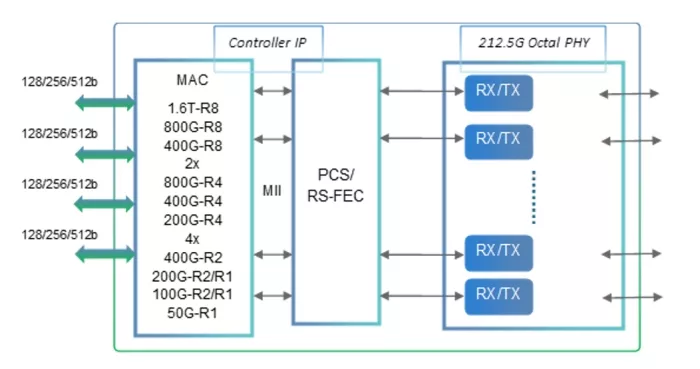
- 1.6T multi-rate Ethernet MAC: Up to four independent 400G channels configurable for 1×1.6T, 2×800G, 4×400G, and 4×200G modes over 224G SerDes; up to four additional 200G channels may be added to the base configuration
- Integrated RS-FEC:
- Integrated RS-FEC options including Low Latency FEC/RS(272, 257+1)
- Software selectable interleaving for minimum latency
- Controller designed for minimum silicon area
Delivered as a complete, pre-verified controller, multi-controller, or integrated PHY package, Cadence ESUN controller IP helps reduce integration complexity, minimize implementation risk, and accelerate time-to-silicon for next-generation AI infrastructure SoCs. The controller combines ESUN link-layer capabilities, multi-rate Ethernet MAC, and integrated RS-FEC in a flexible architecture optimized for high performance, low latency, and efficient silicon utilization.
Explore Cadence IP
Advancing AI Networking
Cadence is an active participant in the open standards shaping AI infrastructure, including OCP, the Ultra Ethernet Consortium, and the UALink Consortium. Building on decades of Ethernet IP leadership, Cadence extends its High-Speed Ethernet IP portfolio with ESUN-ready controller IP designed to address the demands of AI scale-up fabrics.
As the emergence of ESUN reflects growing industry interest in applying the economics, operational familiarity, and ecosystem scale of Ethernet to the scale-up domain, Cadence is enabling customers to engage early with this next-generation scale-up networking architecture. To accelerate your designs with Cadence ESUN Controller IP, please contact your Cadence sales representative.
For a deeper look at AI infrastructure and networking, read the "Building AI Factories With IP Solutions" white paper.
Related Semiconductor IP
- Highly scalable performance for classic and generative on-device and edge AI solutions
- MIPI CSI-2 TX Controller
- 1.6T Ultra Ethernet Controller
- HBM4E PHY and controller
- DDR5 MRDIMM PHY and Controller
Related Blogs
- Rambus LPDDR5T/5X/5 Controller IP Turbocharges AI Inference Performance to 9.6 Gbps
- FuriosaAI Accelerates Innovation with Digital Controller IP from Rambus
- Ask the Experts: HBM4 Controller IP
- Dream Chip, Cadence Unveil Automotive SoC with Tensilica IP at embedded world '25
Latest Blogs
- Mastering Semiconductor Chip Design: Tools, Techniques, and Best Practices
- Strategies for FPGA to ASIC Migration for Product Teams
- Two AI Brains Are Better Than One
- Your FPGA prototype runs. Can you see inside it?
- The Next Leap in Datacenter AI: Orchestrating Custom Accelerators with SiFive Intelligent Control Units (ACUs)