From photon to actuation: How physical AI is redefining embedded compute

Arm and STMicroelectronics are building on decades of Arm Cortex-M innovation to bring intelligence closer to where machines interact with the physical world.
Embedding AI into industrial machines, robots, and vehicles is one of the most complex engineering challenges that the industry faces today. These physical AI systems need to perceive their surroundings, reason about what to do, coordinate movements, and respond quickly and safely, all within strict power, weight, heat and cost limitations.
Getting this right is essential to unlocking massive economic and productivity gains across physical industries that, according to Arm’s own estimates, represent a $200 billion annual compute opportunity into the 2030s.
Physical AI requires intelligence at every plane of computing
The physical AI engineering challenge isn’t simply creating more AI models, but also building complete systems capable of turning intelligence into reliable physical action.
Consider a robot picking up a glass. The robot must recognize the object, determine its position, plan how to reach it and calculate the force required to grasp it without breaking it. Actuators and sensors continuously monitor position, pressure and movement, while motors and control systems adjust in real time as conditions change.
From Arm’s perspective, there are three interconnected “planes of computing” embodied in physical AI systems – augmented by a fourth layer of cloud or data center hosted compute for fleet management, simulation, and training – that make this possible.
- Perception-driven intelligence, which understands the surrounding environment to enable autonomous navigation, obstacle avoidance, and real-time locomotion.
- Interaction-driven intelligence, which understands and responds to human instructions through voice, gestures, and other interfaces to enable natural communication and information exchange between people and machines.
- Actuation execution, which coordinates and executes precise physical movements through the real-time control of motors, joints, and other actuators.
Across these computing planes, safety and security must be foundational, protecting systems and data, while enabling the predictable, reliable operation essential to building trust in autonomous machines.
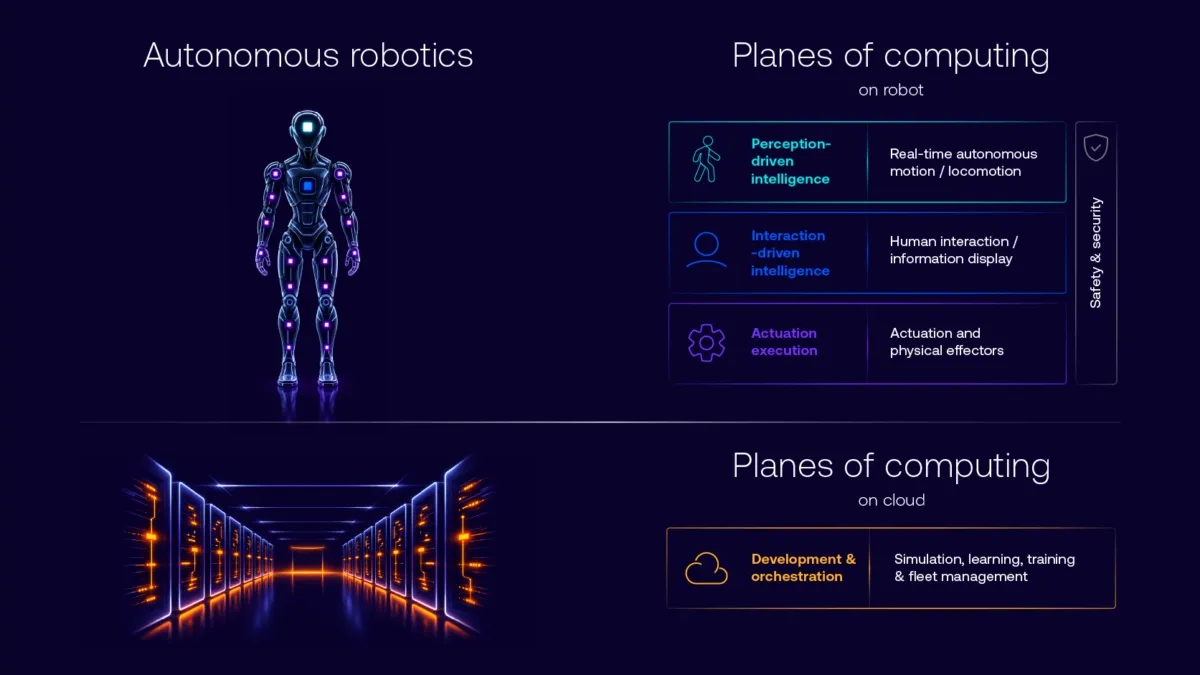
Three interconnected planes of computing enable physical AI systems to perceive, interact, and act, supported by cloud-based computing, with safety and security underpinning every plane.
The compute planes must also coordinate a complex set of AI and classical software processes at varying speeds and levels of granularity, all while interacting and coordinating with each other.
At the perception-driven and interaction-driven intelligence planes, Arm Zena Compute Subsystems (CSS) provides a foundation for integrating the processors, application CPUs, AI accelerators, memory, and interconnect into complete computing systems. Collaborations with leaders like Cadence help partners simplify integration and verification of the technologies needed to bring these systems to market.
Components in the actuation execution plane need to deliver fast, predictable responses to translate AI decisions into physical action. This is where embedded processors play a critical role.
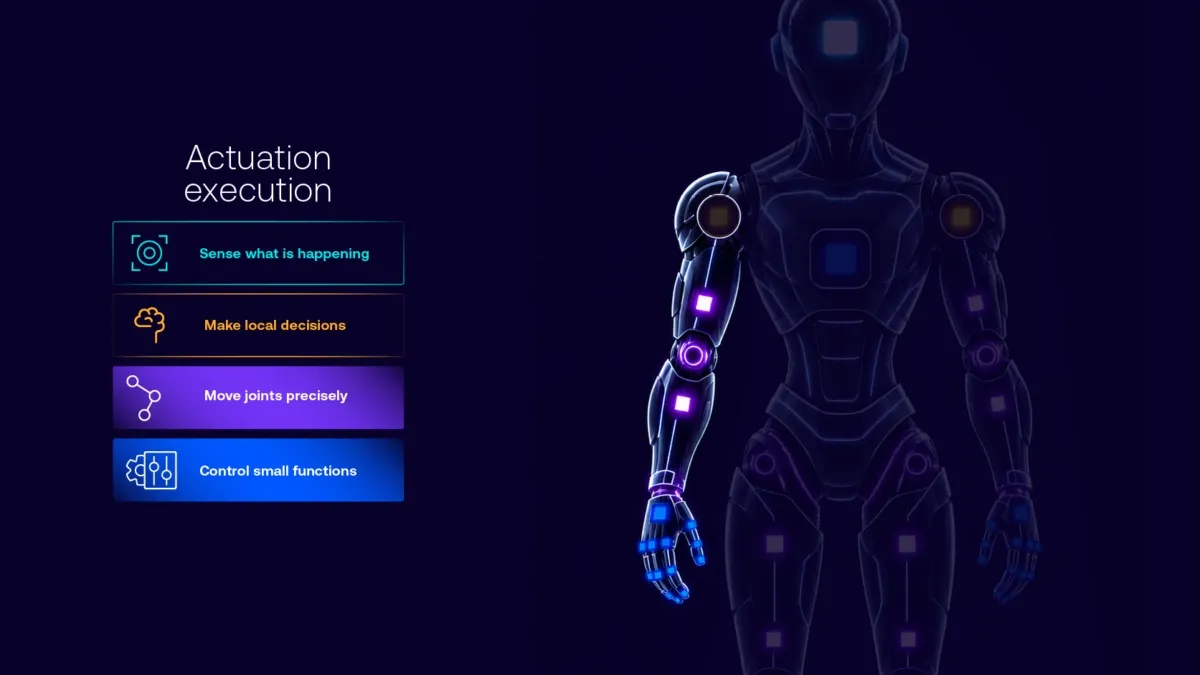
Real-time sensing, decision-making, and precise control enable reliable physical action in the actuation execution plane of computing
Building the next generation of embedded compute for physical AI
Arm and STMicroelectronics have spent decades bringing embedded computing into products across industrial, automotive and consumer markets. Now, this partnership is helping to shape the next generation of the Cortex-M roadmap to address the growing sensing, processing and control demands of increasingly intelligent machines.
At the STM32 Summit this week, STMicroelectronics announced a new strategic direction towards a converged STM32 platform for physical AI, and introduced a new series of Cortex-M-based STM32A microcontrollers designed for autonomous systems requiring high levels of predictability and redundancy to maintain safe, reliable operation, even when individual components fail.
By combining Arm’s processor architecture and software ecosystem with STMicroelectronics’ expertise in embedded applications, the collaboration aims to bring more intelligence closer to where machines interact with the physical world, while maintaining the efficiency, reliability and responsiveness that these computing systems demand. As Drew Henry, EVP of Physical AI at Arm, explains in the video below, ecosystem collaboration is critical to accelerating innovation in physical AI.
The Cortex-M portfolio powers billions of devices, from industrial controllers to automotive systems, with processors such as Arm Cortex-M55 and Cortex-M85 bringing advanced signal processing and machine learning capabilities to power and cost-constrained microcontroller-class systems. As intelligence moves closer to sensors and actuators, Cortex-M provides the precise, predictable, and continuous processing needed to translate AI decisions into physical action. For more details about how Cortex-M and Cortex-R processors support physical AI systems read this blog.
Bringing greater intelligence into embedded compute
The future of physical AI won’t be enabled by increasingly intelligent models alone. It will depend on how effectively machines turn that intelligence into precise, safe, and reliable physical action.
Through continued investment in our technology roadmap and deep ecosystem partnerships, Arm is bringing greater intelligence into every plane of computing, from perception and interaction to real-time sensing and actuation.
This is fundamental to unlocking the next generation of physical AI systems, and the enormous economic and productivity opportunities they represent.
Related Semiconductor IP
- USB-C Power Delivery IP Core
- Configurable Multi-Channel DMA Controller
- Samsung Foundry 4nm 1V8 GPIO I3C
- Root-of-Trust IP - High-Assurance Security for Advanced and Regulated Applications
- Root-of-Trust IP - Enhanced-Assurance, Configurable Security for Scalable Semiconductor Designs
Related Blogs
- How Physical AI Is Redefining the Automotive Industry
- From All-in-One IP to Cervell™: How Semidynamics Reimagined AI Compute with RISC-V
- From GPUs to Memory Pools: Why AI Needs Compute Express Link (CXL)
- How is RISC-V’s open and customizable design changing embedded systems?
Latest Blogs
- The $725 Million Chip Development: Why Execution Risk, Not IP Cost, Now Dictates Advanced-Node Survival
- From photon to actuation: How physical AI is redefining embedded compute
- Secure Boot for embedded Linux on Efinix Ti375C529: Getting started with KiviBoot-Linux
- Akida in High-Frequency Trading: The Smart Signal Layer
- Cadence Expands Sovereign AI in Europe: From Chips to AI Factories