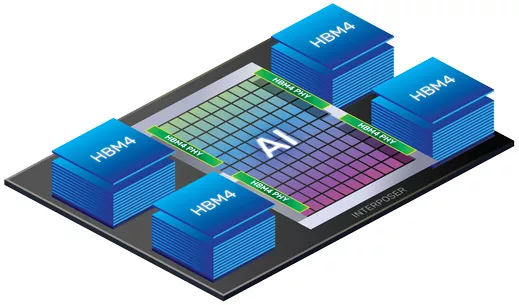
Vendor: Cadence Design Systems, Inc. Category: HBM

HBM4E PHY and controller

Highest performance PHY and controller IP for graphics, AI/ML

Controller + PHY View all specifications

Overview

Providing a Complete Solution for HBM4

The Cadence High-Bandwidth Memory generation 4 (HBM4E) PHY is optimized for systems that require the highest-bandwidth, low-latency memory solution. The memory subsystem consisting of PHY and controller supports data rates up to 12.8Gbps per data pin, featuring 32 independent channels, for a total data width of 2048 bits. The PHY is designed for a 2.5D system with a silicon interposer to route signals between the 3D DRAM stack and PHY. 

The fourth-generation design is optimized for low power consumption and low PHY area. Cadence provides the complete solution including PHY, controller, interposer, and package.

Key features

  • Advanced clocking architecture minimizes clock jitter
  • DFI PHY Independent Mode for initialization and training
  • IEEE 1500 interface, memory BIST feature, and loop-back function
  • Supports lane repair
  • Designed for optimized interposer routing

Block Diagram

Benefits

  • Highest Performance: HBM4E up to 12.8Gbps per pin
  • Low Latency: For data-intensive applications
  • Low Power and Area: Low-power control and advanced low-power modes with power down
  • Complete HBM Solution: Full system design including PHY, controller, interposer, and package
  • Easy integration: PHY is hardened and timing closed, including all I/O and decoupling capacitors
  • Excellent Support: Access to Cadence expert SI/PI team to support customer designs

Specifications

Identity

Part Number
HBM4E
Vendor
Cadence Design Systems, Inc.
Type
Silicon IP
Controller / PHY
Controller + PHY

Files

Note: some files may require an NDA depending on provider policy.

Provider

Learn more about HBM IP core

High Bandwidth Memory Evolution from First Generation HBM to the Latest HBM4

HBM4 is the latest generation of the High Bandwidth Memory (HBM) that has become analogous to the Artificial Intelligence (AI) boom that is everywhere in today’s world. HBM is also increasingly being used in other applications like Data centers, autonomous driving systems, servers, cloud computing just to mention few domains where bandwidth and performance in a key requirement.

The Memory Imperative for Next-Generation AI Accelerator SoCs

AI accelerators are key components of the AI data center tasked with speeding up the complex mathematical calculations required for AI and machine learning (ML). As the demand for AI continues to skyrocket, it’s crucial that SoCs provide the necessary “brain power” for these AI accelerators to keep pace.

Heterogeneous Multicore using Cadence IP

This blog presents a heterogeneous multicore system built with the RISC-V Host CPU and Cadence IP: Xtensa DSPs, and the Janus Network-on-Chip (NoC). While this example uses an RISC-V CPU, any other ISA with similar capabilities can also serve as the host CPU.

Cadence Powers AI Infra Summit '25: Memory, Interconnect, and Interface Focus

AI is driving a new semiconductor renaissance—it's no longer just a workload, but the defining force behind a new era of semiconductor innovation. Cadence Fellow Charles Alpert echoed this message in his keynote, "Design for AI and AI for Design," offering insights into how AI is reshaping infrastructure and accelerating innovation.

Designing the AI Factories: Unlocking Innovation with Intelligent IP

The rapid evolution of artificial intelligence (AI) is reshaping the technological landscape, driving unprecedented demands on computing infrastructure. At the heart of this transformation lie innovations in intellectual property (IP) that enable scalable, efficient, and performance-driven AI factories.

HBM4 Boosts Memory Performance for AI Training

The recent HBM4 specification announced by JEDEC is great news for developers of AI training hardware. HBM4 is the latest specification in the rapidly evolving High Bandwidth Memory (HBM) DRAM standard, providing 2TB/s of memory performance and higher density up to 64GB (32Gb 16-high), according to JEDEC. "The advancements introduced by HBM4 are vital for applications that require efficient handling of large datasets and complex calculations, including generative artificial intelligence (AI), high-performance computing, high-end graphics cards, and servers," said the JEDEC release.

Frequently asked questions about HBM Interface IP

What is HBM4E PHY and controller?

HBM4E PHY and controller is a HBM IP core from Cadence Design Systems, Inc. listed on Semi IP Hub.

How should engineers evaluate this HBM?

Engineers should review the overview, key features, supported foundries and nodes, maturity, deliverables, and provider information before shortlisting this HBM IP.

Can this semiconductor IP be compared with similar products?

Yes. Buyers can compare this product with similar semiconductor IP cores or IP families based on category, provider, process options, and structured technical specifications.

×
Semiconductor IP