Vendor: CAST Category: CPU

Ultra-Low-Power Deeply Embedded RISC-V Processor

The BA51 is a configurable, low-power, deeply embedded RISC-V processor IP core.

Overview

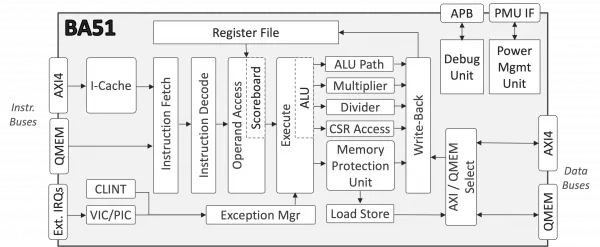
The BA51 is a highly configurable, low-power, deeply embedded RISC-V processor IP core. It implements a single-issue, in-order, 2-stage execution pipeline and supports the RISC-V 32-bit base integer instruction set (RV32I), or the 32-bit base embedded instructions set (RV32E).

Configuration Options for Broad Application Support

The processor core can be configured to meet different application requirements. It can optionally support user and supervisor privilege modes, as well as the ISA extensions for Compressed Instructions (C), Integer Multiplication and /Division Instructions (M), Atomic Instructions (A), User-Level Interrupts (N), Control and Status Register (Zicsr), and Instruction-Fence (Zifencei). Support for the single-precision floating-point (F) ISA extension can also be added upon request. And code size reduction (Zc) ISA extensions can also be added upon request.

Furthermore, the BA51 supports software and timer interrupts and up to 64 external interrupt lines. It features a remarkably low interrupt response time, which makes the core ideal for real time control applications. The time elapsed from when an external interrupt is asserted until the first instruction in the resolved interrupt handler can be issued is just 4 clock cycles. The user can minimize the core’s silicon footprint by choosing not to implement internal modules such as the machine mode internal timers and counters; the vectored interrupt controller (VIC); or the debug, power management (PMU), or memory protection (MPU) units. Finer-grained controls give designers the means to further tune the processor’s features and size to their specific design needs, including the number and size of memory regions for the MPU, the mapping of memory addresses to interfaces, and the width of the instruction and data buses

The user can minimize the core’s silicon footprint by choosing not to implement internal modules such as the machine mode internal timers and counters; the vectored interrupt controller (VIC); or the debug, power management (PMU), or memory protection (MPU) units. Finer-grained controls give designers the means to further tune the processor’s features and size to their specific design needs, including the number and size of memory regions for the MPU, the mapping of memory addresses to interfaces, and the width of the instruction and data buses.

The processor can optionally be equipped with a highly configurable instruction cache. The set associativity of this L0 cache can be specified from 1 to 4, while its block size and total size are also configurable at synthesis time.

Compact & Energy Efficient

Designed for low energy consumption the BA51 is compact and enables advanced power management. Under its minimal configuration the processor size is just 16k gates, and even when most of the optional features are enabled, its size is about 50k gates. This small silicon footprint is critical for minimizing leakage currents during idle or standby modes and for reducing dynamic power consumption. The BA51 also enables dynamic clock gating, unused modules power shut-off, and software or hardware dynamic frequency scaling of the bus and the CPU.

Furthermore, delivering more processing power per MHz than most processors in its class, the BA51 can be configured to operate at low frequencies to further save power, or to meet the most demanding embedded processing requirements, or any optimum combination of both. 

Easy Integration and Low Risk

The processor core uses AMBA®, AXI-4 and low-latency Quickaccess Memory (QMEM) interfaces for fetching instructions and accessing data and peripherals, while the debug unit connects to an external JTAG/TAP controller via an APB port. Part of the family of processor cores available from CAST for more than a decade and used by hundreds of customers, the BA51 IP core has been designed for easy reuse and integration, has been rigorously verified, and is LINT-clean, scan-ready and silicon-proven. It is available in Verilog source code for ASICs or FPGAs.

Part of the family of processor cores available from CAST for more than a decade and used by hundreds of customers, the BA51 IP core has been designed for easy reuse and integration, has been rigorously verified, and is LINT-clean, scan-ready and silicon- proven. It is available in Verilog source code for ASICs or FPGAs

Key features

  • Low-Power Embedded Processor
    • Small silicon footprint for lower leakage and dynamic CPU power
      • From 16k gates
    • Advanced power management
      • Dynamic clock gating and unused units power shut off
      • Software- and hardware-controlled clock frequency scaling
    • Single-issue, in-order, 2-stage pipeline
    • Harvard architecture with separate instruction and data AXI-Lite and Quick-access Memory (QMEM) buses
    • Optional L0 Instruction Cache with synthesis-time configurable associativity and size
  • Performance
    • 3.0 Coremarks/MHz
    • Over 500 MHz in 16 nm
  • RISC-V Features
    • 32-bit Base RISC-V ISA (I/E) with optional M, A, Zicsr, Zifencei, C, and N Extensions
    • F ISA extension upon request
    • Supervisor, User, and Machine Modes
    • Memory protection unit with a configurable number of regions
    • Core Local Interrupt Controller (CLINT) for timer and software interrupts
    • Programmable and/or Vectored Interrupt Controller (PIC or VIC) for up to 64 direct external interrupts
  • Available Pre-Integrated Platforms
    • Integrate bus fabric with peripherals such as GPIO, UART, Real-Time Clock, Timers, I2C, and SPI
    • Optionally customized to include memory controllers, interconnects and more from the CAST IP line
  • Deliverables
    • Available in Verilog source-code
    • Comprehensive Documentation
    • Testbench and sample simulation scripts
  • Low Risk & Flexible Licensing
    • Reliable vendor with an extensive track record and excellent support
      • Thousands of IP core licenses, and billions of units shipped with IP from CAST since 1997
      • Experienced and responsive support team with a 24/7 culture
    • Industry-standard licensing terms with royalty-free options

Block Diagram

Specifications

Identity

Part Number
BA51
Vendor
CAST
Type
Silicon IP

Compute

CPU Architecture
RISC-V

Files

Note: some files may require an NDA depending on provider policy.

Provider

HQ: USA

Learn more about CPU IP core

From Classical CAN and CAN FD to CAN XL: Functional Safety and Security for Next-Generation In-Vehicle Communication

This article reviews the functional-safety attributes of Classical CAN and CAN FD, then explains how CAN XL preserves and extends them. It also discusses higher-layer safety protocols, fault-tolerant CAN XL controller implementations, and CANsec, the CAN XL security extension inspired by the MACsec model. Finally, it highlights how the CAST CAN XL controller IP and CANsec acceleration IP can support the efficient deployment of safety- and security-capable in-vehicle networks.

8051s in Modern Systems: Interfacing to AMBA Buses

Despite being 40 years old, 8051 microcontrollers can still serve useful roles in modern systems. But integrating 8051s in today's systems with their de facto standard AMBA® buses, wider datapaths, and shared memories can seem impossible. Yet it can be done. Here we take a look at the challenges, and how to overcome them.

CANsec: Security for the Third Generation of the CAN Bus

CANsec is a resource-efficient solution for securing the CAN bus against the most common cyber security threats on software-defined vehicles. Here we show that the encryption and authentication of CAN XL frames are possible without latencies or loss...

Announcing Arm AGI CPU: The silicon foundation for the agentic AI cloud era

For the first time in our more than 35-year history, Arm is delivering its own silicon products – extending the Arm Neoverse platform beyond IP and Arm Compute Subsystems (CSS) to give customers greater choice in how they deploy Arm compute – from building custom silicon to integrating platform-level solutions or deploying Arm-designed processors.

Frequently asked questions about CPU IP cores

What is Ultra-Low-Power Deeply Embedded RISC-V Processor?

Ultra-Low-Power Deeply Embedded RISC-V Processor is a CPU IP core from CAST listed on Semi IP Hub.

How should engineers evaluate this CPU?

Engineers should review the overview, key features, supported foundries and nodes, maturity, deliverables, and provider information before shortlisting this CPU IP.

Can this semiconductor IP be compared with similar products?

Yes. Buyers can compare this product with similar semiconductor IP cores or IP families based on category, provider, process options, and structured technical specifications.

×
Semiconductor IP