Bridging the MACsec Gap: Add Line-Rate Security Without Redesigning Your Ethernet Subsystem
Now place a MACsec engine between an existing MAC and PHY with new xMII bridges; handle key management with new MKA stack and drivers
Fault Tolerant and Precise - Scalable from 1Gbps to 10Gbps
Standard Ethernet network equipment lacks concept of time, deterministic and guaranteed timely delivery. Time Sensitive Networking (TSN), a set of standards for commercial and aerospace under the development of the IEEE and SAE organizations, defined the abilities for time synchronization, scheduling and traffic shaping, selection of communication paths, path reservations, and fault tolerance.
There are many TSN standard specifications. In aerospace applications, IEEE Std 802.1AS and 802.1IDP standards are of particular interest. TSN has similarities to its predecessor, time-triggered Ethernet (TTE), in capabilities and features, but TSN has wider support. It uses the well-known Precision Time Protocol (PTP) and the standards are developed in conjunction with many organizations from commercial and government sectors. It’s expected to be used in industrial automation, automotive, aerospace, medical, and others – potentially having wide adoption.
Previously, LeWiz developed a precision, multi-speed TTE Core for endpoint and switching applications. With this IP core offer, we provide solutions for TSN supporting endpoint, switches and other user equipment. The technology can be used in FPGA, ASIC, and SoC devices and includes software support, simulation bench, documentation, etc.
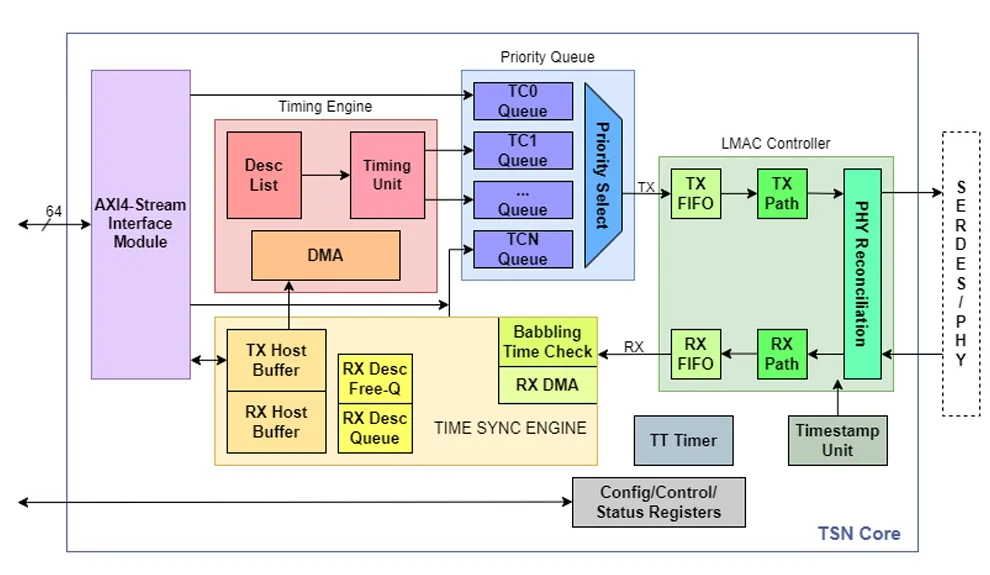
The TSN IP core is designed to be scalable from 1Gbps to 10Gbps or higher, suitable for use in high reliability aerospace applications. The core mainly consists of an Ethernet front-end media access controller (MAC), a timing engine, Time-sync engine, and host interface unit for high speed, low latency data movements. The MAC is the LeWiz LMAC Core2 with 10/5/2.5/1Gbps speeds and the flexible PHY interface supports X/R/G/MII standards, compatible with various PHY and SerDes designs on or off chip. It has a register control unit to that allows software to configure the core and network functions. This unit uses the well-known AXI-lite bus.
The core’s AXI* interface module allows it to operate at a different frequency than the host clock’s speed. For example, the AXIS bus may be running at a clock frequency relative to the on-chip processor or internal bus while the core’s internal clock may be running relative to the Ethernet PHY speed.
The fine grain on-chip timer provides time in microticks and macroticks for users to track time. Its frequency can be a function of the global clock or a dedicated clock which can be supplied from an ultra-accurate source, i.e., does not drift over voltage or temperature variation so that the clock remains stable.
Its priority queue supports multi-level priority traffic classes required by the TSN standards. Utilization of the priority queue is application dependant and controllable by software.
LeWiz TSN IP Core supports multiple traffic types including PTP or time-sync, time-critical (TSN), rate controlled, and best effort (or normal Ethernet) traffic. An on-chip hardware engine supports time sync for precision and low latency and works in master or slave mode supporting 1-step and 2-step time sync functions.
The core supports 3-plane network for fault tolerance. It’s capable of handling babbling and other mal conditions in the network. It supports a space-capable version suitable for low-Earth orbit, deep space, and others. The fault tolerant capability enables the device to continue to function even when encountering errors due to radiation and other severe conditions in space applications.
There is also a verification bench; this bench is composed of 3 major units: the master emulator, device under test, and PHY/network emulator. The master emulator generates data or packets that are sent to the core under test or TSN Core. The packets can be hardcoded by users or previously captured by the user and embedded into the master emulator. The bench is useful for debugging in user-friendly simulation environments with real data/conditions found during field deployment.
Note: some files may require an NDA depending on provider policy.

Time Sensitive Network IP Core is a Ethernet IP core from LeWiz Communications, Inc. listed on Semi IP Hub.
Engineers should review the overview, key features, supported foundries and nodes, maturity, deliverables, and provider information before shortlisting this Ethernet IP.
Yes. Buyers can compare this product with similar semiconductor IP cores or IP families based on category, provider, process options, and structured technical specifications.