New Number Formats for FFT IP Cores in Optical OFDM Transceivers
By Lukas Krupp 1, Gustavo Magalhães Gomes De Souza 1, Sani Nassif 2, Norbert Wehn 1
1 RPTU University Kaiserslautern-Landau, Kaiserslautern, Germany
2 Radyalis LLC, Austin, TX, USA
Abstract
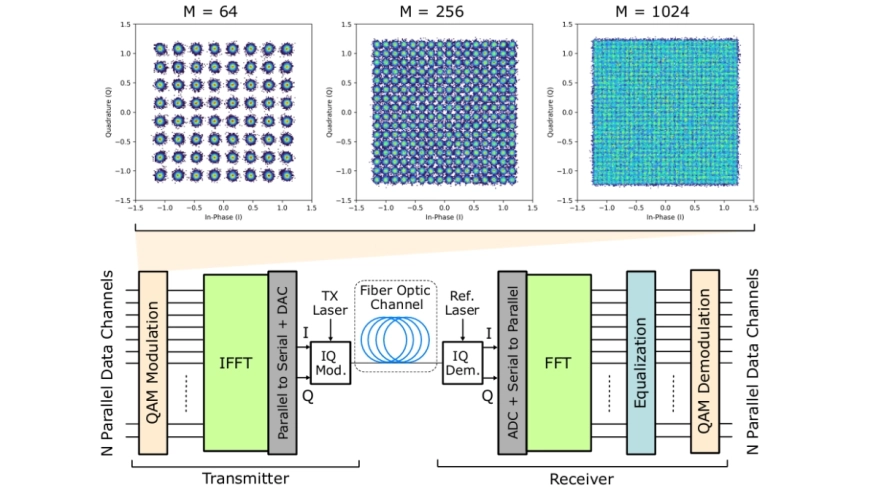
Many state-of-the-art DSP implementations use fixed-point arithmetic due to its reduced hardware complexity and high throughput compared to conventional floating-point arithmetic. In contrast, machine learning accelerators exhibit substantial gains from reduced-precision floating-point formats, enabling improvements in energy efficiency and peak throughput. These advances motivate a re-evaluation of numerical representations for classical DSP workloads. A central question is whether reduced-precision floating-point formats can achieve competitive power, performance, and area compared to fixed-point implementations, while providing advantages in dynamic range and numerical robustness. This paper presents a new cross-layer co-design methodology for DSP kernels that jointly optimizes numerical representations, arithmetic units, and application-level performance. As a case study, we focus on the FFT, a fundamental DSP block across many applications. The FFT is evaluated within optical OFDM transceivers, where it dominates power consumption and silicon area as FFT size and modulation order scale to support data rates beyond 100 Gbit/s. We compare fixed-point and reduced-precision floating-point formats using post-layout power and area results in a 12nm FinFET technology and demonstrate system-level performance in terms of BER versus Eb/N0. For a 256-point FFT engine in a 128 Gbit/s transceiver, we show that 11- and 12-bit custom floating-point formats preserve BER performance close to a 32-bit floating-point reference across multiple modulation orders, while reducing FFT core power by up to 19.8% and area by up to 12.0% compared to representative fixed-point designs. To the best of our knowledge, this is the first investigation of custom reduced-precision floating-point arithmetic for FFT cores in optical OFDM transceivers.
To read the full article, click here
Related Semiconductor IP
- FFT Algorithm Accelerator
- Single precision fixed-size streaming floating-point FFT
- Fixed-size streaming FFT
- Fast Fourier Transform (FFT)
- FFT Intel® FPGA IP Core
Related Articles
- New tech? Show me: EEs review IP cores
- MEMS -> D-MEMS yield new flexibility for optical nets
- SoCs: DSP World, Cores -> New DSP architectures work harder
- Open-source cores provide new paths to SoCs
Latest Articles
- Terracotta: Enabling the Adoption of New DRAM Techniques via a Flexible DRAM Interface and Memory Controller
- A Framework for Accelerating Transformer Inference on RISC-V for Edge AI
- An Interleaved Parallel Dependent Quantization Hardware Architecture for H.266/VVC
- A Formal Security Analysis of CAN XL
- A Secure dToF LiDAR SoC with Dual-Domain Fingerprinting and Event-Driven AFE Circuit Achieving Sensor-Level Attack Resilience