SEAM-V: A Hybrid-Decoupled RISC-V Vector Processor with Backend-Visible EP Context for Sustained Vector Throughput
By Weiying Wang, Zhiwei Zhang
Chinese Academy of Sciences and University of Chinese Academy of Sciences, China
Abstract
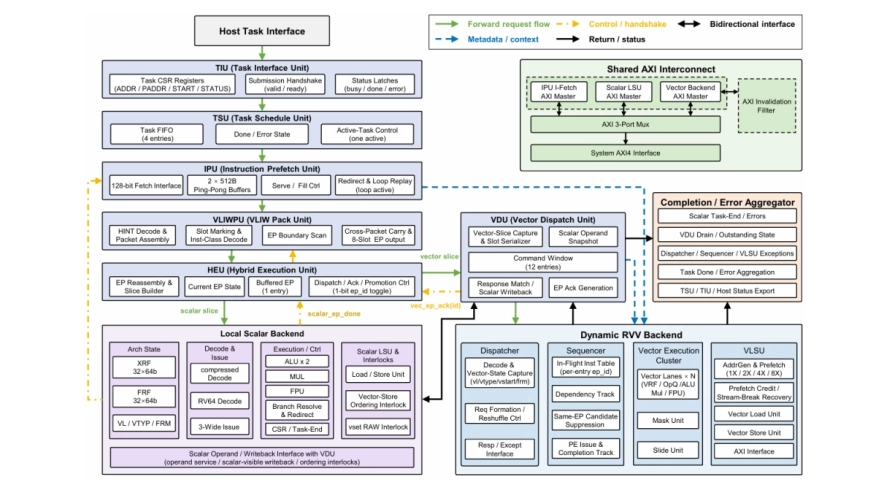
Data-parallel workloads in deep learning and scientific computing continue to drive demand for higher processor throughput, energy efficiency, and scalability. The RISC-V Vector Extension (RVV) supports scalable execution through a vector-length-agnostic programming model. However, many tightly coupled implementations still rely on the scalar core to supply vector instructions one at a time, making execution susceptible to vector-instruction supply gaps, scalar-side progression delays, and conservative dependence handling in short-vector, loop-tail, and control/memory-interleaved phases. This paper presents SEAM-V, a hybrid-decoupled vector execution architecture for RVV. SEAM-V forms a continuous stream of execute packets (EPs) through task-level decoupling, local instruction supply, and VLIW-style packing. After an EP is serialized into individual requests, its EP identity and request-bound prefetch context remain visible to the dynamic vector backend, enabling same-EP candidate-hazard suppression and request-bound prefetching. The hybrid-dispatch path can also provide limited cross-EP vector overlap when the required safety conditions are satisfied. Cross-EP dependences, dependences not exempted by the EP contract, resource conflicts, and memory ordering remain dynamically managed by the backend. Cycle-accurate RTL evaluation shows that, compared with an Ara-based tightly coupled RVV implementation (TC), SEAM-V achieves a geometric-mean speedup of 1.34x across 17 representative kernels. The one-dimensional variable-AVL, BLAS and matrix, and fixed-size application groups achieve speedups of 1.50x, 1.25x, and 1.27x, respectively. At AVL=32, the geometric-mean speedup across six one-dimensional vector kernels approaches 3x.
To read the full article, click here
Related Semiconductor IP
- RISC-V Debug & Trace IP
- RISC-V IOPMP IP
- Gen#2 of 64-bit RISC-V core with out-of-order pipeline based complex
- 64-bit RISC-V core with in-order single issue pipeline. Tiny Linux-capable processor for IoT applications.
- Multi-core capable RISC-V processor with vector extensions
Related Articles
- Creating a custom processor with RISC-V
- Maven Silicon's RISC-V Processor IP Verification Flow
- A formal-based approach for efficient RISC-V processor verification
- Soft Tiling RISC-V Processor Clusters Speed Design and Reduce Risk
Latest Articles
- Terracotta: Enabling the Adoption of New DRAM Techniques via a Flexible DRAM Interface and Memory Controller
- A Framework for Accelerating Transformer Inference on RISC-V for Edge AI
- An Interleaved Parallel Dependent Quantization Hardware Architecture for H.266/VVC
- A Formal Security Analysis of CAN XL
- A Secure dToF LiDAR SoC with Dual-Domain Fingerprinting and Event-Driven AFE Circuit Achieving Sensor-Level Attack Resilience