Towards a Formal Verification of Secure Vehicle Software Updates
By Martin Slind Hagen a, Emil Lundqvist a, Alex Phu a, Yenan Wang a, Kim Strandberg a,b, Elad Michael Schiller a
a Chalmers University of Technology, Computer Science and Engineering, Gothenburg, 41296, Sweden
b Volvo Car Corporation, Department of Research and Development, Gothenburg, 40531, Sweden
Abstract
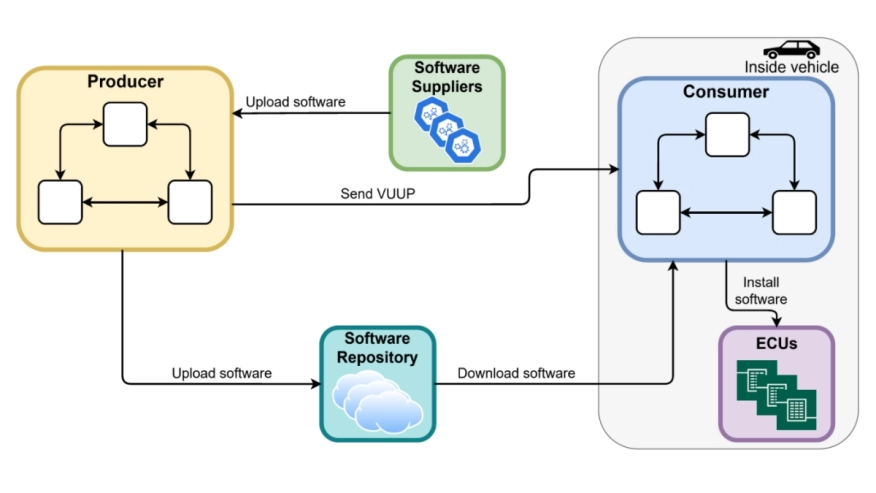
With the rise of software-defined vehicles (SDVs), where software governs most vehicle functions alongside enhanced connectivity, the need for secure software updates has become increasingly critical. Software vulnerabilities can severely impact safety, the economy, and society. In response to this challenge, Strandberg et al. [escar Europe, 2021] introduced the Unified Software Update Framework (UniSUF), designed to provide a secure update framework that integrates seamlessly with existing vehicular infrastructures.
Although UniSUF has previously been evaluated regarding cybersecurity, these assessments have not employed formal verification methods. To bridge this gap, we perform a formal security analysis of UniSUF. We model UniSUF's architecture and assumptions to reflect real-world automotive systems and develop a ProVerif-based framework that formally verifies UniSUF's compliance with essential security requirements - confidentiality, integrity, authenticity, freshness, order, and liveness - demonstrating their satisfiability through symbolic execution. Our results demonstrate that UniSUF adheres to the specified security guarantees, ensuring the correctness and reliability of its security framework.
Keywords: Provable Security, Vehicular Systems, Secure Software Updates
To read the full article, click here
Related Semiconductor IP
- NPU IP
- JPEG XL Encoder
- I2C Master/Slave Controller Core
- NVMe Validation Test Suite
- Hybrid Memory Cube Verification IP
Related Articles
- A new era of chip-level DRC debug: Fast, scalable and AI-driven
- Veri-Sure: A Contract-Aware Multi-Agent Framework with Temporal Tracing and Formal Verification for Correct RTL Code Generation
- A Formal Security Analysis of CAN XL
- Building more secure embedded software with code coverage analysis
Latest Articles
- Terracotta: Enabling the Adoption of New DRAM Techniques via a Flexible DRAM Interface and Memory Controller
- A Framework for Accelerating Transformer Inference on RISC-V for Edge AI
- An Interleaved Parallel Dependent Quantization Hardware Architecture for H.266/VVC
- A Formal Security Analysis of CAN XL
- A Secure dToF LiDAR SoC with Dual-Domain Fingerprinting and Event-Driven AFE Circuit Achieving Sensor-Level Attack Resilience